
Over the past twenty years, climate-related disasters have nearly doubled, widening existing inequalities within and between countries. The Sendai Framework for Disaster Risk Reduction recognises that building resilience requires more than managing hazards, it demands tackling the underlying social, economic, and institutional conditions that shape how risks and vulnerabilities are created and experienced.
Integrating a gender perspective in disaster and climate action is not only about women – it is about understanding how power dynamics, gender norms, and social expectations influence who is most exposed to risk, who has access to resources, and who participates in decisions that affect recovery and resilience. Gender equality in DRR calls for addressing systemic barriers that affect women, men, boys, girls, and people of diverse gender identities, including those with disabilities, from different ages, and cultural or socio-economic backgrounds. Evidence shows that these intersecting factors determine how people prepare for, respond to, and recover from disasters. For instance, restrictive gender roles may limit women’s access to early-warning information or leadership opportunities, while social expectations around masculinity can place men and boys in higher-risk situations during emergencies.
UNDRR supports countries and partners to generate and use sex-, age-, and disability-disaggregated data (SADDD) and other inclusive evidence to design and monitor equitable, people-centred DRR policies and investments. By shifting focus from individual vulnerability to the systems that create and sustain inequality, an intersectional and rights-based approach to DRR strengthens resilience and contributes to a safer, more just, and sustainable future for all.

Videos: Watch and share
What is the Sendai Gender Action Plan?
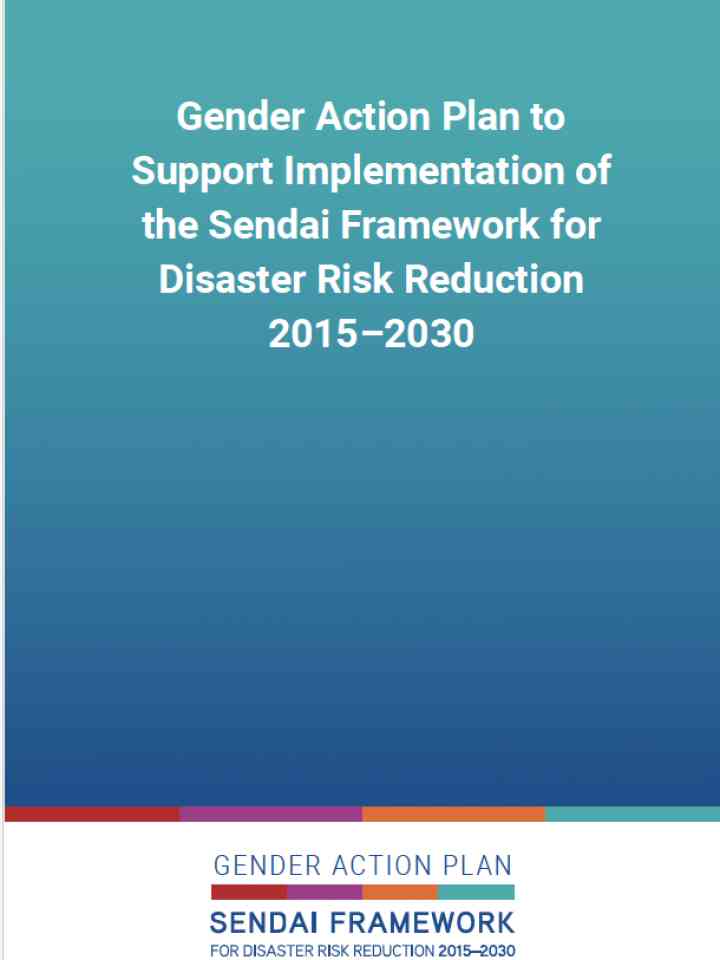
The Gender Action Plan to support implementation of the Sendai Framework for Disaster Risk Reduction 2015-2030 (Sendai GAP) has been launched and is available now. The Sendai GAP aims to accelerate progress towards the mutually reinforcing goals of gender equality and the prevention and reduction of disaster risk by ensuring DRR efforts are gender-responsive, and promote and support women’s empowerment and leadership.
The Sendai GAP identifies nine key objectives related to the four priorities of the Sendai Framework, and 33 recommended actions promote gender equality and the empowerment and leadership of women and gender stakeholders in disaster risk reduction.
Provisional and unedited translations are now available in: Arabic, Chinese, French, Russian, Spanish, Portuguese.
Effective disaster risk reduction requires meaningful and diverse participation, engagement and leadership, through an inclusive and accessible, all-of-society approach. It must consider the ways in which gender dynamics influence disaster impacts. When women’s capacities, knowledge and skills are utilized in disaster risk reduction efforts, we will all benefit. We can accelerate progress towards achieving the mutually reinforcing goals of gender equality and the prevention and reduction of disaster risks by ensuring disaster risk reduction efforts are gender-responsive and promote and support women’s empowerment and leadership.
Gender dynamics of disaster risk resilience
- 71 % of men receive early warning from a formal source, while 51% of women receive warnings through informal and social sources (Brown et al., 2019).
- 77 % of men compared to 48 % of women plan to stay and defend their property in a bushfire event in Australia (Eriksen, Gill & Head, 2010).
- 97 % of females survey in Afghanistan said domestic violence increased since the COVID-19 outbreak (Oxfam, 2020).
- COVID-19 has disrupted 76 % of sexual health clinics in Asia and the Pacific (International Planned Parenthood Federation, 2020).
- In Kenya, women who experienced severe weather events – including heatwaves – had 60% higher odds of reporting intimate partner violence (MDPI, 2021).
- Men account for 70 % of flood-related deaths in Europe and the United States primarily due to over-representation of men in rescue professions (World Bank, 2021).
- In Myanmar, 80% of the livestock lost to the 2015 floods belonged to women (World Bank, 2015).
- Risks of interpersonal violence increased by 2.3% and intergroup conflicts by 13.2% as temperatures rose (Science, 2013).
Too often, gender is not considered when disaster prevention, response, preparedness and resilience priorities are identified, and the specific needs and capacities of women and girls are neglected as a result. The disaster risk experienced by women can be further exacerbated by various forms of inequalities intersecting and influencing each other, for example age, disability, ethnicity, class, migrant status, sexuality, etc. DRR programming must be informed by an intersectional gender analysis. Sex, age and disability disaggregated data must be collected and used to better understand the gendered nature of disaster risk and inform DRR decision-making.
UNDRR supports gender-transformative disaster risk reduction that not only identifies and meets the different needs of women and girls, men and boys, and people of diverse gender identities, but seeks to redress the underlying causes of vulnerability by putting women’s resilience at the centre of disaster risk reduction strategies, policies and programming in order to promote women’s leadership and achieve gender equality.
Publications



Stories


Events
Understanding how people’s lives are impacted by gender norms, roles and relations within a given culture and society is critical to understanding and reducing disaster risk.