Words into Action (WiA)
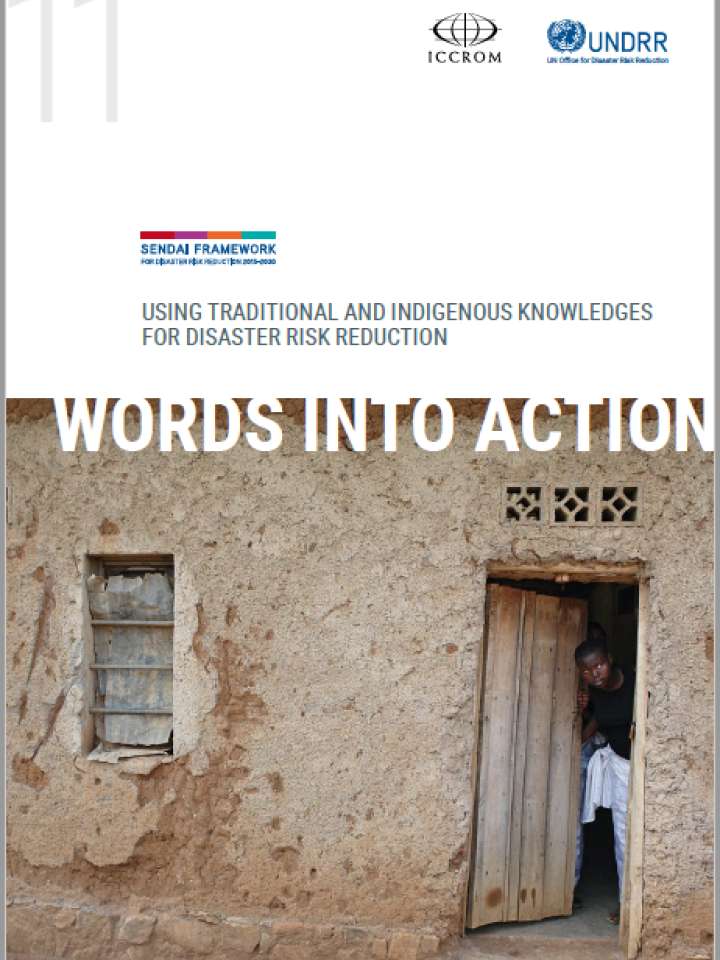
Traditional and Indigenous Knowledges for Disaster Risk Reduction
Formed over centuries and adapted to local cultures and environments, the term “Traditional Knowledge” refers to the knowledge, practices, and behaviours of indigenous and local communities all around the world.
In the context of Disaster Risk Reduction (DRR), Traditional Knowledge lies in the accumulated experience that comes with the close relationship of Indigenous communities to their environment, formed through successive trials and errors over generations.
The Words into Action: Using Traditional and Indigenous Knowledges for Disaster Risk Reduction guide argues that we need the space for traditional and scientific knowledge to co-exist. It gives guidance in translating the Sendai Framework into credible and implementable actions for DRR with a focus on the application of Traditional and Indigenous Knowledges. It outlines possible ways in which this knowledge can be used to reduce, prepare for and respond to disasters and provides a methodology to include aspects of Traditional Knowledge in decision-making.
It is also filled with practical guidance for stakeholders in the DRR community, including administrative bodies, disaster risk management professionals, local people and indigenous communities, among many others.
How do Traditional and Indigenous Knowledges benefit DRR?
For generations, Indigenous peoples and local communities have successfully been using traditional methods to prepare for and respond to disasters. Find out what Traditional Knowledge is and how it can benefit DRR.
Traditional building techniques and DRR
How do Traditional and Indigenous Knowledges contribute to disaster resilient planning and building design? Examples from Haiti, Japan and India shine a light on many of the possibilities.
Supporting Indigenous peoples to achieve better DRR outcomes
For millennia, Indigenous Peoples have used their Traditional Knowledges to prepare for, cope with, and survive disasters. But Indigenous Peoples often do not have adequate opportunities to participate in the design, implementation, monitoring, and evaluation of state-led strategies and policies.
Here are six ways to achieve better and more inclusive DRR outcomes working in cooperation with Inidigenous Peoples.

In this podcast, Simon Lambert, an Associate Professor of Indigenous Studies, and Amy Cardinal Christianson, an Indigenous Fire Specialist join us to discuss how Traditional and Indigenous Knowledges can change the way we look at hazards and why we need to stop thinking that all fire is bad.
Case studies
DRR Community resources: Traditional and Indigenous Knowledges