
The Common Alerting Protocol (CAP)
What is the CAP?
The Common Alerting Protocol (CAP) is the international standard format for emergency alerting and public warning. It has been developed by the Organization for the Advancement of Structures Information Standards and adopted by the International Telecommunication Union (ITU).
It is designed for all hazards – weather events, earthquakes, tsunamis, volcanoes, public health crises, power outages and other types of emergencies.
CAP is promoted by many international agencies, including the International Federation of Red Cross and Red Crescent Societies (IFRC), ITU, the United Nations Office for Disaster Risk Reduction (UNDRR), the World Meteorological Organization (WMO) and the World Broadcasting Unions.
How does a CAP work?
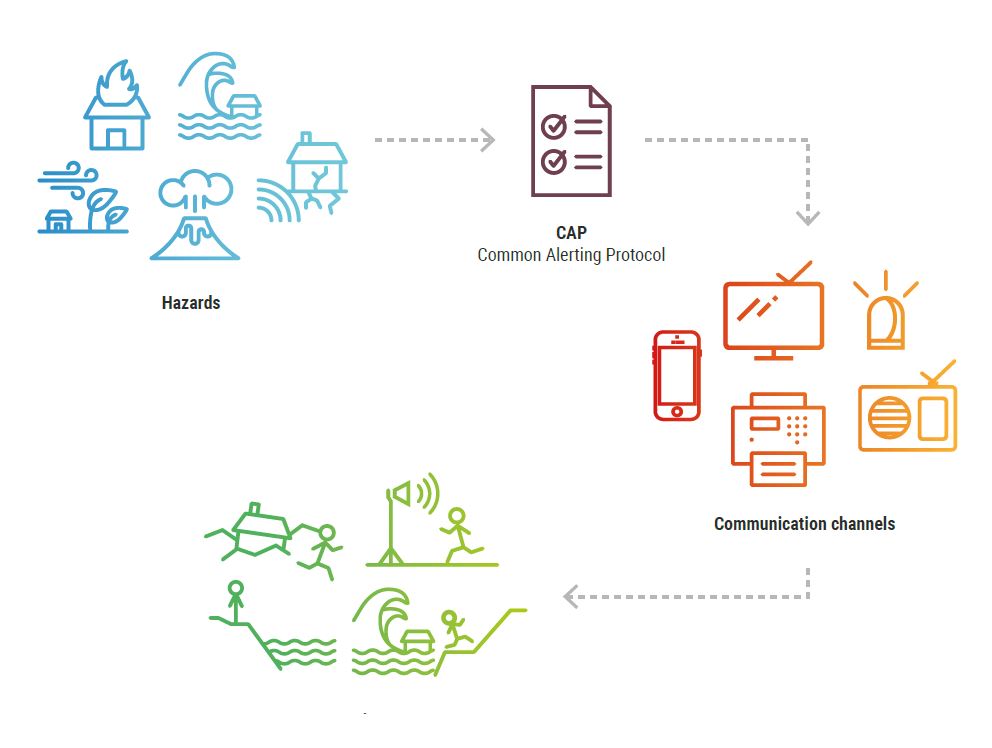
To publish a CAP emergency warning, an alerting authority enters key facts into a form that is designed to cover all types of emergencies and then posts that warning on an Internet newsfeed (the same technology as a weblog). This process enables vast dissemination capabilities, helping to get the warning to everyone at risk via all available media.
Key facts include (GDPC, 2021b):
- What is the emergency?
- Where is the affected area?
- How soon should people act?
- How bad will the emergency be?
- How sure are the experts?
- What should people do?
What are the benefits of a CAP?
When an emergency is extensive, it is common to have overlapping jurisdictions, and different authorities might issue more alerts as the emergency evolves. The use of CAP by all alerting authorities to communicate key facts as the emergency unfolds helps to ensure key facts are communicated coherently. This applies to private communications among alerting authorities and affiliates, as well as public messaging.
CAP also simplifies the process of issuing warnings is quicker and easier than some other methods. Alerting authorities without CAP issue alerts by, for example, making phone calls, sending emails and posting on online media. Those activities consume valuable time, distracting from the mission of composing accurate and actionable alerts. With CAP, a single message disseminates quickly over multiple alerting methods. For reaching people in harm’s way, CAP is the fastest and least error-prone way to disseminate emergency alerts.
Using the international standardized alerting format – CAP – helps to communication key facts clearly and avoid confusion. This is because CAP is a simple but general format for exchanging all-hazard emergency alerts and public warnings over all kinds of information and communications technology (ICT).
Many people at risk are undeserved with current public alerting because they are, for example, blind, deaf, cognitively impaired or they do not understand the language used in the alerts. These issues can be addressed by exploiting the data featured of CAP and with automated translation

Check out the Words into Action guide on Multi-Hazard Early Warning Systems. This guide aims to promote greater implementation of Multi-Hazard Early Warning Systems (MHEWS) across all sectors to protect the most exposed populations from disasters.
MHEWS save lives and provide significant economic benefits, such as reduced damage costs. As an example, with just 24 hours’ notice, MHEWS can reduce damage from hazardous events by up to 30%, and longer lead times offer even broader benefits. Through this guide, key principles and practical steps for establishing and maintaining effective, end-to-end, people-centered MHEWS will be explored, including risk assessment, data management, communication strategies, and community engagement.
Access the publication
Good practice

Saint Vincent and the Grenadines, considered a Small Island Developing State (SIDS), is one of the most vulnerable countries to natural hazards in the eastern Caribbean.
Since 1900, the country has been hit by eight named storms, the strongest being Hurricane Allen (Category 4). Hurricane Tomas in 2010 left a trail of destruction, particularly in the agricultural sector and across the remote northern parts of the islands. Dams and losses from Tomas exceeded EC$120 million. In April 2011, severe flash floods occurred in the same areas affected by Tomas, causing EC$100 million in damage.
Following those events, the Saint Vincent and the Grenadines National Emergency Management Office and the Water Resources Management Unit prioritized the Cuban volunteer river observation model as a key methodology to supplement the monitoring system in place.
This community-based voluntary river observation in high-risk communities has contributed to filling the gap in the set-up of fail-safe systems and complements the existing CAP system. It also provided redundant options complementing the data collection gathered by equipment. As a result, the monitoring system can be reliable at critical times of hazardous events. Moreover, the strengthened capacities have also contributed to transmitting information effectively to the exposed population.
Way forward
CAP uptake has been weakest in developing countries and especially the 46 Least Developed Countries (LDC), even though those are the most vulnerable countries to disasters. Recognizing this CAP implementation, international organizations, international Non-Governmental Organizations (NGOs) and international companies involved in emergency warnings are endorsing the Call to Action on Emergency Alerting to scale up efforts to ensure that by 2025 all countries have the capability for effective, authoritative emergency alerting that leverages CAP, suitable for all media and all hazards.
Some nations are lacking the requisite ICT or skills to fully leverage the emerging opportunities ushered in by the all-hazards, all-media approach to an emergency warning. It need not to be expensive for a country to implement CAP. For example, the free and open-source CAP Editor tool is initialized for over 360 alerting authorities across 200 countries and 28 languages, and more can be added easily. As a cloud-based service, this is a simple option for an alerting authority. It is necessary only for the alerting authority to designate who is authorized to compose or approve its CAP alerts.
Related information

Act now for global resilience:
Support early warnings and disaster preparedness
There's nothing natural about disasters.
In fact, contrary to popular perception, we are far from powerless in the face of earthquakes, tsunamis, cyclones and pandemics. Such hazards may be inevitable, but their disastrous impacts are not: we can curb their devastating power by understanding their interrelated risks, setting up early warning systems and investing preemptively.
Every contribution makes a difference.
Early warning's impact
30% reduction
24 hours of early warning can cut the ensuing damage by 30 per cent
$3-16B in losses
Investing US$ 800 million in early warning systems in developing countries would avoid losses of $3-16 billion per year
1-in-3 lack warning
One-third of the world’s people, mainly in the least developed countries and small island developing states, are still not covered by early warning systems. In Africa, 60% of people lack coverage
8x mortality
Countries with limited early warning coverage have disaster mortality that is eight times higher than countries with substantial to comprehensive coverage