UNDRR News

The latest news from the United Nations Office for Disaster Risk Reduction (UNDRR), the lead UN agency for the coordination of disaster risk reduction (DRR).

United Nations Office for Disaster Risk Reduction - Regional Office for Asia and Pacific
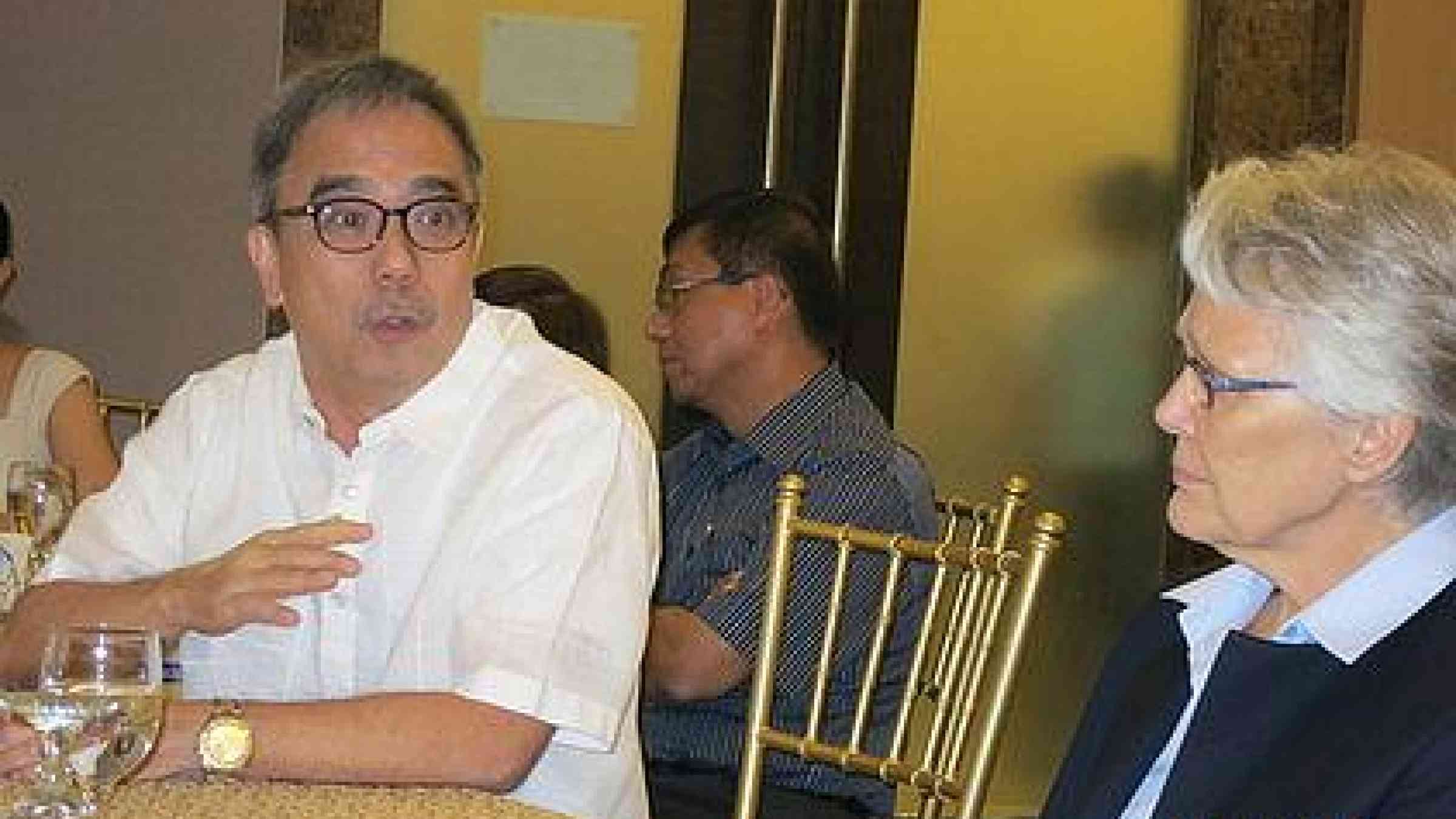
UNISDR Chief Margareta Wahlstrom is pictured here with Japan's first ever Minister for Building National Resilience, Keiji Furuya, who is also Minister for Disaster Management.
Update

For the third time in thirty years, Japan is preparing to host a World Conference on Disaster Risk Reduction.

United Nations Office for Disaster Risk Reduction - Regional Office for Asia and Pacific
United Nations Office for Disaster Risk Reduction - Kobe Office
<b>Path to resilience: </b>Lao Cai in Vietnam was one of four study cities that benefited from the use of UNISDR’s Local Government Self-Assessment Tool (LGSAT).
Update

UNISDR’s Local Government Self-Assessment Tool (LGSAT) is an effective tool to assess a city’s institutional capacity to build resilience, a new report has found. The study said the LGSAT opened up dialogue and enabled the establishment of baseline data for the Ten Essentials of UNISDR’s Making Cities Resilient Campaign “that can be used to track progress as the cities continue to build disaster and climate resilience”. The report, titled ‘Assessing City Resilience: Lessons from using the UNISDR Local Government Self-Assessment Tool in Thailand and Vietnam’, said the LGSAT enabled local discussions to take place within an internationally-applied framework of common issues. The study looked at four cities – Hue and Lao Cai, in Vietnam, and Udon Thani and Hat Yai, in Thailand – and identified gaps between policy and practice, and between planning and implementation.

United Nations Office for Disaster Risk Reduction - Regional Office for Asia and Pacific
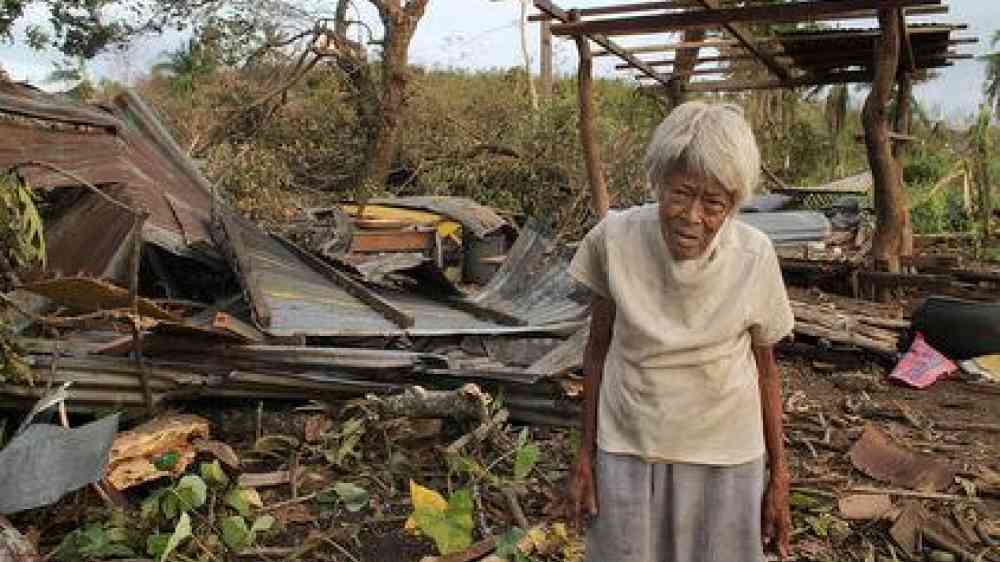
Eighty-one-year-old Nemesia Tipait was buried under the rubble of her house before being rescued by neighbours in Kayang local district, Bogo City, after Typhoon Haiyan. The Philippines has unveiled a 2014 national budget that recognises the need to reduce disaster risk at the local level.
Update

The Philippines’ national budget for 2014 has ensured dedicated funding for disaster risk reduction and climate change adaptation programmes.

United Nations Office for Disaster Risk Reduction - Regional Office for Asia and Pacific
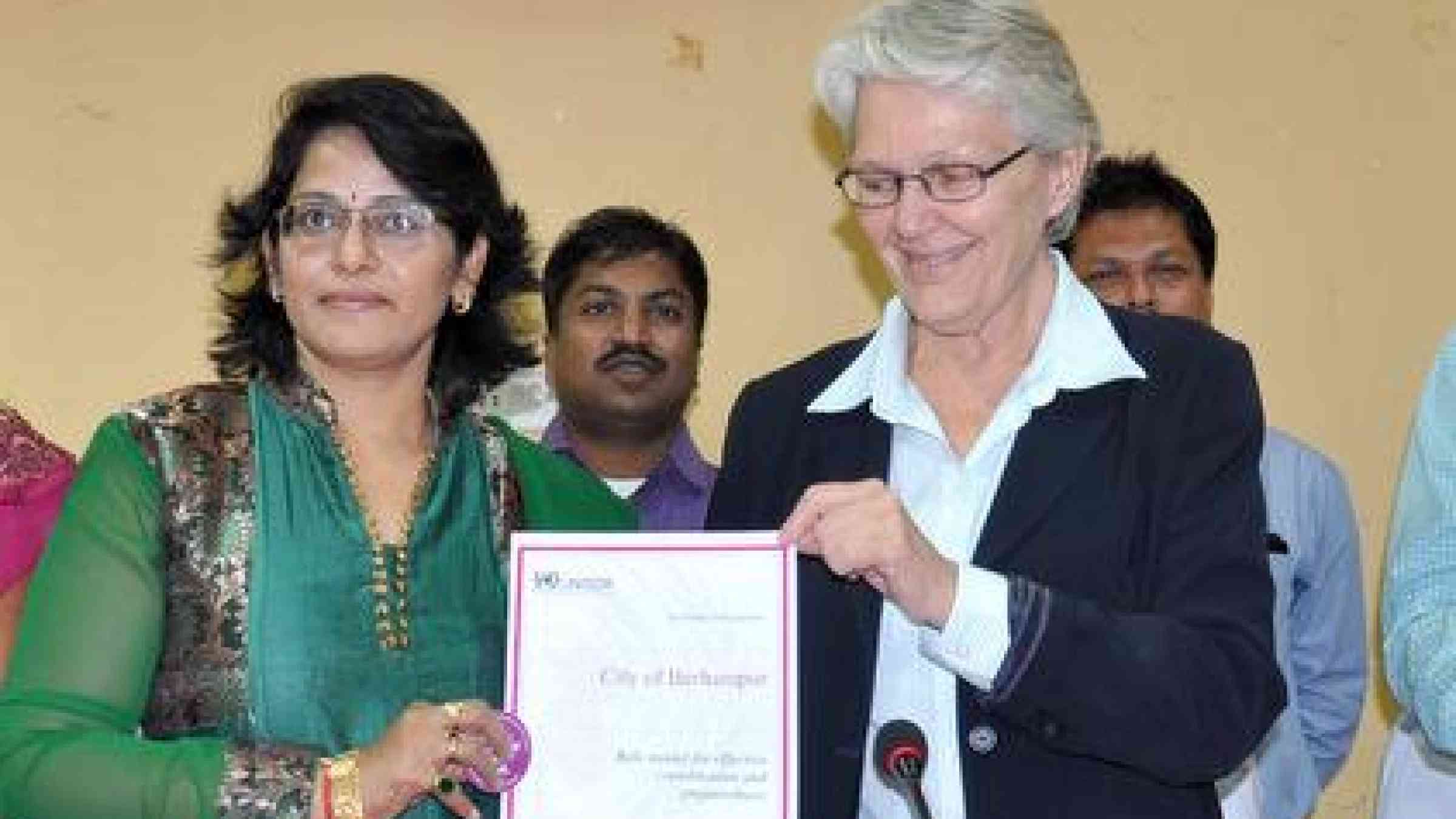
The Mayor of Berhampur, Ms K. Madhavi (left) receives a certificate of recognition from UNISDR Head Ms Wahlström.
Update

Local leaders in cyclone-hit Odisha said their successful early warning ahead of the recent Cyclone Phailin was down to good information that was delivered on time and acted upon quickly. On a tour of cyclone-ravaged Ganjam district, the Head of the UN Office for Disaster Risk Reduction (UNISDR), Ms Margareta Wahlström, heard that 30,000 people had been evacuated in less than 30 hours. The District Collector of Ganjam, Mr Krishan Kumar, said the prompt movement of people from villages within 5km of the coast was crucial in dramatically reducing the number of casualties.

United Nations Office for Disaster Risk Reduction - Regional Office for Asia and Pacific
The Chief Minister of Odisha Naveen Patnaik receives the citation recognising Odisha’s effective cyclone preparedness from Ms Wahlström.
Update

The effective evacuation of almost 1 million people in Odisha ahead of Cyclone Phailin will be highlighted as a global example in the lead-up to the 3rd World Conference on Disaster Risk Reduction, in 2015. The Head of the UN Office for Disaster Risk Reduction (UNISDR), Ms Margareta Wahlström, lauded Odisha for its ‘landmark success’ actions in limiting the number of deaths directly caused by the cyclone to 21. “We have started work on documenting the Odisha success story and will highlight it as an example at the World Conference. It is easy to talk about problems and failures. We have to bring into people’s minds what works,” Ms Wahlström said.

United Nations Office for Disaster Risk Reduction - Regional Office for Asia and Pacific
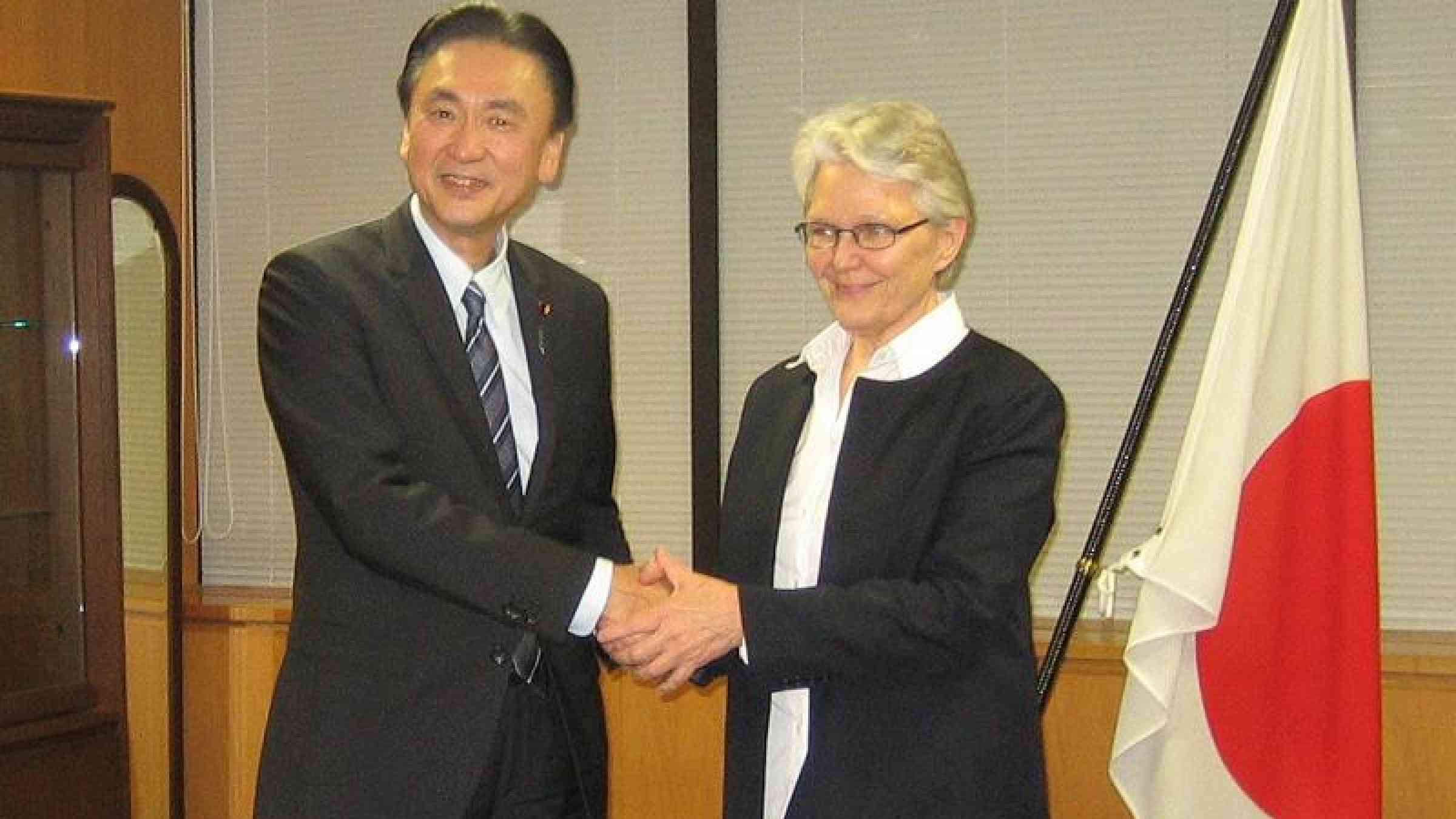
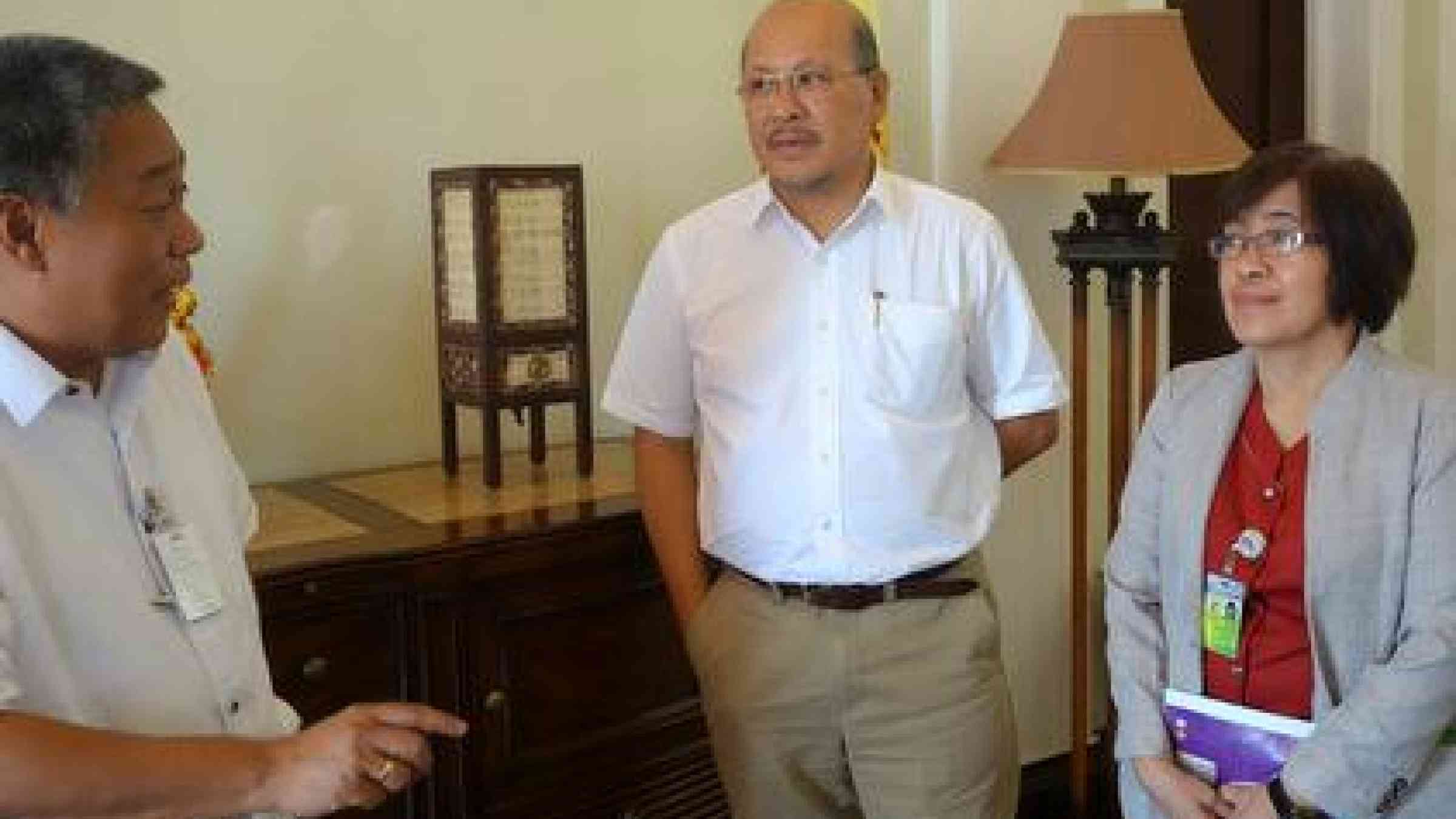
<b>Post-Haiyan rehabilitation planning: </b>From left, Hilario Davide III discusses the way forward with key advisors Efren Carreon and Melita Labarejos.
Update

The Philippines Province of Cebu prides itself on its zero casualty policy when it comes to disasters. As of yesterday, it had recorded just 73 of the 6,057 deaths so far attributed to Typhoon Haiyan despite the widespread damage and loss to housing, critical infrastructure and agriculture especially in northern Cebu where Haiyan made two of its six landfalls in the Philippines. Governor Hilario Davide III explained: “I would credit the low fatalities first to the people themselves and the local government units who heeded our advice and warnings to evacuate people from the areas that were most vulnerable to the typhoon.” Some estimates put the number of people who evacuated in Cebu as high as one million. The Governor also said that the earthquake which hit in October may have been a strange blessing in disguise as it gave people a sharp reminder of the threat posed by natural hazards.

United Nations Office for Disaster Risk Reduction - Regional Office for Asia and Pacific
<b>Trying to get back to normal: </b>These schoolgirls are making the best of their makeshift classrooms.
Update

Pop idol Justin Bieber paid a surprise visit to the San Jose Elementary School in Tacloban this week. He stayed about 30 minutes, hugged the kids, sang a few songs, signed some autographs and landed on the front pages of all the Philippine newspapers. If nothing else, his visit brought a spotlight to bear on the precarious lives of thousands of children with no school to go to for the last four weeks. Over 600 schools were destroyed by Typhoon Haiyan. Despite a government instruction for classes to re-open on December 2, many, such as the Anibong Elementary School overlooking the ship-strewn shoreline of the neighbourhoods known as barangays 68 and 70, remain packed with evacuees.

United Nations Office for Disaster Risk Reduction - Regional Office for Asia and Pacific

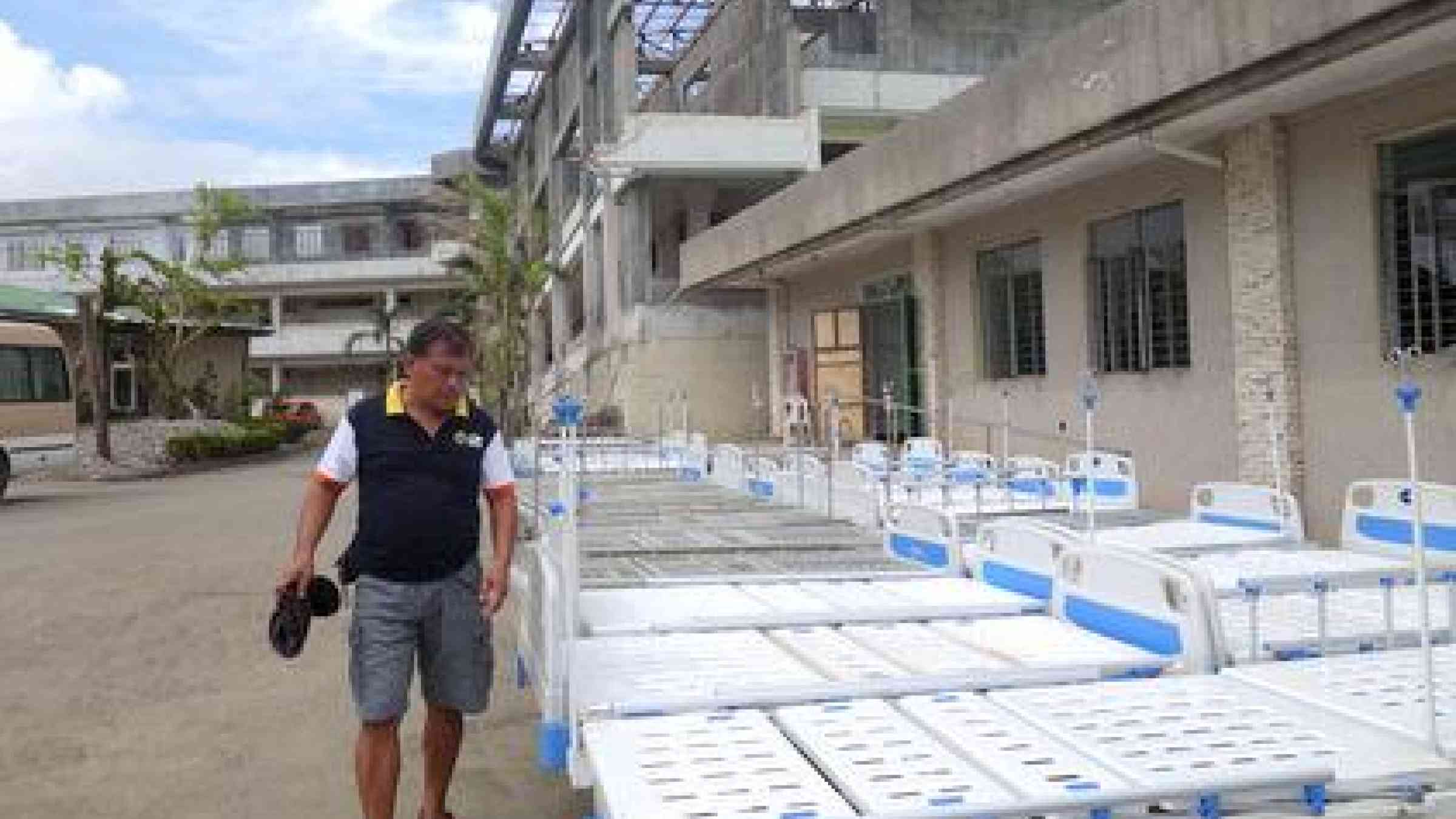
Dr. Cirilo Galindez inspects replacement beds for the flood-damaged hospital. Behind him looms the wreck of the concrete out-patients department which protected the main hospital from the worst of Typhoon Haiyan's fury.
Update

The ground floor patients including those in intensive care had a narrow escape. Indeed, as the tidal surge broke through the hospital’s perimeter wall security guards had to come and rescue the director of Leyte Island’s largest public hospital, the Eastern Visayas Regional Medical Center (EVRMC), as he struggled waist deep in water in his hospital residence overlooking the sea. Dr. Cirilo R. Galindez who is now on secondment from Luzon as acting hospital director, describes the frenetic activity following the slow realization that the hospital was about to be inundated by sea-water as a result of Typhoon Haiyan in the early dawn hours of November 8. “In about twenty minutes they had to move all the patients from the ground floor to the second floor including those in the intensive care unit. The staff did a superb job and there were no casualties among the patients,” he said.

United Nations Office for Disaster Risk Reduction - Regional Office for Asia and Pacific
The Governor of Cebu Province, Hilario Davide III, addresses today's gathering in the Capitol's Social Hall Building, to come up with a rehabilitation plan for the typhoon shattered province.
Update

Private sector representatives took their place today alongside the usual line-up of NGOs and international organizations who came together to brainstorm a rehabilitation plan for those parts of Cebu province.

United Nations Office for Disaster Risk Reduction - Regional Office for Asia and Pacific

Tacloban Vice Mayor Jerry Yoakasin discussing typhoon-proof housing with architect and urban planner James Jao.
Update

The City of Tacloban which accounts for almost 50% of the dead and displaced in the Typhoon Haiyan (known locally as Yolanda) disaster, is to hold a summit inviting mayors and other public representatives to come to the city to talk about the lessons learned for disaster risk management. The announcement comes with recognition by the city authorities that there were several barriers to compliance with evacuation procedures despite many sweeps through the most exposed neighbourhoods – or Barangays as they are known in the Philippines – by teams of local volunteers and officials led by the Barangay captains. Three days before Typhoon Haiyan struck, a meeting was called by the City Mayor, Alfred Romualdez, of all 138 Barangay Captains to be briefed on the coming storm and they were all instructed to order their constituents to evacuate. The meeting was reportedly attended by about 75% of all Barangay captains.

United Nations Office for Disaster Risk Reduction - Regional Office for Asia and Pacific

You might also find these helpful

Cover- Shutterstock main report
Publications
We produce a range of publications by collecting and analysing risk data through a range of tools, knowledge products, and mobilising like-minded partners.

Cheerful young black lady leading international group of protestors
Campaigns
Our communications and advocacy campaigns call for taking action today to protect people and prevent disasters from happening.

Media Centre Thumb
Media centre
Access to a range of multimedia resources related to disaster risk reduction, including news releases, photos, videos, and other materials.

WIN DRR Leadership Awards
DRR Awards
These awards not only celebrate exemplary contributions but also encourage efforts to build more resilient societies.