Strengthening Readiness for Resilient Recovery
Why recovery readiness matters
When disasters strike, the speed and quality of recovery can determine whether communities emerge stronger – or fall deeper into cycles of vulnerability. Too often, recovery is treated as an afterthought, leaving countries scrambling to mobilize systems, resources, and coordination when it is already too late.
Direct disaster costs have grown to approximately $202 billion annually, but that the true costs of disasters are over $2.3 trillion when cascading and ecosystem costs are taken into account.” (Global Assessment Report on Disaster Risk Reduction 2025)
Readiness for resilient recovery means having pre-disaster planning and practices that empower communities and systems to recover faster, more inclusively, and more sustainably

Kamal Kishore
Special Representative of the United Nations Secretary-General for Disaster Risk Reduction, and Head of the UN Office for Disaster Risk Reduction (UNDRR)
The cost of disasters is rising sharply, with cascading impacts on lives, economies, and development. For the most vulnerable economies, recovery delays are compounded by indirect impacts such as loss of livelihoods, disrupted education and health services, and weakened fiscal space. Inequalities in recovery times widen global development gaps, erode resilience, and leave countries more exposed to future shocks.
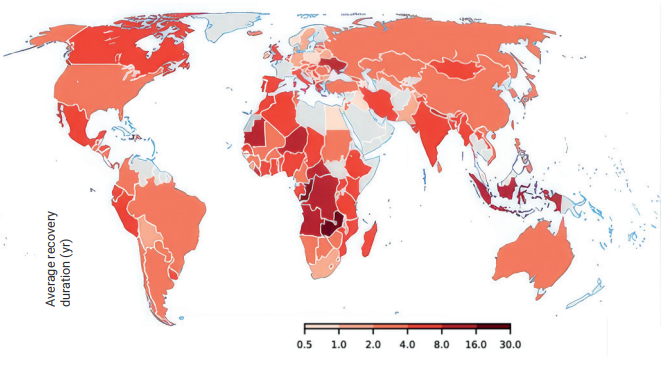
Average post-disaster recovery duration by country
This is why Priority 4 of the Sendai Framework for Disaster Risk Reduction – Enhancing disaster preparedness for effective response and “Build Back Better” in recovery, rehabilitation and reconstruction – remains unfinished business. While the principle of building back better is widely recognized, implementation is uneven, The Sendai Framework Mid-Term Review shows that too many opportunities to reduce risk through recovery are being missed, with devastating impacts on people and communities.
To change this trajectory, governments and partners worldwide endorsed the Priority Actions to Enhance Readiness for Resilient Recovery at the World Resilient Recovery Conference (2025). These ten actions call for stronger governance, inclusive financing, empowered local leadership, resilient housing and infrastructure, livelihood recovery systems, and adaptive monitoring.

Countries that prepare for recovery before disasters strike achieve dramatically better outcomes. Recovery readiness represents the foundation that allows governments to seize the narrow post-disaster window of opportunity to build back better rather than simply rebuild previous vulnerabilities. It means having the governance, policies, financing mechanisms, and technical capacities in place before disasters happen – so that when crises hit, countries and communities can recover swiftly, inclusively, and sustainably.
What we do
UNDRR supports governments to: assess recovery readiness and prioritize actions; strengthen coordination for recovery across sectors; ensure recovery efforts are inclusive and aligned with long-term development goals; and connect with resources, partners and capacity development.
UNDRR has made recovery readiness one of four catalytic areas in its new Strategic Framework (2026–2030). This elevates recovery readiness from a recurring theme to a sustained institutional priority, backed by dedicated resources, tools, and partnerships to support countries in making resilient recovery a standard practice.
Recovery Readiness Framework and Assessment Tool
The Recovery Readiness Framework and Assessment Tool, developed by UNDRR in collaboration with IRP, enables governments to systematically measure and strengthen their preparedness for resilient recovery.
Through key performance indicators, it helps countries identify gaps, set priorities, and guide investments in national recovery systems. In practice, this means supporting countries to assess and strengthen their post-disaster institutional arrangements, including legislative and regulatory frameworks; technical capabilities; financing mechanisms; and data and knowledge.
Access the Recovery Readiness Framework and Assessment Tool.
International Recovery Platform (IRP)
UNDRR hosts the International Recovery Platform (IRP) in Japan, a global partnership of governments, international organizations, and regional bodies working to advance resilient recovery.
Established in 2005 after the Great Hanshin-Awaji Earthquake, the IRP was created to ensure that lessons from recovery are systematically captured and shared. Now, at its 20th anniversary, the Platform is evolving, leveraging its role as a knowledge hub to also provide direct support to countries to operationalize the Priority Actions to Enhance Readiness for Resilient Recovery.
Through platforms such as the annual IRP Forum and the World Resilient Recovery Conference, the IRP convenes global and national leaders to exchange knowledge, track progress, and secure new commitments. Its partners provide policy guidance, technical assistance, training, and peer learning opportunities that enable governments to design and implement recovery readiness strategies. The IRP embodies global solidarity – ensuring that no country is alone in facing recovery challenges and that all can draw on collective experience to build stronger systems for the future.