Corporate Chief Resilient Officers (CCROs) Network

What is the ReMA Tool?
Developed by UNDRR and the Corporate Chief Resilience Officers (CCRO) network, the Resilience Maturity Assessment (ReMA) tool provides a comprehensive self-assessment framework designed to evaluate and enhance your organization's capacity to withstand disruptions and adapt to change.
Whether you are a micro enterprise, a small business, or a global corporation, ReMA tool equips you with the insights needed to measure, improve, and disclose your resilience.
Start your assessment and build a stronger, more resilient future.

What does REMA do?
Why is enterprise resilience important?
In an age of increasing uncertainty, organizations across all sectors face new and unforeseen challenges that are becoming business as usual. These challenges can stem from climate change, cyber-crime, fraud, AI advancements, or other sources of disruption that could be transformational or reputational.
Resilience is vital for any enterprise to survive and thrive in a complex and volatile environment. This ability to adapt and grow amid challenges is not only beneficial for the enterprises themselves, but also extends to impact all their stakeholders and surrounding communities.
Resilient organizations for a resilient future
The Resilience Maturity Assessment (ReMA) tool is designed to help organizations of all sizes evaluate and strengthen their resilience against disruptions. With its fast and easy assessment process, ReMA provides clear, practical feedback to identify gaps and enhance preparedness. The tool also offers ready-made templates and expert recommendations to support effective improvements. Scalable across industries, ReMA empowers businesses to reduce risks, ensure business continuity, and drive long-term performance and sustainable growth in an ever-changing world.

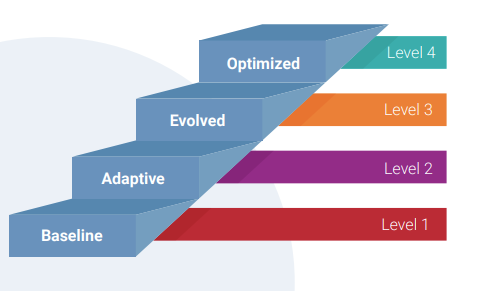
The 4 resilience maturity levels
The four levels represent stages of resilience maturity, serving as convenient boundaries to categorize progress.
However, it's important to recognize that resilience maturity is fundamentally subjective. You may find your organization performing well in some areas while needing improvement in others. The maturity level you aim for may also vary depending on your organization's size, complexity, and priorities. Although Levels 1 to 4 are distinct categories, it's more accurate to view resilience as a continuous spectrum.
The model allows you to benchmark your own maturity against certain criteria. This generates a benchmark band which you should strive to achieve.
The 6 operational maturity pillars to assess maturity
The ReMA tool uses six operational pillars that are recurrent in resilience practices to assess enterprise maturity.
Governance
Overarching approach to resilience management
Increasing formality with a well understood policy and methodology on which the programme me is based.
Culture
Role of top management and awareness in the organization
Active senior management involvement and commitment with resilience being recognized and practiced at a strategic level and high degrees of awareness throughout the organization.
Organization
Responsibilities, cross function liaison and risk alignment
Clarity of roles and responsibilities together with a high degree of liaison and consultation between all departments and business units.
Operating Model
Integration of resilience with business activities
Recognition of the relevance and utility of resilience to support business activities with resilience designed from the outset.
Value Chain
Meeting business objectives and supplier resilience
An increasing ability to maintain customer/client services based on a thorough analysis of supply chain issues.
Capacity
Limitations of potential response and how they are resourced
A comprehensive understanding of the resources available, their efficacy and their limitations.
Watch the ReMA demo
Learn how ReMA helps organizations assess their resilience, identify gaps, and access practical recommendations and ready-to-use resources.
To increase business resilience and protection of livelihoods and productive assets throughout the supply chains, ensure continuity of services and integrate disaster risk management into business models and practices (p.20).
- Sendai Framework for Disaster Risk Reduction 2015-2030

Collaborators
UNDRR acknowledges the collaboration of all member and guest member companies of the Corporate Chief Resilience Officers (CCRO) network in the development of this tool.
This tool was shaped through extensive discussions and consultations with a diverse range of stakeholders, whose valuable insights and suggestions contributed to its refinement.
“Business, professional associations and private sector financial institutions, including financial regulators and accounting bodies, as well as philanthropic foundations, to integrate disaster risk management, including business continuity, into business models and practices through disaster-risk-informed investments, especially in micro, small and medium-sized enterprises (p. 23).”
- Sendai Framework for Disaster Risk Reduction 2015-2030