
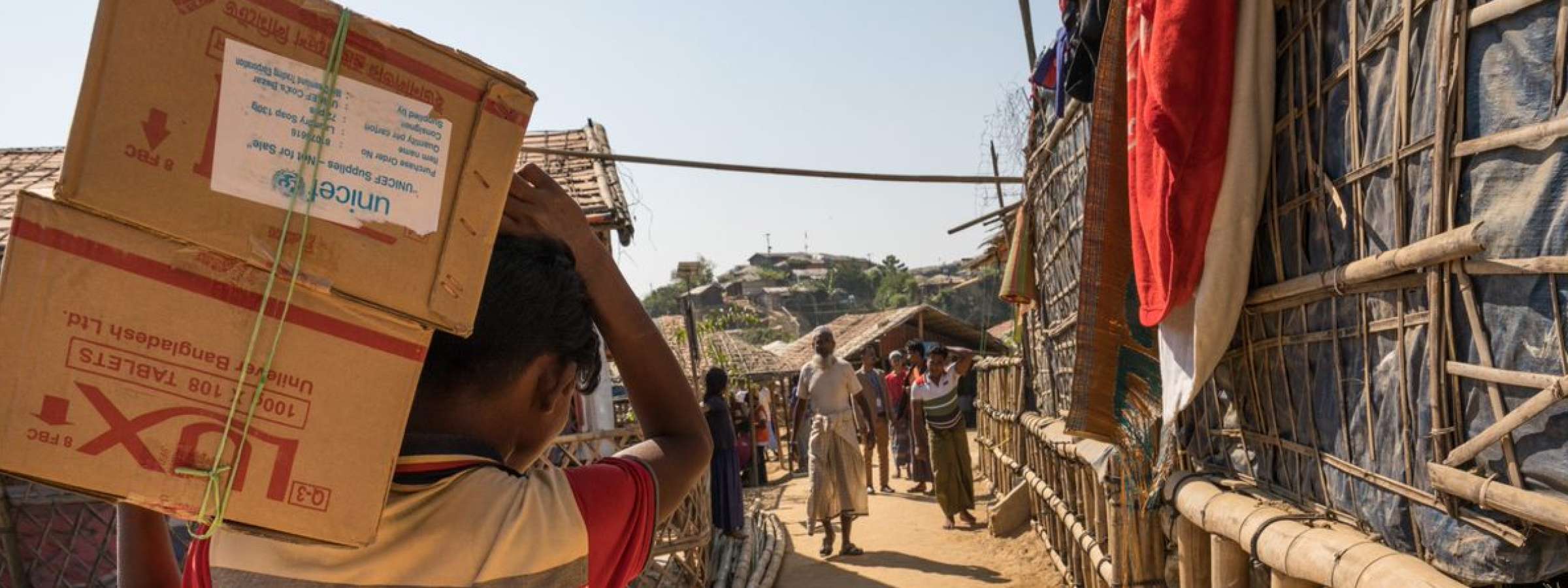
Least developed countries (LDCs) face an increasingly complex and interconnected risk landscape. Disasters continue to reverse hard-won development gains, threaten lives and livelihoods, and constrain progress toward achieving the Sustainable Development Goals. Despite contributing least to the climate crisis, LDCs are among the most severely affected, facing recurrent droughts, floods, cyclones, and other shocks that strain fragile economies and institutions.
Building resilience in the least developed countries is not an act of charity; it is a prerequisite for sustainable development.
Amina J. Mohammed
Deputy Secretary-General of the United Nations
Disasters undermine development
The devastating impacts of the COVID-19 crisis and the climate emergency reveal how systemic risk and cascading disasters affect every facet of life and economies in LDCs, from agriculture and industry to health, mobility, and basic services. In several LDCs, disaster risk is further compounded by fragility and protracted humanitarian crises.
Facts and Figures
Impact of disasters on LDCs
- LDCs have contributed nearly 1% of global emissions but have seen a five-fold increase in climate-related hazards since the 1970s (UNCTAD, 2022).
- LDCs have experienced nearly 70% of the deaths caused by climate-related disasters over the last 50 years (WMO, 2020).
- Disasters impact the economies of LDCs around 10 times worse than the economies of the richest countries, as a share of their GDP (UNDRR GAR, 2022).
- In 2020, more than 8.5 million people in LDCs were displaced by disasters (IDMC, 2021).
- Droughts remain the deadliest and floods the costliest hazard (WMO, 2020).
- 34 percent of crop and livestock production loss in LDCs is traced to drought, costing the sector USD 37 billion between 2008 and 2018. (FAO, 2021).
- Floods are responsible for a total of USD 21 billion of the crop and livestock production loss 2008-2018 in LDCs - this amounts to 19 percent of total loss (FAO, 2021).
State of Disaster Risk Reduction (DRR) in LDCs
- 38 LDCs report on SFM, 4 LDCs report on DesInventar, a total of 42 out of 44 LDCs (95%) reporting on the progress of implementing Sendai Framework through UNDRR databases
- 64% have national disaster risk reduction strategies
- 59% reported having a multi-hazard early warning system
- 25% of all LDCs have accessible, understandable, usable and relevant disaster risk information and assessment available at national and local levels
- Between 2015 and 2024, disaster-related mortality in LDCs was 1.76 per 100,000 population, 2.35 times higher than the global average. Direct economic loss accounts for 3.22% of GDP in reporting LDCs, which is more than 11 times higher than the global level (0.28% of GDP), showing that LDCs continue to sustain disproportionate economic burden of the disasters.
(Source: Sendai Framework Monitor. Data as of October 2025)
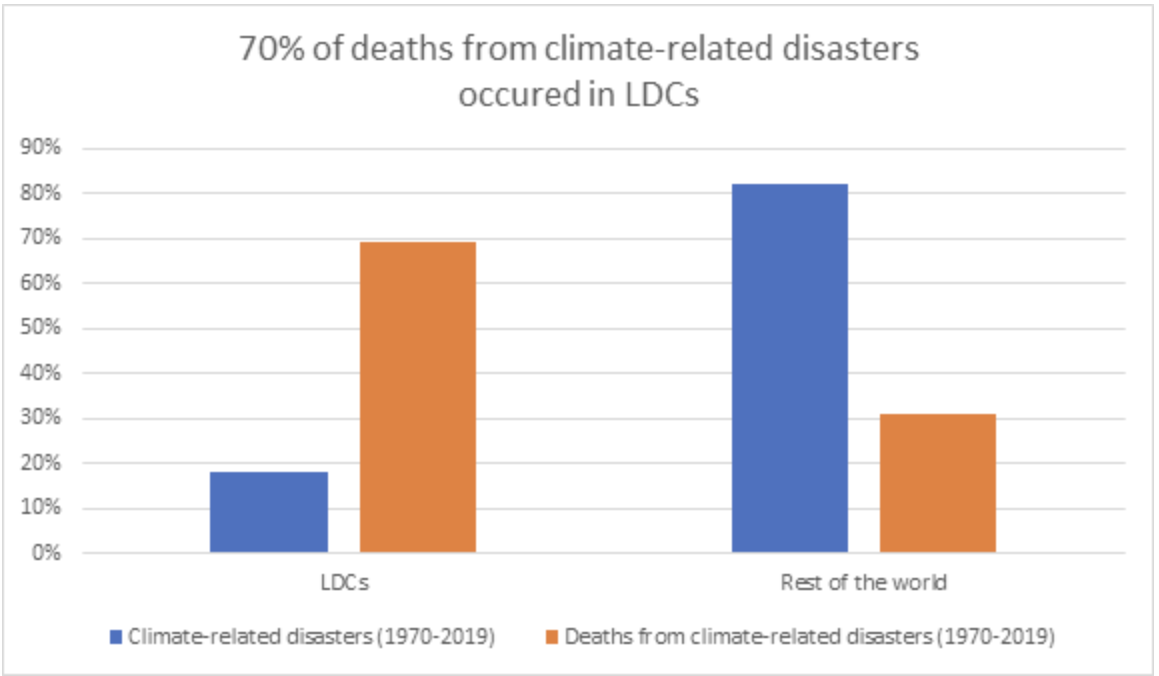
Between 2013 and 2023, disaster-related mortality in LDCs was 2.19 per 100,000 population, 2.5 times higher than the global average. The economic loss ratio is also 7.5 times higher than the global level, showing that LDCs remain disproportionately affected by disasters.
Advancing resilience under the UNDRR Strategic Framework
Under the UNDRR Strategic Framework 2026–2030, work with LDCs focuses on translating risk knowledge into action, scaling local leadership, mobilizing financing, and strengthening recovery readiness. Together, these priorities ensure that development is risk-informed, inclusive, and sustainable.
UNDRR’s approach builds on its value proposition as a global convener, knowledge leader, and catalyst for partnerships. Through collaboration with governments, UN Country Teams, UN agencies and Offices, regional organizations, civil society, academia, and the private sector, UNDRR helps ensure that every policy and investment contributes to a safer and more resilient future.
Strengthening risk knowledge
Understanding risk is the foundation of resilience. UNDRR supports governments in strengthening the collection, analysis, and use of disaster data.
- The Enhanced Disaster Tracking System, developed with UNDP and WMO, improves the quality of loss, damage, and exposure data.
- Through the Early Warnings for All (EW4All) initiative, UNDRR supports 13 LDCs, including Bangladesh, Burundi, Cambodia, Chad, Comoros, Djibouti, Ethiopia, Haiti, Lao PDR, Mozambique, Somalia, South Sudan, and Uganda, in designing and expanding multi-hazard early warning systems.
- UNDRR advances impact-based forecasting and helps countries integrate hazard and climate information into policy and investment decisions.
- In Bangladesh, a new subnational earthquake risk assessment covers all 64 districts, providing the first comprehensive understanding of hazard exposure and vulnerability.
To improve knowledge and understanding of disaster risk, LDCs need a radical scale-up of adaptation measures and risk analysis capacities. UNDRR helps build the capacity of government institutions, academia, and young professionals to conduct regular multi-hazard risk assessments, analyze disaster loss data, and apply findings to national planning and investment.
Investments in technology and data systems are also essential. UNDRR promotes the use of geographic information systems and advanced modeling, alongside accessible communication of risk information to decision-makers, communities, and households.
Integrating resilience into structural transformation and sustainable development
Reducing disaster risk and building resilience are embedded across the economic, social, and environmental pillars of the Doha Programme of Action (DPoA) for the LDCs. UNDRR supports countries in ensuring that structural transformation reduces rather than creates risk, and that resilience is integrated into all development pathways.
- National and local strategies: Strengthen disaster risk reduction strategies that take a comprehensive approach to climate and disaster risk governance, ensuring all sectoral investments align with these strategies.
- Productive capacity development: Integrate DRR into policies on industry, agriculture, trade, and supply chains so they remain resilient against future shocks and climate impacts.
- Resilient infrastructure: Ensure that all infrastructure investments, including digital and energy systems, housing, and basic services, undergo comprehensive risk assessments.
- Graduation strategies: Embed DRR in smooth transition and graduation strategies, including through the Sustainable Graduation Support Facility.
UNDRR’s work with countries such as Haiti, Kiribati, and Tuvalu demonstrates how integrating risk reduction into development planning supports sustainable graduation and resilience.
Empowering locally led disaster risk reduction
Resilience starts at the local level. UNDRR promotes inclusive risk governance that empowers communities to lead and implement local resilience strategies.
- The Making Cities Resilient 2030 (MCR2030) initiative provides tools and diagnostics to help cities assess and improve their resilience.
- The Comprehensive School Safety Framework helps safeguard education systems.
- Partnerships with women’s groups, youth, and organizations of persons with disabilities ensure local resilience planning is inclusive.
- UNDRR promotes anticipatory action in countries such as Bangladesh, Cambodia, Nepal, and Timor-Leste, enabling early measures that protect livelihoods.
Combined preventive and anticipatory actions have shown measurable impact, such as during the desert locust outbreak in the Horn of Africa, where early investment protected food security for 42 million people.
Financing for disaster risk reduction
Sustainable financing is essential for long-term resilience. UNDRR helps LDCs embed risk-informed approaches into public finance and investment decisions.
- In Bangladesh and Madagascar, UNDRR supported the development of comprehensive DRR financing strategies with IMF, UNDP, and FAO.
- UNDRR collaborates with development banks and the private sector to create risk-informed investment pipelines and parametric insurance products with UNCDF.
- Governments are supported to undertake Risk-Sensitive Budget Reviews and enhance tracking of DRR investments in national financing frameworks.
- Bilateral donors, development banks, and international financial institutions are encouraged to align support with national DRR strategies and the Sendai Framework.
Only 50 cents of every 100 dollars of international disaster assistance currently go to prevention and risk reduction. UNDRR advocates for increased predictable financing, risk-informed climate adaptation, and investments that protect development progress.
Public finance systems should embed DRR through budget tagging and tracking, and LDCs should establish a pipeline of investable, resilient infrastructure projects. Partnerships with the private sector are key to co-developing innovative financial instruments and supporting small and medium enterprises to reduce risk across their operations.
Advancing recovery readiness
Resilient recovery means rebuilding stronger, safer, and more inclusively after disasters.
- Through the International Recovery Platform (IRP), UNDRR supports countries in applying the Recovery Readiness Assessment Framework to evaluate and strengthen recovery systems before disasters occur.
- Technical guidance ensures that reconstruction in housing, education, and infrastructure builds long-term resilience.
- UNDRR facilitates after-action reviews and peer learning to enhance preparedness and knowledge exchange.
By prioritizing recovery readiness, LDCs can transform crises into opportunities to strengthen governance and development systems.
The road ahead
Despite progress, LDCs continue to face overlapping challenges, including limited fiscal space, data gaps, and fragile governance systems. Narrowing fiscal capacity often forces difficult choices between debt repayment and investing in resilience. Sustainable graduation requires development models that reduce existing risk, prevent new risk creation, and are inclusive of all communities.
Strengthened international solidarity, predictable financing, and capacity support are essential. Resident Coordinators and UN Country Teams continue to advocate for integrating DRR into national and graduation strategies, ensuring risk reduction remains central to development planning.
UNDRR’s role and offer
UNDRR supports LDCs by:
- Providing policy guidance and technical assistance for national and local DRR strategies.
- Strengthening early warning systems and disaster data ecosystems through EW4All.
- Supporting risk-informed investment and financing strategies across sectors.
- Facilitating partnerships, knowledge exchange, and capacity development.
- Promoting anticipatory and preventive approaches to manage and mitigate shocks.
Together with governments, the UN system, civil society, and the private sector, UNDRR works to ensure that every step of LDCs’ development journey is risk-informed, inclusive, and resilient.