
UNDRR at COP30
This year marks the 10th anniversary of the adoption of the Sendai Framework for Disaster Risk Reduction, the 2030 Agenda for Sustainable Development, and the Paris Agreement. There has been much progress with respect to the implementation of each of these agreements. Resilience-building efforts have started giving us dividends – global disaster-related mortality has been reduced by half. However, stocktaking exercises have demonstrated the significant gaps that remain. The window for turning the tide is slim but possible.
Last year, 2024, was the warmest on record in 175 years, and for the first time, average temperatures exceeded 1.5C degrees above pre-industrial levels. Other climate records such as sea level rise, ocean warming and glacial retreat, continue to trend upward. At the same time, while the official estimates of direct cost of disasters range between US$180-200 billion, they increase exponentially to US$2.3 trillion if cascading and ecosystem impacts are included, as per the Global Assessment Report (GAR) 2025.
...Reform the global financial architecture. Drastically increase the lending capacity of multilateral development banks -- making them bigger, bolder, and better able to leverage massive amounts of private finance at reasonable costs; And take effective action on debt relief – and scale up proven tools like debt for climate swaps.

António Guterres
United Nations Secretary-General
Call to action
Reduce emissions to prevent further harm – as every degree counts
Keeping global warming below 1.5°C is crucial to minimizing current climate-related risks and preventing the creation of new risks, thus reducing harmful impacts and alleviating human suffering. Every 0.1°C above this threshold will intensify extreme weather events—such as heatwaves, droughts, wildfires, and severe flooding—and pose serious threats to food security worldwide.
- The next generation of Nationally Determined Contributions (NDCs) must align with limiting global warming to 1.5°C above pre-industrial levels to reduce extreme weather events
- We call on countries, the support of non-Party stakeholders, to implement new and revised NDC 3.0 in a timely manner to urgently ramp up emissions reduction efforts, energy transition, and to tackle the effects and impact of extreme heat.
Anticipate and act – adaptation ambition is a must
As the climate emergency intensifies, climate change adaptation and disaster risk reduction efforts, such as expanding multi-hazard early warning systems and strengthening infrastructure resilience, must be scaled up to match the severity of the crisis. When guided by risk-informed strategies and supported with sufficient funding, they act as a vital shield for saving lives and protecting livelihoods.
- Continue scaling up adaptation efforts, particularly in line with the Global Goal on Adaptation and its targets, tracked through the indicators, once in place, under the UAE Framework for Global Climate Resilience, leveraging and complementing the Sendai Framework targets and indicators.
- Accelerate Early Warnings for All, embedding it into national systems and matching its ambition with finance.
- Promote and pursue synergies between adaptation and disaster risk reduction planning and implementation using a comprehensive risk management approach.
- We are also calling for 100,000 disaster resilient schools by 2030, to protect our children and their future.
Roll-out and scale-up the loss and damage architecture for the vulnerable
Some effects of climate change are irreversible and already leading to more frequent and intense climate-related disasters. Encouragingly, the loss and damage landscape is rapidly evolving, including with the establishment of the Santiago Network and the Fund for responding to Loss and Damage (FRLD). As the co-host of the Santiago Network Secretariat, UNDRR urges and encourage Parties to ensure the loss and damage architecture addresses the needs of the most vulnerable countries and communities amid intensifying climate-related impacts.
- Further strengthen and scale-up the Santiago Network to provide much needed technical assistance to developing countries to avert, minimize and address loss and damage. We invite developing countries to access the Santiago Network to receive the technical support they need for disaster resilience.
- Fully operationalize and rapidly roll-out the FRLD to meet the growing needs of developing countries and to ensure financial assistance is provided to the most vulnerable nations.
- Ensure the Santiago Network and the FRLD are complementary and together build on and reinforce support available from disaster risk reduction, humanitarian and other climate finance.
- Strengthen recovery readiness to minimize loss and damage; by facilitating a more inclusive, efficient and faster recovery process, enabling governments to build back better during the post-disaster phase.
Scale finance to meet the new collective quantified goal
Building climate resilience must become central to multilateral financial systems. Climate risks must be fully integrated into investment decisions, and disaster risk reduction must be embedded within financing frameworks to strengthen resilience and safeguard sustainable development. Otherwise, investments that are risk-blind could lead to the creation of new disaster risks which increase losses.
- Support developing countries as they establish national DRR financing systems tailored to their specific development context and needs.
- Increase international assistance for DRR, ensuring that financing is balanced between disaster response and prevention, and use resilience standards, taxonomy, and risk information to guide finance decisions by both public and private actors.
- Build a coalition of willing private sector leaders to drive momentum and scale investment in adaptation and resilience finance, leveraging existing initiatives such as UNDRR Investor Advisory Board.
Key enablers
Data for action
Disaggregated, accessible data is fundamental to climate action, especially to drive evidence-based, inclusive, and effective action. We therefore encourage Parties and other stakeholders to invest in data, and promote climate risk reporting across institutions, to understand and plan for the observed, and cascading and compounding impacts and risks. We also call for all stakeholders to contribute to data for the indicators to be adopted for the Global Goal on Adaptation and the associated targets, as well as loss and damage action.
Holistic action for resilience-building
The 8th Global Platform for Disaster Risk Reduction held in June 2025 highlighted the need for strengthening the synergy between climate action and disaster risk reduction. We call on Parties to synergize and align planning, implementation and finance to maximize the benefits to be derived from such an approach, while reducing duplication and inefficiencies in the pursuit of resilience.
Inclusiveness leaves no one behind
The climate crisis is not “gender neutral”. Women and girls frequently bear the brunt of its impacts, as climate change deepens existing gender inequalities and exposes them to distinct risks that threaten their livelihoods, rights, health, and safety. Climate action for countries and communities must be truly inclusive, ensuring that such action give due regard to the voices and needs of the vulnerable, including but not limited to children and youth, women and girls, persons with disabilities, displaced persons, and those living in at-risk areas.
News and updates


UNDRR events at COP30
UNDRR's engagement at COP30 is directed towards promoting and advocating for alignment and integration of climate action and DRR
- Sustained actions to avert, minimize and address losses and damages
- Advocating for the timely implementation of NDCs to support mitigation and climate resilient goals.
- Enhancing the implementation of Early Warnings for All
- Calling for stronger, more systemic action on extreme heat
- Calling for finance to be scaled up including US$1.3 trillion per year
| Event | Day | Date | Time | Venue |
|---|---|---|---|---|
| Water Security and Cooperation for Climate Resilience in the Amazon | MON | 10-Nov | 11:00 - 12:00 | Museu Goeldi/MCTI |
| Powering resilient supply chains through planetary data, finance, and digital climate intelligence | MON | 10-Nov | 12:00 - 13:30 | Singapore Pavilion, Blue Zone |
| The Climate Prescription | MON | 10-Nov | 15:30 - 16:30 | UK Pavilion |
| CREWS Strategy 2030 Launch | MON | 10-Nov | 16:15 | Canada Pavilion |
| UN Side Event: Confronting climate disasters with innovation and technology | MON | 10-Nov | 16:45 - 18:15 | Side Event Room 5 |
| Announcement of the Regional Recovery Center at state of Rio Grande do Sul (RS) | TUE | 11-Nov | 11:00 - 12:00 | UN Brazil Pavillion |
| COP 30 Global Climate Action Agenda: From Crisis to Resilience: Launch of the Acceleration Plan for Post-Disaster Recovery | TUE | 11-Nov | 11:00 - 12:00 | Axis 4 Thematic Room |
| COP 30 Global Climate Action Agenda: Scaling-up Early Warnings for All through risk governance and locally-led action | TUE | 11-Nov | 12:30 - 13:30 | Axis 4 Thematic Room |
| Tackling the menace of Extreme Heat – Heat Governance and Action, responding to the SG’s Call to Action | TUE | 11-Nov | 12:40 - 13:40 | SDG Pavillion |
| Italy-Africa cooperation for disaster resilience | TUE | 11-Nov | 15:30 - 16:15 | Italian Pavilion |
| Extreme Heat Risk Governance - Launch of the Framework and Toolkit | TUE | 11-Nov | 16:15 - 17:15 | Luxembourg Pavillion |
| Brazil Ministerial Special Session | WED | 12-Nov | 9:00 | Science Pavillion/ Goeldi Museum |
| COP 30 Presidency High-Level Event on Early Warnings for All | WED | 12-Nov | 09:30 - 10:30 | Room 1 (Axis 1) |
| Auditing for Resilience: Protecting public budgets from disaster risks | WED | 12-Nov | 12:00 - 12:45 | Finland Pavilion PVC63 |
| From Commitment to Action: Accelerating monitoring and evaluation to advance and inform health-protective climate action | WED | 12-Nov | 14:00 - 15:00 | Health Pavilion |
| CDRI Side-Event: Building Climate Resilience through Debt Reform, Infrastructure Investment and Private Sector Action | WED | 12-Nov | 15:00 - 16:30 | Side Event Room 2, Blue Zone |
| Multilevel financing DRR: From global to local alternatives to create resilience dividends | WED | 12-Nov | 16:15 - 17:30 | CDRI Pavillion |
| UN Side Event: Santiago network in action: Empowering countries to avert, minimize and address loss and damage | WED | 12-Nov | 16:45 - 18:15 | Side Event Room 3 |
| Turning Data into Action: First results from Water at the Heart of Climate Action | THU | 13-Nov | 09:30 - 10:15 | WMO-IPCC Meri Pavilion |
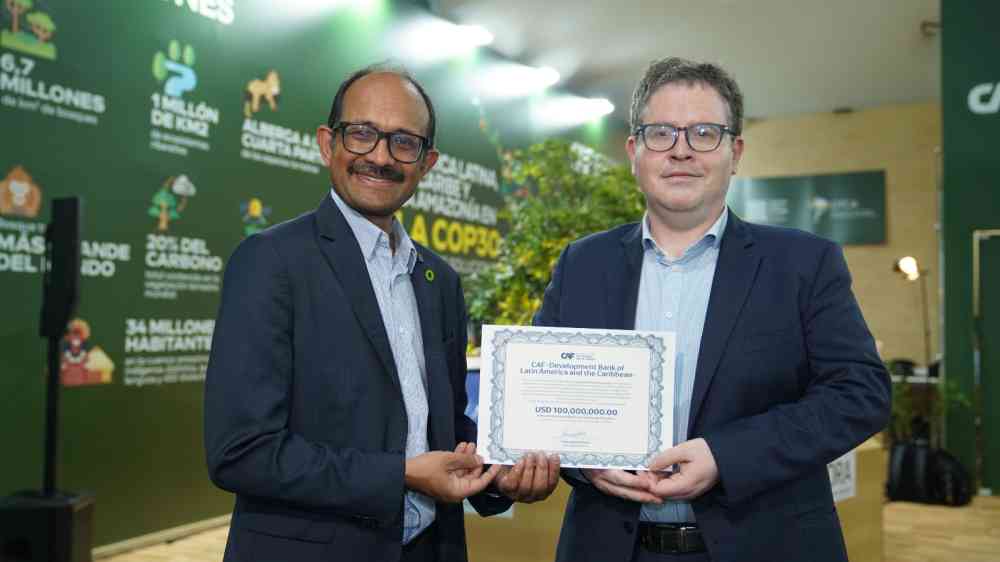
| Loss and damage event - SN, ExCom, FRLD | THU | 13-Nov | 17:00 | CAF Pavillion |
| Enhancing Early Warning for Climate Change Adaptation | FRI | 14-Nov | 09:30 - 12:30 | China Pavilion |
| Achieving the Global Goal on Adaptation | FRI | 14-Nov | 10:00 - 11:30 | Water Pavilion |
| Sustainable Financing for AMHEWAS Programme: Bridging the Gap between Early Warning and Anticipatory Action | FRI | 14-Nov | 10:30 - 12:00 | Africa Pavilion |
| Launch CAF Resilience Bonds | FRI | 14-Nov | 10:00 - 10:30 | CAF Pavillion (press room) |
| Belém to Busan: Roadmap for Coastal Cities’ Global Ambition on Ocean and Climate Resilience | FRI | 14-Nov | 16:15 - 17:15 | CDRI Pavillion |
| Powering Resilience: How AI and Innovation are reinventing Disaster Resilience. | FRI | 14-Nov | 17:00 - 18:00 | IADB Pavillion |
| UN Side Event: Weather, Water and Climate Information for a Resilient Future | FRI | 14-Nov | 16:45 - 18:15 | Side Event Room 4 |
| High-Level Dialogue on Loss and Damage | SAT | 15-Nov | 09:00 - 10:00 | ASEAN Pavillion |
| Climate Mobility Data and Literacy | SAT | 15-Nov | 11:30 - 12:30 | Climate Mobility Pavilion |
| Bridging Data, Policy, and People: Scaling Multi-Hazard Resilience in Thailand | SAT | 15-Nov | 13:30 - 14:30 | Thailand Pavilion |
| Catalyzing systems approaches for water and climate resilience | SAT | 15-Nov | 14:30 - 16:00 | Water Pavilion |
| Technical Discussion on Loss and Damage | SAT | 15-Nov | 15:00 - 16:30 | ASEAN Pavillion |
| From Early Warning to Shared Risk: Building People-Centred Comprehensive Risk Management Systems | MON | 17-Nov | 14:00 - 15:15 | Resilience Hub |
| Partnerships for a Resilient Future: Accelerating Global Cooperation through CDRI | MON | 17-Nov | 16:45 - 18:00 | DRI Pavilion, PV-C100 |
| Build (back) to adapt and transform | TUE | 18-Nov | 11:30 - 12:30 | Spain Pavillion |
| Resilient Futures: Delivering Solutions for Loss and Damage to Accelerate the SDGs | TUE | 18-Nov | 12:00 - 12:45 | SDG Pavillion |
| COP30 Stocktake (AG#26 Governance) | TUE | 18-Nov | 14:00 - 15:00 | Axis Room 5 |
| Side Event: Integrating Disaster Resilient Infrastructure (DRI) into National Adaptation Plans (NAP): A Global South Focus | TUE | 18-Nov | 15:15 - 16:30 | DRI Pavilion (PV-C100) |
| COP 30 Global Climate Action Agenda: Designing the Future: Women, Climate, and Justice | WED | 19-Nov | 11:15 - 12:15 | Blue Zone (ZA) |
| Capacity-building Hub: Nature-based Solutions Day | THU | 20-Nov | 10:30-12:00 | UNFCCC Capacity-building Hub |
| Governance as a key enabler for systemic resilience and climate change adaptation in infrastructure: from national to regional engagement. | THU | 20-Nov | 10:00 - 11:15 | DRI Pavilion |
| Baku High-Level Dialogue on Adaptation | THU | 20-Nov | 10:00 - 13:00 | Meeting room 19 |