Disaster losses and damages tracking
DELTA Resilience: Disaster losses and damages tracking system
Tracking losses and damages: turning impact data into action
With five years to 2030, understanding disaster impacts is urgent and achievable. UNDRR and partners help countries generate trusted risk evidence and use it to prevent risk, reduce losses and strengthen resilience.
What is DELTA Resilience?
DELTA Resilience (Disaster & Hazardous Events, Losses and Damages Tracking & Analysis) is a comprehensive system, not just open-source software. Co-developed with data producers and users and building on DesInventar Sendai, DELTA brings together:
- Methodological frameworks
- Data standards and governance
- Capacity development and technical assistance
- Open-source software
It supports nationally owned Disaster Tracking Systems to monitor hazardous events and record losses and damages at national and subnational levels, whether countries use the DELTA Resilience software interface or strengthen their existing national platforms.
Why this matters
- Builds a consistent evidence base to track progress in preventing and reducing disaster impacts, and in averting, minimizing and addressing climate-induced loss and damage.
- Drives accountability and transparency, guiding smarter investment in prevention, risk reduction and recovery.
- Makes impact data publicly accessible, inclusive and actionable: a true public good for a more resilient world.
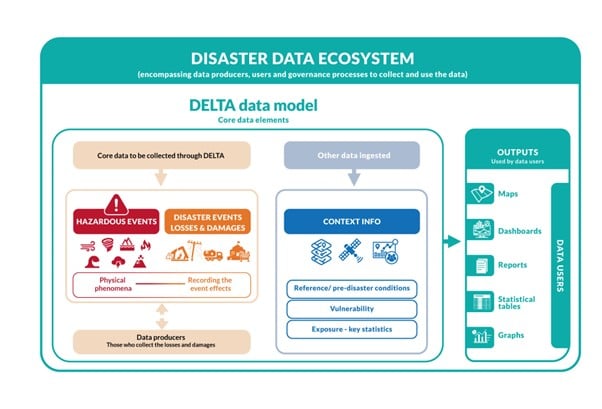
DELTA Resilience: a toolkit for strengthening national disaster tracking systems
Responding to evolving user needs and modern solutions, UNDRR, in close collaboration with UNDP and WMO, has developed a solution for nationally owned, interoperable disaster tracking systems for hazardous events and losses and damages (L&D).
- What’s new: DELTA Resilience builds on DesInventar to offer a more comprehensive, granular, standards-based system that enables capturing hazardous events and disaggregated losses and damages at local and subnational scales, supports open APIs, and enables quick visualization through dashboards to analyse impacts at relevant scales by sector, hazard and disaster.
- Aligned with WMO-CHE (and linking hazardous events to impacts): DELTA Resilience embeds hazardous-event records per the WMO Cataloguing of Hazardous Events (CHE) methodologies and standards. Using universally unique identifiers (UUIDs) and linking parameters, it systematically links hazardous-event observations and catalogues to observed impacts to account for losses and damages, including cascading and compound effects, improving analysis, reporting and decision-making.
- Built through partnerships: DELTA Resilience strengthens collaboration between National Disaster Risk Management agencies, sectoral entities, hazard-monitoring organizations (including National Meteorological and Hydrological Services (NMHSs)) and National Statistics Offices (NSOs), extending the losses and damages data value chain from collection to use.
- Use-case driven: DELTA Resilience has been developed on the basis of a detailed analysis of user needs for multiple existing data applications and emerging use cases, including early warning and anticipatory action, risk-informed planning, disaster risk reduction (DRR) and climate financing, reporting and progress monitoring.
Where DELTA Resilience is being rolled out
Implementation is under way in 35 countries and in preparation in 11 more, and another 27 are engaged. Select a country to find the UNDRR regional office that supports it.
DELTA Resilience rollout status by country, October 2026. Source: UNDRR (2026)
Addressing persistent challenges
More than a software system, the UNDRR-supported approach aims to strengthen how losses and damages are tracked and understood, turning data into insights for decisions to prevent, reduce and address disaster and climate risk and impacts.
In the final five years of the Sendai Framework and the 2030 Agenda for Sustainable Development, we focus on urgent, solutions-driven action, because DRR is everyone’s business and progress in embedding resilience in the DNA of sustainable development is within reach when we work together.
The initiative tackles persistent challenges:
- Rising interconnectedness and complexity: Enabling data ecosystems to build a deeper picture of underlying risks, triggers, and cascading effects, capturing both direct and indirect effects to understand impacts.
- Data governance and sustainability: Strengthen policies, roles, and processes so databases and information systems are institutionalized and maintained over time.
- Digital and data innovation: Match technology options to country and institutional maturity, deploying practical, scalable tools that meet real capacities and needs.
- Evolving methodologies: Apply and advance standards for assessing losses, damages and impacts to ensure comparability and credibility.
- Interoperability: Connect systems so data can be found, shared and reused, linking multiple sources to foster complementarity and reduce duplication.
Why this matters
The enhanced system bridges data, insight and action, enabling timely risk-informed decisions for governments, UN entities, civil society, academia and the private sector.
It advances risk knowledge, one of the catalytic areas of UNDRR’s new strategic framework alongside locally led DRR, financing for DRR and recovery readiness, while addressing cross-cutting priorities: closing risk-governance gaps, aligning with climate change adaptation, and harnessing technology and innovation.
UNDRR’s value and how we work
As the United Nations steward on DRR, UNDRR brings global leadership as a convener and catalyst, providing trusted knowledge and insight and driving accountability across the system. We achieve impact in strengthening the risk knowledge base with and through partners, from governments and UN agencies to civil society, academia and business, so that DRR efforts are inclusive, coherent, and transformative.
Our offering
- A modular, interoperable open-source software system (DELTA Resilience) for hazardous event and losses and damages data, aligned with international standards and enabling institutionalized national tracking systems.
- Practical governance models, institutionalization support, technical assistance and capacity development for long-term sustainability.
- Fit-for-purpose digital solutions and guidance tailored to different data and digital maturity levels.
- Methods, tools and analytics that translate losses and damages data into actionable insights for policy, planning and financing.
The result: a future-ready ecosystem that supports both new and traditional use cases, accelerating collective action to reduce risk and build resilience.
To learn more, explore the sections below or get in touch.
- Methodologies & Data Standards
Methodologies & Data Standards
DELTA Resilience is an open-source toolkit for countries to track hazardous events linked to their human, economic, and non-economic impacts using internationally aligned terminology, well-established methodologies for losses and damages assessment, and hazard taxonomies. It is designed to track hazardous events, disasters and their effects across sectors (not to dispatch emergency response), so countries can analyse trends and patterns, calibrate risk models, plan investments, and inform policies. There are no minimum thresholds for recording: localized, cascading, slow-onset and rapid-onset events can all be documented consistently across sectors and scales.
Alignment with the forthcoming Global Disaster-Related Statistics Framework (G-DRSF)
DELTA Resilience is structured to be consistent with the emerging G-DRSF, operationalizing shared definitions, classifications, and comparability rules so countries can produce comparable official disaster- and climate-impact statistics. It promotes standardized event classification (for example, UNDRR/ISC 2025 Hazard Information Profiles and WMO-CHE methodologies), multidimensional disaggregation, and governance practices that link disaster risk management agencies, hydrometeorological and geological services and national statistics offices, improving data quality, coverage, and interoperability across time and space.
Tracking non-economic losses
Building on the forthcoming FRAME-ECO developed with UNEP and UNU-EHS, DELTA Resilience enables assessment of losses to biodiversity and ecosystem services by comparing post-event change against reference levels of ecosystem extent, condition (including biodiversity) and the diverse values of nature. It works for both extreme and slow-onset contexts (for example, sea-level rise and ocean acidification), supports continuous monitoring, and overlays hazardous event footprints with ecosystem metrics to quantify losses that matter for people and nature.
In parallel, the data model captures human effects with compound disaggregation, recording age, sex and disability (and, where nationally defined, gender) together for variables such as deaths, injuries and missing persons, and introduces time-stamped displacement variables. Displacement metrics follow and build on the emerging IOM–IDMC disaster displacement indicators for DRR, aligning disaster event records with standardized characteristics of disaster-induced displacement patterns.
Data model, scope, and methods
The data model links hazardous events to disaster events and records with relevant sector classifications (social, productive, infrastructure, cross-cutting) and advanced disaggregation, including displacement with time-stamps. It captures qualitative context (for example, early warning and early action, or response operations) and supports compound/cascading relationships (for example, NaTech chains). As countries integrate exposure and vulnerability data and sector statistics (for example, on supply and demand for productive sectors), the system enables valuation of damage and estimation of losses across scenarios, building on PDNA/DALA approaches.
- Open Source Software solution
Open Source Software solution
DELTA Resilience open-source software is a modular, open-source system for recording hazardous events and associated losses and damages, developed by UNDRR with partners and offered for countries to deploy as nationally owned instances. A beta release, launched in June 2025, is available upon request with three pre-configured dashboards for hazard, sector and disaster-event views to accelerate analysis and support reporting.
Countries can self-host on-premises or in a secure cloud, administer roles and validation workflows, and retain full control over data sharing; the stack typically uses PostgreSQL/PostGIS and Node.js with SMTP, domain/subdomain and SSL, and is distributed under the Apache License 2.0. To protect data and ensure trust, the architecture supports role-based access control, encryption, audit logs and other UN-standard cybersecurity practices.
For legacy data from DesInventar Sendai, an API-based extract-transform-load tool (DiX) maps DesInventar records to the new data model and updated classifications, with guidance available and adaptation options for other formats. The software system is mobile-first today, with a roadmap for a native offline app and integrations with survey tools to sync field data from low-connectivity areas, and UNDRR is refactoring the application toward an optional SaaS delivery for contexts with limited IT capacity.
To learn more, visit deltaresilience.org.
- Capacity Development & Technical Assistance
Capacity Development & Technical Assistance
DELTA’s capacity development goes beyond software installation. UNDRR, together with core partners UNDP and WMO, supports countries to strengthen governance, methods and skills for tracking hazardous events and associated losses and damages. A recommended first step is a Data Ecosystem Maturity Assessment to diagnose data governance and value-chain gaps; the findings inform a country-specific rollout plan and can underpin proposals to mobilize partners and financing.
Countries that reach out receive an orientation to the DELTA toolkit, with training modules, technical guidance and tutorials made available progressively, including via digital and interactive platforms. Capacity support is tailored to context and needs, and may focus on governance, methodological development, or technical skills rather than software per se.
Institutionalization is a core objective of capacity work. This includes assigning clear roles and responsibilities, embedding processes in legal or policy frameworks where relevant, establishing regular data collection and validation workflows, and building the technical and human capacities to manage, analyse and use data for planning, decision-making, reporting and accountability. System features such as configurable roles, validation steps, and audit trails support these practices and are aligned with nationally approved procedures. Partnerships extend this offer. Depending on use cases, such as impact-based early warning and early action, specialized partners and initiatives can be mobilized. Regional organizations, NGOs and academia are encouraged to contribute through capacity development, technical assistance and research/innovation, complementing government leadership of national systems. UNDRR also provides migration guidance and technical documentation to help teams carry legacy data into DELTA’s model as part of a managed change process.
- Partnerships
Partnerships
The DELTA Resilience initiative, including the DELTA open-source software, is led by a tripartite coalition of the UN Office for Disaster Risk Reduction (UNDRR), the UN Development Programme (UNDP), and the World Meteorological Organization (WMO). This joint effort builds on each organization’s comparative strengths (normative guidance, technical excellence and in-country programme delivery), recognized by Member States as essential to advancing global disaster risk reduction and climate resilience agendas.
Leveraging this collective mandate and trusted country presence, the lead agencies mobilize partners, align investments in data for sustainable development, and strengthen synergies with flagship initiatives such as the UN Secretary-General’s Early Warnings for All (EW4All). Partnerships are also shaped to support the UN Secretary-General’s Data Strategy and the UNDRR Data Strategy, ensuring responsible, interoperable and impactful data use.
Theme-specific collaborations reinforce data standards and methodological innovation, for example on non-economic losses and ecosystem impacts with UNU-EHS and the UN Environment Programme (UNEP); on slow-onset processes; on disaster displacement with the International Organization for Migration (IOM); and on sector-specific loss and damage metrics with the Food and Agriculture Organization of the United Nations (FAO) and others.
Research, academic and technical organizations contribute through co-development, pilots, and knowledge exchange to strengthen both the methodology and the software stack. Contributors include the ITC Faculty of Geo-Information Science and Earth Observation (University of Twente), 510 – an initiative of the Netherlands Red Cross, the Pacific Disaster Center (PDC), CIMA Research Foundation, the World Food Programme (WFP), Youth Innovation Lab, the UN Office of Information and Communications Technology (OICT), and the UN International Computing Centre (UNICC), among others, collectively enhancing tools, practices, and evidence on disaster impacts.
- Use cases - Data applications
Use cases - Data applications
Reliable, comparable data on disaster losses and damages is essential to understand risk and impacts. Impact data helps reveal root causes, track shifts in exposure and vulnerability, and assess the likelihood and consequences of cascading, multi-hazard events. Yet many countries still do not collect or use disaster data systematically. Differences in methods, coverage, and system governance create gaps that hinder effective risk management.
A review of case studies shows how investments in high-quality data collection and management can strengthen decision-making across preparedness, early warning and early action, disaster risk reduction (DRR) financing, risk-informed planning and development, and reporting, benchmarking, and progress monitoring.
Recommendations to improve usability of losses and damages data for decisions
- Disaggregate by hazard type, geography, sector, and by sex, age, disability status, and income level to reveal differential exposure and vulnerability. Collect disaggregated impact information by sector, location, and population groups to identify common disruptions to livelihoods, systems, and services from recurrent hazards, and to monitor the effectiveness of early/anticipatory actions.
- Geo-reference impact records to support accurate, replicable risk models and impact-based forecasting.
- Link impacts to specific hazardous events, including intensity and other event characteristics, as well as cascading sequences, to connect outcomes with exposure and vulnerability.
- Increase spatial resolution of damage records so machine-learning models can improve prediction resolution and support higher-performance impact-based forecasting.
- Strengthen sector-specific data on assets and service systems (e.g., water distribution). Capture event parameters (e.g., flow speeds, inundation depth, stagnation time/duration) to explain damage mechanisms and inform sector-specific insurance and risk-transfer products.
- Differentiate private vs. public losses to guide DRR and financing strategies across productive and infrastructure sectors.
- Disaggregate historical damage data and integrate robust baseline exposure data (e.g., asset inventories and production processes), beyond buildings and population counts, to enhance the evidence base for risk transfer and investment planning.
- Adopt globally agreed standards, including the 2025 ISC/UNDRR hazard classification and Hazard Information Profiles (HIPs), as the backbone of databases and tracking systems to enable comparability and regional benchmarking.
Key components of DTS




Events


Resources


All past events
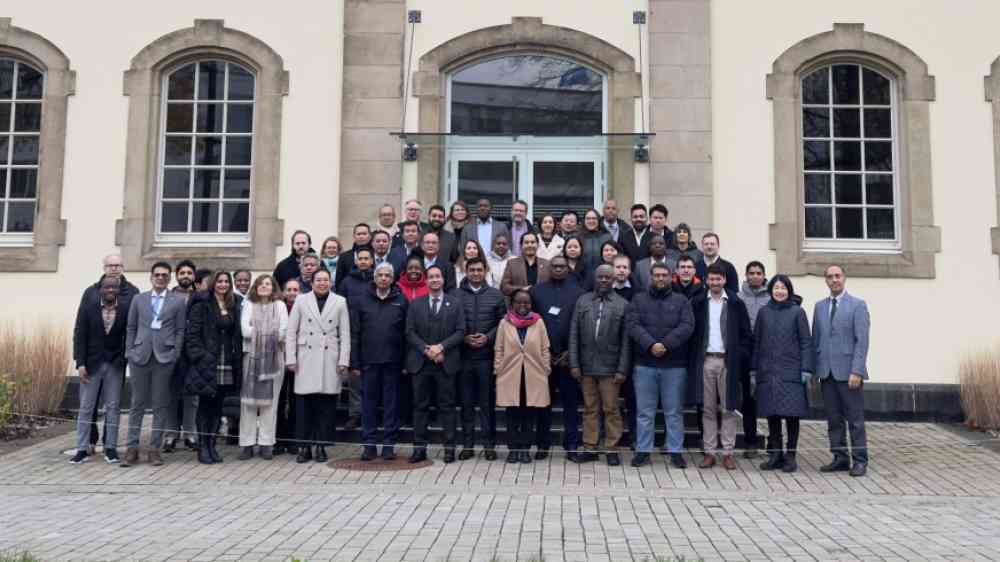
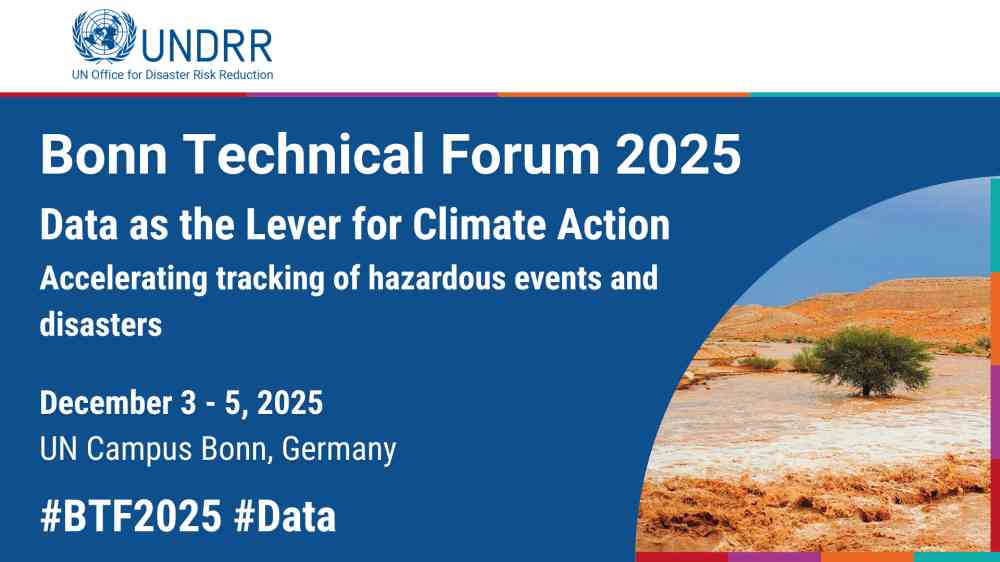
Meetings and conferences Bonn 22 October 2024 - 23 October 2025 In person
Contact the UNDRR Bonn Office to know more and contribute
Bonn, Germany
UNDRR Office in Bonn
UN Campus
Platz der Vereinten Nationen 1
53113 Bonn
Germany
Phone: +49 228 8152000
Email: [email protected]
Web: www.undrr.org/bonn