
Arab States strengthen regional cooperation on urban resilience and risk-informed development
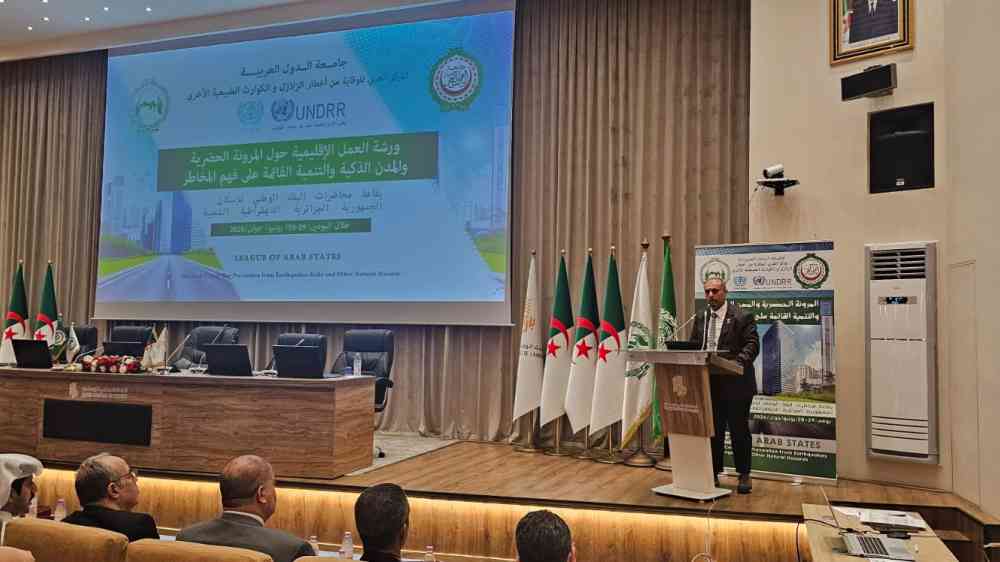
Representatives from governments, regional organizations, United Nations agencies, technical institutions and city authorities gathered in Algiers for a three-day regional workshop on urban resilience, smart cities and risk-informed development, reaffirming their commitment to building safer, more resilient and sustainable cities across the Arab States.
Organized alongside the inaugural meeting of the Arab Urban Resilience Committee, the workshop provided a regional platform to exchange knowledge, strengthen institutional coordination, and identify practical approaches for integrating disaster risk reduction into urban planning, governance and investment.
The event was organized by the League of Arab States (LAS), the Arab Centre for the Prevention of Earthquake and Other Natural Disasters (ACPEND), the United Nations Office for Disaster Risk Reduction (UNDRR), UN-Habitat, and regional partners, reflecting a shared commitment to advancing risk-informed urban development in support of the Sendai Framework for Disaster Risk Reduction 2015–2030 and the Sustainable Development Goals.
Advancing risk-informed urban resilience
The workshop focused on translating global commitments into practical action at the national and local levels, emphasizing the need to strengthen governance, improve risk-informed planning, and promote investments that enhance urban resilience.
Participants explored regional priorities for addressing urban risks, integrating disaster risk reduction into urban development policies, strengthening institutional coordination, and reinforcing collaboration between national and local authorities to better anticipate, manage and reduce current and emerging risks.
Discussions also highlighted the growing importance of resilient cities in addressing the interconnected challenges of climate change, rapid urbanization, infrastructure development and disaster risk, while ensuring that resilience is embedded within sustainable development planning.
From commitment to implementation through MCR2030
UNDRR facilitated a dedicated session on the Making Cities Resilient 2030 (MCR2030) initiative, showcasing progress across the Arab region and demonstrating how cities are translating global commitments into concrete local action.
The session highlighted practical tools and approaches for strengthening urban resilience, including the MCR2030 roadmap, the Disaster Resilience Scorecard for Cities, resilience action planning, disaster risk financing, disaster loss and damage data systems, and the Early Warnings for All initiative.
Participants also exchanged experiences from cities including Salalah and Alexandria, illustrating how local leadership, peer learning and partnerships are helping cities move from resilience planning to implementation. The discussion underscored the value of city-to-city cooperation and regional knowledge exchange in accelerating resilience action across the Arab region.
Building greener, smarter and more resilient cities
Participants explored how nature-based solutions, smart city approaches and digital innovation can strengthen resilience while supporting sustainable urban development.
Sessions examined the growing impacts of climate-related hazards, including extreme heat, flooding, drought and environmental degradation and highlighted the importance of resilient infrastructure, integrated urban planning, sustainable finance and community engagement in reducing disaster risk.
The workshop reaffirmed that resilient cities require coordinated action across all levels of government, supported by strong partnerships with academia, the private sector, civil society and local communities.
Sharing national experiences to accelerate resilience
The workshop also highlighted the value of sharing national experiences to demonstrate how global frameworks can be translated into practical action across diverse urban contexts in the Arab region.
Country presentations showcased a range of approaches to strengthening urban resilience. Algeria shared its experience in governance, urban planning, technical oversight and nature-based solutions.
Egypt presented Alexandria's work on risk-informed urban planning and institutional coordination, alongside the Ministry of Housing's efforts to build more resilient cities, including initiatives such as green roofs.
Oman highlighted Salalah's experience in translating global frameworks into local plans and actions, while Lebanon emphasized the role of national centres in supporting evidence-based decision-making for urban resilience.
Jordan presented its experience in flood risk management through community participation in planning and emergency response, while Bahrain showcased the use of early warning systems and rapid response mechanisms to strengthen urban preparedness.
Palestine highlighted the exceptional challenges that occupation-related constraints pose to sustainable urban development, increasing vulnerability and complicating disaster risk management.
Participants concluded that exchanging national experiences is essential for accelerating the implementation of resilience measures, enabling countries to adapt successful approaches to their own contexts and strengthen regional cooperation on disaster risk reduction.
Strengthening regional cooperation
A key outcome of the meeting was the establishment of the leadership of the Arab Urban Resilience Committee, marking an important step towards strengthening regional cooperation on urban resilience.
Recognizing the leadership demonstrated by the City of Salalah through its engagement in the MCR2030 initiative and its contribution to advancing urban resilience across the region, the Sultanate of Oman was selected to chair the Arab Urban Resilience Committee, with Algeria and the State of Palestine serving as Vice-Chairs. The Committee will provide a regional platform to promote collaboration, facilitate knowledge exchange, and support the implementation of risk-informed urban resilience policies and practices across the Arab States.
The workshop concluded with renewed commitment from participating countries and partners to strengthen regional cooperation, enhance technical exchange, and accelerate the implementation of risk-informed urban development.
By connecting global frameworks with national policies and local action, participants reaffirmed that resilient cities are fundamental to protecting development gains, reducing disaster risk, and advancing sustainable development throughout the Arab States.