
Salalah steps forward as a regional resilience leader, advancing safer cities across the Arab States
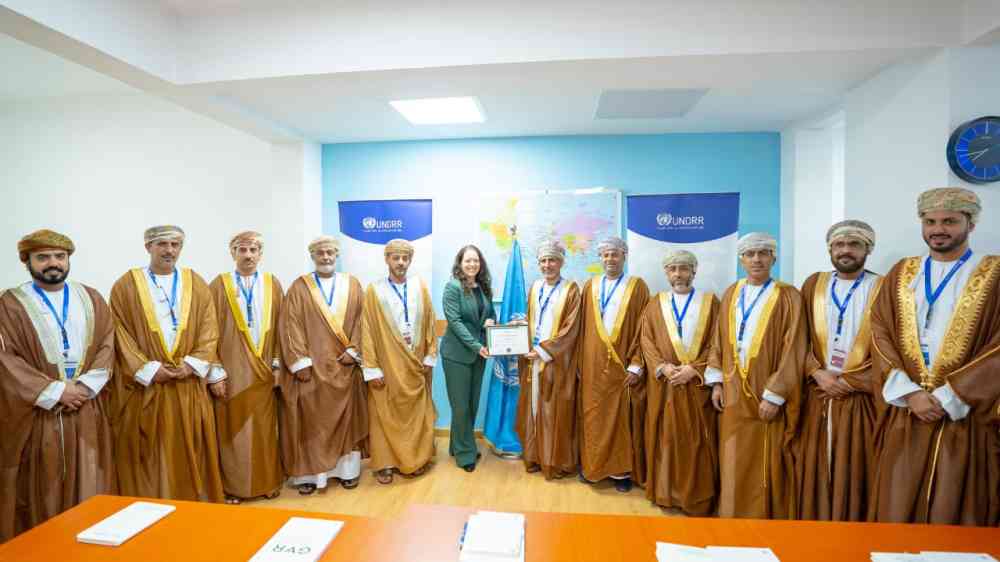
Cities across the Arab region are gaining new momentum in building resilience to disasters and climate risks, as Salalah is recognized as a Regional Resilience Hub under the Making Cities Resilient 2030 (MCR2030) initiative.
A high-level delegation from Salalah, bringing together representatives from civil defence, environmental authorities, risk management institutions and the private sector, visited Cairo to strengthen regional cooperation and accelerate practical action on urban resilience.
A milestone with regional impact
The visit marked a significant step forward for regional collaboration, with Salalah formally accredited as a Resilience Hub at a ceremony hosted by the UNDRR Regional Office for Arab States.
Presenting the certificate, Ms. Sandra Amlang, Chief of Office, UNDRR ROAS, noted:
“This recognition reflects Salalah’s strong commitment to advancing urban resilience and supporting other cities across the region through knowledge-sharing and collaboration.”
As a Resilience Hub, Salalah will play a catalytic role in supporting cities across the Arab States to translate resilience commitments into practical, locally driven solutions.
From commitment to implementation
The visit focused on moving from strategy to action. Discussions between UNDRR and the Salalah delegation explored:
- Priority actions to operationalize Salalah’s role as a Resilience Hub
- Target cities and countries for peer-to-peer support
- Timelines for implementation under MCR2030
- Opportunities for technical partnerships and collaboration
The delegation presented its vision for resilience-building, highlighting integrated risk management, institutional coordination, and community preparedness as key pillars.
Governor Sheikh Said bin Hamid Al Harthy emphasized:
“Salalah is committed to playing an active role in supporting cities in the region, building on partnerships and shared expertise to strengthen resilience and safeguard communities.”
Learning through partnership
As part of the programme, the delegation engaged with Egypt’s Information and Decision Support Center (IDSC), gaining insights into national systems for data-driven decision-making, risk analysis, and crisis management.
This exchange supports Salalah’s evolution as a regional hub by strengthening its capacity to apply risk information for planning, preparedness and response.
A whole-of-society approach
The delegation reflected a strong multi-sector approach, including:
- Dhofar Governor’s Office
- Civil Defence and Ambulance Authority
- Environment Authority
- Oman Chamber of Commerce and Industry (Dhofar branch)
- Private sector partners, including OQ Group
The participation of media representatives also underscored the importance of risk communication and public awareness in building resilient communities.
Scaling resilience across the region
The recognition of Salalah highlights growing regional momentum under MCR2030, as cities move toward more risk-informed, inclusive and sustainable urban development.
As a Resilience Hub, Salalah is expected to:
- Support cities in strengthening disaster risk governance
- Facilitate technical exchange and capacity-building
- Promote scalable and locally adapted resilience solutions
- Contribute to the implementation of the Sendai Framework for Disaster Risk Reduction
Looking ahead
The visit concluded with a shared commitment to operationalize Salalah’s role through concrete actions, strengthened partnerships, and measurable results.
Through continued collaboration with UNDRR and regional partners, Salalah is set to play a leading role in advancing safer, more resilient cities across the Arab States.