
Indicators and their linkages to the SDGs and the Global Goal on Adaptation
What the 38 indicators measure, how they are defined, and how Sendai Framework reporting connects to the Sustainable Development Goals and the Global Goal on Adaptation.
How progress is monitored
Strong accountability is one of the cornerstones of the Sendai Framework for Disaster Risk Reduction. The seven targets of the Sendai Framework are tracked using 38 indicators, recommended by an Open-ended Intergovernmental Expert Working Group. The tabs below provide information on the seven targets, the definitions what each indicator measures, how the framework integrates with the Sustainable Development Goals 1, 11 and 13, and how it aligns with the Global Goal on Adaptation (GGA). For the actual figures countries have reported, see the explore the data page.
- Targets
Targets
The Sendai Framework outlines seven global targets to be achieved between 2015 and 2030.
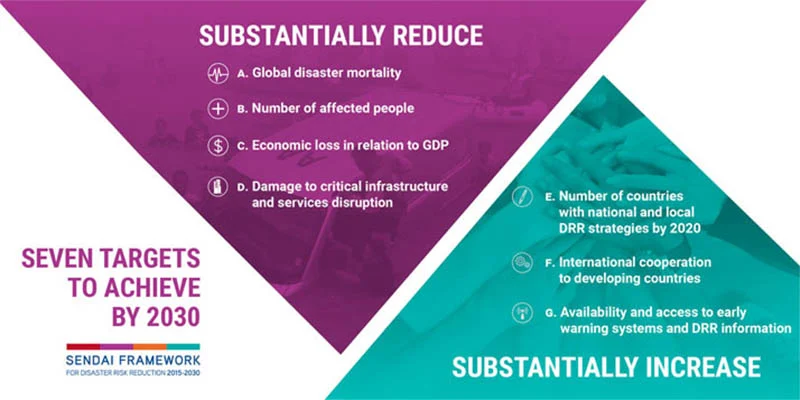
- Target A: Substantially reduce global disaster mortality by 2030, aiming to lower average per 100,000 global mortality
between 2020-2030 compared to 2005-2015 - Target B: Substantially reduce the number of affected people globally by 2030, aiming to lower the average global figure per 100,000 between 2020-2030 compared to 2005-2015
- Target C: Reduce direct disaster economic loss in relation to global gross domestic product (GDP) by 2030
- Target D: Substantially reduce disaster damage to critical infrastructure and disruption of basic services, among them health and educational facilities, including through developing their resilience by 2030
- Target E: Substantially increase the number of countries with national and local disaster risk reduction strategies by 2020
- Target F: Substantially enhance international cooperation to developing countries through adequate and sustainable support to complement their national actions for implementation of this framework by 2030
- Target G: Substantially increase the availability of and access to multi-hazard early warning systems and disaster risk information and assessments to people by 2030
- Target A: Substantially reduce global disaster mortality by 2030, aiming to lower average per 100,000 global mortality
- Indicators
Indicators
Global target A: Substantially reduce global disaster mortality by 2030, aiming to lower average per 100,000 global mortality between 2020-2030 compared with 2005-2015.
Target Description A-1 (compound) Number of deaths and missing persons attributed to disasters, per 100,000 population. A-2 Number of deaths attributed to disasters, per 100,000 population. A-3 Number of missing persons attributed to disasters, per 100,000 population.The scope of disaster in this and subsequent targets is defined in paragraph 15 of the Sendai Framework for Disaster Risk Reduction 2015-2030 and applies to small-scale and large-scale, frequent and infrequent, sudden and slow-onset disasters caused by natural or man-made hazards, as well as related environmental, technological and biological hazards and risk. Global target B: Substantially reduce the number of affected people globally by 2030, aiming to lower the average global figure per 100,000 between 2020-2030 compared with 2005-2015.
B-1 (compound) Number of directly affected people attributed to disasters, per 100,000 population. B-2 Number of injured or ill people attributed to disasters, per 100,000 population. B-3 Number of people whose damaged dwellings were attributed to disasters. B-4 Number of people whose destroyed dwellings were attributed to disasters. B-5 Number of people whose livelihoods were disrupted or destroyed, attributed to disasters. Global target C: Reduce direct disaster economic loss in relation to global gross domestic product (GDP) by 2030.
C-1 (compound) Direct economic loss attributed to disasters in relation to global gross domestic product. C-2 Direct agricultural loss attributed to disasters. Agriculture is understood to include the crops, livestock, fisheries, apiculture, aquaculture and forest sectors as well as associated facilities and infrastructure. C-3 Direct economic loss to all other damaged or destroyed productive assets attributed to disasters. Productive assets would be disaggregated by economic sector, including services, according to standard international classifications. Countries would report against those economic sectors relevant to their economies. This would be described in the associated metadata. C-4 Direct economic loss in the housing sector attributed to disasters. Data would be disaggregated according to damaged and destroyed dwellings. C-5 Direct economic loss resulting from damaged or destroyed critical infrastructure attributed to disasters.
The decision regarding those elements of critical infrastructure to be included in the calculation will be left to the Member States and described in the accompanying metadata. Protective infrastructure and green infrastructure should be included where relevant.C-6 Direct economic loss to cultural heritage damaged or destroyed attributed to disasters. Global target D: Substantially reduce disaster damage to critical infrastructure and disruption of basic services, among them health and educational facilities, including through developing their resilience by 2030
D-1 (compound) Damage to critical infrastructure attributed to disasters D-2 Number of destroyed or damaged health facilities attributed to disasters. D-3 Number of destroyed or damaged educational facilities attributed to disasters. D-4 Number of other destroyed or damaged critical infrastructure units and facilities attributed to disasters.The decision regarding those elements of critical infrastructure to be included in the calculation will be left to the Member States and described in the accompanying metadata. Protective infrastructure and green infrastructure should be included where relevant. D-5 (compound) Number of disruptions to basic services attributed to disasters. D-6 Number of disruptions to educational services attributed to disasters. D-7 Number of disruptions to health services attributed to disasters. D-8 Number of disruptions to other basic services attributed to disasters.The decision regarding those elements of basic services to be included in the calculation will be left to the Member States and described in the accompanying metadata. Global target E: Substantially increase the number of countries with national and local disaster risk reduction strategies by 2020.
E-1 Number of countries that adopt and implement national disaster risk reduction strategies in line with the Sendai Framework for Disaster Risk Reduction 2015-2030. E-2 Percentage of local governments that adopt and implement local disaster risk reduction strategies in line with national strategies.Information should be provided on the appropriate levels of government below the national level with responsibility for disaster risk reduction. Global target F: Substantially enhance international cooperation to developing countries through adequate and sustainable support to complement their national actions for implementation of this framework by 2030.
F-1 Total official international support, (official development assistance (ODA) plus other official flows), for national disaster risk reduction actions.Reporting of the provision or receipt of international cooperation for disaster risk reduction shall be done in accordance with the modalities applied in respective countries. Recipient countries are encouraged to provide information on the estimated amount of national disaster risk reduction expenditure. F-2 Total official international support (ODA plus other official flows) for national disaster risk reduction actions provided by multilateral agencies. F-3 Total official international support (ODA plus other official flows) for national disaster risk reduction actions provided bilaterally. F-4 Total official international support (ODA plus other official flows) for the transfer and exchange of disaster risk reduction-related technology. F-5 Number of international, regional and bilateral programmes and initiatives for the transfer and exchange of science, technology and innovation in disaster risk reduction for developing countries. F-6 Total official international support (ODA plus other official flows) for disaster risk reduction capacity-building. F-7 Number of international, regional and bilateral programmes and initiatives for disaster risk reduction-related capacity-building in developing countries. F-8 Number of developing countries supported by international, regional and bilateral initiatives to strengthen their disaster risk reduction-related statistical capacity. Global target G: Substantially increase the availability of and access to multi‑hazard early warning systems and disaster risk information and assessments to the people by 2030.
G-1 (compound G2‑G5) Number of countries that have multi-hazard early warning systems. G-2 Number of countries that have multi-hazard monitoring and forecasting systems. G-3 Number of people per 100,000 that are covered by early warning information through local governments or through national dissemination mechanisms. G-4 Percentage of local governments having a plan to act on early warnings. G-5 Number of countries that have accessible, understandable, usable and relevant disaster risk information and assessment available to the people at the national and local levels. G-6 Percentage of population exposed to or at risk from disasters protected through pre-emptive evacuation following early warning.Member States in a position to do so are encouraged to provide information on the number of evacuated people. - Integrated Monitoring with the SDGs
Integrated Monitoring with the SDGs
Both the Sendai Framework and the Sustainable Development Goals (SDGs) outcomes are a product of interconnected social and economic processes. As such, there is a lot of synergy between the two policy instruments. In fact, Sendai Framework monitoring is intended to complement monitoring of 11 SDG indicators listed below.


Goal 1. End poverty in all its forms everywhere
- Number of deaths, missing persons and directly affected persons attributed to disasters per 100,000 population
- SDG Indicator: 1.5.1
- Sendai Framework Indicators: A1 and B1
- Direct economic loss attributed to disasters in relation to global gross domestic product (GDP)
- SDG Indicator: 1.5.2
- Sendai Framework Indicators: C1
- Number of countries that adopt and implement national disaster risk reduction strategies in line with the Sendai Framework for Disaster Risk Reduction 2015-2030
- SDG Indicator: 1.5.3
- Sendai Framework Indicators: E1
- Proportion of local governments that adopt and implement local disaster risk reduction strategies in line with national disaster risk reduction strategies
- SDG Indicator: 1.5.4
- Sendai Framework Indicators: E2

Goal 11. Make cities and human settlements inclusive, safe, resilient and sustainable
- Number of deaths, missing persons and directly affected persons attributed to disasters per 100,000 population
- SDG Indicator: 11.5.1
- Sendai Framework Indicators: A1 and B1
- Direct economic loss attributed to disasters in relation to global gross domestic product (GDP)
- SDG Indicator: 11.5.2
- Sendai Framework Indicators: C1
- (a) Damage to critical infrastructure and (b) number of disruptions to basic services, attributed to disasters
- SDG Indicator: 11.5.3
- Sendai Framework Indicators: D1 and D5
- Number of countries that adopt and implement national disaster risk reduction strategies in line with the Sendai Framework for Disaster Risk Reduction 2015-2030
- SDG Indicator: 11.b.1
- Sendai Framework Indicators: E1
- Proportion of local governments that adopt and implement local disaster risk reduction strategies in line with national disaster risk reduction strategies
- SDG Indicator: 11.b.2
- Sendai Framework Indicators: E2
Goal 13. Take urgent action to combat climate change and its impacts
- Number of deaths, missing persons and directly affected persons attributed to disasters per 100,000 population
- SDG Indicator: 13.1.1
- Sendai Framework Indicators: A1 and B1
- Number of countries that adopt and implement national disaster risk reduction strategies in line with the Sendai Framework for Disaster Risk Reduction 2015-2030
- SDG Indicator: 13.1.2
- Sendai Framework Indicators: E1
- Proportion of local governments that adopt and implement local disaster risk reduction strategies in line with national disaster risk reduction strategies
- SDG Indicator: 13.1.3
- Sendai Framework Indicators: E2
Integrating with Voluntary National Reviews
To learn more on how to integrate disaster-related data into the Sustainable Development Goals Voluntary National Reviews please see UNDRR Guidance for countries on disaster-related data for Voluntary National Reviews.
- Number of deaths, missing persons and directly affected persons attributed to disasters per 100,000 population
- Supporting the Global Goal on Adaptation
Supporting the Global Goal on Adaptation
Climate change adaptation and disaster risk reduction are similar in their aims and approaches. The Global Goal on Adaptation aims to enhancing adaptive capacity, strengthening resilience and reducing vulnerability to climate change, which is fully aligned with reduction of hazard, vulnerability and exposure, and enhancing capacity and resilience, as outlined in the goal of the Sendai Framework. Contributing to the achievement of sustainable development is explicit in both the goals.
The last ten years has seen a steady progress in translating this goal from a broad aspiration into a measurable, actionable and accountable effort. The COP28/ CMA5 in Dubai adopted 11 targets under the UAE Framework for Global Climate Resilience - covering both thematic areas (water, food, health, etc.) and the adaptation process (assessing, planning, implementing, monitoring), guiding countries to build resilience. Two years later, and through an intergovernmental and multistakeholder process, supported by a group of experts, a total of 59 indicators were adopted at COP30/ CMA7, called as the “Belem Adaptation Indicators”.
As both the Paris Agreement and the Sendai Framework complete their 10 years of existence, their respective indicators provide further opportunities for coherence and coordination.
Explore the Sendai Framework Monitor
You are here
Understand the indicators
What the 38 indicators measure, and how the framework connects to the SDGs and the Global Goal on Adaptation.