
Near-Earth Object
A near-Earth object (NEO) is an asteroid or comet whose trajectory brings it to within 1.3 astronomical units of the Sun and hence within 0.3 astronomical units, or approximately 45 million kilometres, of the Earth’s orbit (UN OOSA, no date).
Primary reference(s)
UN OOSA, no date. UN-SPIDER knowledge Portal, Near-Earth Objects. United Nations Office for Outer Space Affairs (UN OOSA). Accessed 1 April 2025.
Annotations
Additional scientific description
The definition above includes objects that will come close to Earth at some point in their future orbital evolution. Near-Earth objects (NEOs) generally result from objects that have experienced gravitational perturbations from nearby planets, moving them into orbits that allow them to come near to Earth.
IAWN has proposed the following definition of an NEO: An asteroid, meteoroid, or a comet as it passes near Earth, enters the Earth's atmosphere, and/or strikes the Earth, or provokes changes in inter-planetary conditions that affect the Earth's magneto- sphere, ionosphere, and thermosphere. The criteria and thresholds related to this definition are as follows (UN OOSA, no date):
- The probability that an NEO will impact Earth (either 1% for warning or 10% for terrestrial preparedness planning).
- The probable size, or at least its luminosity in the night sky (greater than 10 meters or at least absolute magnitude 28).
- How far in the future the NEO will impact Earth (20 years).
Metrics and numeric limits
A near-Earth asteroid is said to be a potentially hazardous asteroid when its orbit comes within 0.05 astronomical units of the Earth’s orbit and it has a measured absolute magnitude H<22 mag (an estimated diameter greater than 140 meters) (NASA, no date).
Key relevant UN convention / multilateral treaty
The Committee on the Peaceful Uses of Outer Space (COPUOS) was set up by the United Nations General Assembly in 1959 to govern the exploration and use of space for the benefit of all humanity: for peace, security and development (COPUOS, no date). The Committee was tasked with reviewing international cooperation in peaceful uses of outer space, studying space-related activities that could be undertaken by the United Nations, encouraging space research programmes, and studying legal problems arising from the exploration of outer space.
Drivers
Not Applicable
Impacts
Near-Earth Object- related impact hazards consist primarily of the risk of airbursts and meteorite impacts.
The dominant hazards from airbursts consist of highly energetic shock fronts with overpressure, severe wind speeds and thermal radiation. Threat levels range from effects comparable to conventional explosives but can vary on many orders of magnitude, up to exceeding the highest levels of nuclear explosions (but without radioactivity).
Small meteorite impacts, with parent bodies on the scale of no more than a few metres, will have only highly localized hazard potential, essentially comprised of material falling around terminal velocities.
Decametre- sized parent objects can cause airbursts which may reach the ground and cause hazards through shock waves, overpressure and high wind speeds. In addition, larger masses can reach the ground at high speeds, causing localised explosions upon impact.
Objects larger than about 50 metres in diameter (in addition to airburst effects) have the potential to cause sizeable craters, fully destroying the area occupied by the crater (varying with the size of an impactor) and posing further risk to the surrounding area upon impact, comparable to ground-level explosions of varying size.
Objects of sizes more than 100 metres in diameter will pose a risk to areas of tens to hundreds of kilometres and should be avoided through internationally coordinated space-based deflection efforts.
Multi-hazard context
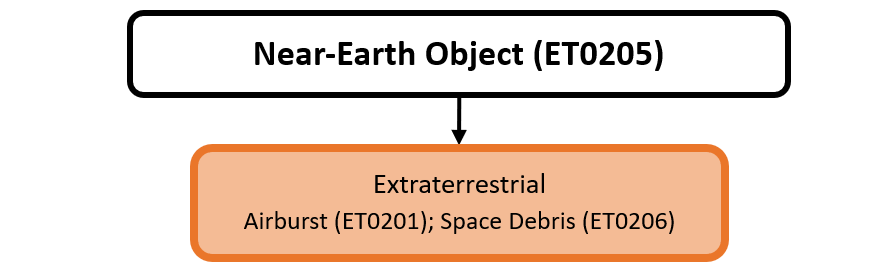
The figure below summarises common interactions between near-Earth objects and other hazards. This information should be used with caution and not be solely relied upon in Disaster Risk Management, particularly as some interactions may not have been included. Note that hazardous events occurring together or locally in space or time may not necessarily cause, amplify, or be otherwise related to each other. Specific examples of multi-hazard context can be found in the ‘Hazard drivers’ and ‘Impacts’ sections above.
Multi-hazard diagram
Risk Management
The International Asteroid Warning Network (IAWN) was established in 2013 as a result of the UN-endorsed recommendations for an international response to a potential NEO impact threat, to create an international group of organisations involved in detecting, tracking, and characterising NEOs. IAWN is tasked with developing a strategy using well-defined communication plans and protocols to assist governments in the analysis of asteroid impact consequences and in the planning of mitigation responses. Currently, IAWN includes members from Europe, Asia, South and North America (IAWN, 2020).
The European Space Agency’s (ESA) Space Safety Programme (S2P) partners with many countries, organisations and individuals. In particular, it has strong links with the United Nations Committee on the Peaceful Uses of Outer Space (UNCOPUOS), which facilitates the Space Mission Planning Advisory Group (SMPAG) and IAWN. SMPAG and IAWN were both established in response to the need for an international response to the threat of NEO impacts. SMPAG coordinates the technological know-how of agencies, including ESA, recommending specific responses to asteroid threats, including basic research and development, impact mitigation measures and deflection missions. Depending on the capabilities and specific technologies available to each agency, options are made to ensure the best use is made of the resources of each organisation. ESA’s primary projects are the Space Safety Programme– especially the activities carried out by the Planetary Defence Office, such as Observation and Tracking of Near-Earth Objects (NEOs), Orbit determination and Impact monitoring and support of international mitigation activities, such as asteroid reconnaissance missions like Hera and the planned RAMSES mission to asteroid (99942).
IAWN and SMPAG have agreed on the following criteria and thresholds for impact-response actions:
IAWN shall warn of predicted impacts exceeding a probability of 1% for all objects characterised to be greater than 10 meters in size, or roughly equivalent to absolute magnitude of 28 if only brightness data can be collected.
Rationale: Impact probabilities greater than 1% are rare. Most objects greater than 10 meters in size will have effects (air blast and pieces) that could reach the Earth’s surface. IAWN is compelled to warn populations if bodies will have effects that reach the ground. Setting the threshold at 1% is a compromise between not being overly alarmist and not warning too late for necessary action to be initiated. It is a probability figure that individuals and governments can comprehend. An alert such as this demonstrates that the IAWN is functioning. Further, it ensures the flow of communication from IAWN to the public and the United Nations.
Terrestrial preparedness planning is recommended to begin when warned of a possible impact is predicted to be within 20 years; the probability of impact is assessed to be greater than 10%; and the object is characterised to be greater than 20 meters in size, or roughly equivalent to absolute magnitude of 27 if only brightness data can be collected.
Rationale: Terrestrial preparedness and the increased potential for impact will also involve the determination of a ‘risk corridor’ from objects with 10% impact probabilities and impacts in less than 20 years. This provides populations and population centres on Earth with information to begin preparations for emergency preparedness if needed. The surprising effects of the Chelyabinsk event in 2013 from an object ~18 meters in size, in turn led to the establishment of a lower limit (20 meters) in these threshold criteria.
SMPAG should start mission option(s) planning when warned of a possible impact predicted to be within 50 years; where the probability is assessed to be greater than 1%; and if the object is characterised to be greater than 50 meters in size, or roughly equivalent to absolute magnitude of 26 if only brightness data can be collected.
Rationale: Several decades warning, if available, enables sufficient lead time to mount characterisation missions. If a 1% probability on a 100-meter object is assessed, SMPAG will be informed immediately following verification of the precise orbit. Part of such a characterisation mission would likely deploy a transponder with the object.
Monitoring
Monitoring of the risk of Near-Earth Objects (NEOs) impacts can mostly be supplied via telescopic observations of various positions of an object. Observational data is exchanged via the Minor Planet Center (MPC). The acquired positional data can be used to determine current and predict future orbits and potential impact probabilities. This activity is being executed by several agencies, such as ESA (Aegis system), NASA (Sentry system) and SpaceDyS (NEODyS system). In case of identified impact threats, the International Asteroid Warning Network (IAWN) will coordinate and aggregate information and inform decision- makers and the general public.
References
COPUOS, no date. Committee on Peaceful Uses of Outer Space. United Nations Office for Outer Space Affairs. Accessed 1 April 2025.
ESA, 2018. Space Mission Planning Advisory Group (SMPAG). European Space Agency (ESA). Accessed 1 April 2025.
IAWN, 2020. ‘IAWN’s functions are:’ International Asteroid Warning Network (IAWN). Accessed 1 April 2025.
NASA, no date. NEO Basics. National Aeronautics and Space Administration (NASA). Accessed 1 April 2025.
UN OOSA, no date. UN-SPIDER knowledge Portal, Near-Earth Objects. United Nations Office for Outer Space Affairs (UN OOSA). Accessed 1 April 2025.