GAR 2025 Hazards: Earthquakes
Earthquakes account for over a quarter (25.6%) of global economic disaster losses.
Earthquakes continue to cause high death tolls despite major advances in understanding earthquake risk, and in deploying improved engineering techniques to reduce loss of life. Since 1900, 12 earthquakes have had single-event fatality totals of 50,000 or more, with five of these events occurring in 2000 or after. The most recent was the 2023 Kahramanmaraş earthquake sequence which killed over 50,000 people in Türkiye and another 8,700 in northwest Syria as vulnerable multi-story buildings collapsed by the thousands.
Between 1970 and 2023, the economic cost of geophysical disasters like earthquakes accounted for an estimated USD 1.59 trillion. The direct impacts of some 24,433 reports floods, storms, droughts and extreme heat worldwide led to more than USD 5.18 trillion in economic losses, while other disasters totalled an additional USD 0.10 trillion.
Hazards like floods and earthquakes can also trigger compound disasters, such as landslides in mountainous areas, which have associated average annual economic losses estimated to be USD 26 billion globally.

A lack of resilience investment and finance is often cited as a key barrier to seismic resilience, and improved approaches to investment will be required to address the seismic inequalities.
Relative Concern about High Fatality Earthquake Occurrence
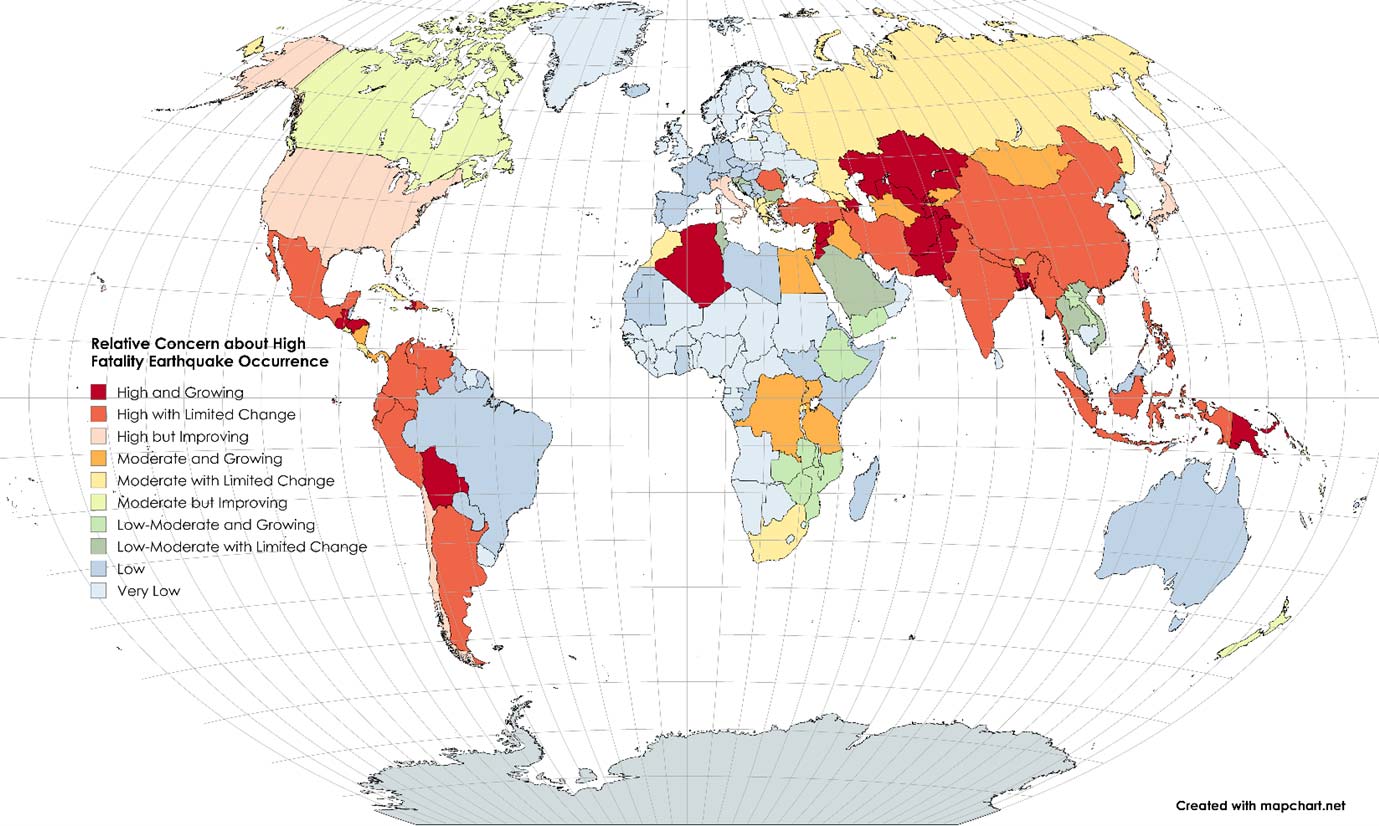
Source: Klusak, Patrycja, Matthew Agarwala, Matt Burke, Moritz Kraemer, and Kamiar Mohaddes. 2023. “Rising Temperatures, Falling Ratings: The Effect of Climate Change on Sovereign Creditworthiness.” Management Science 69 (12): 7468–91. https://doi.org/10.1287/mnsc.2023.4869.
The designations employed and the presentation of material on this map do not imply the expression of any opinion whatsoever on the part of the Secretariat of the United Nations concerning the legal status of any country, territory, city or area or of its authorities, or concerning the delimitation of its frontiers or boundaries.
Future earthquake risk
Making sound investments to build resilience is highly effective in countering seismic risk. But in key sectors such as infrastructure this is still not happening enough, meaning more people and assets are being left in harm’s way.
The Dominican Republic in 2015 had a baseline average annual loss figure of 1.55 deaths per 100,000 habitants from earthquakes. According to analysis by the Global Earthquake Model (GEM) team, without stepped up risk reduction action, this is projected to increase to 1.69 deaths per 100,000 people by 2030 and 1.82 deaths per 100,000 people by 2050, mainly due to demographic growth, urbanization and policy choices. While the Dominican Republic has already invested in developing strong seismic codes, it faces challenges in enforcing them and in retrofitting existing housing stock. However, these future impacts could be significantly reduced with stepped-up action on seismic risk management.
Solutions vary across locations, but in this case, code enforcement was identified as the most effective long-term mitigation action at the national level: with this option, the number of deaths could fall to 1.40 fatalities per 100,000 habitants by 2030 (a drop of 17 percent, compared to no action being taken) and 1.33 by 2050 (a reduction of 26 percent). However, a retrofitting campaign, would also have significant impact, leading to a 4 percent reduction compared to the baseline scenario by 2030 and a 7 percent reduction by 2050. The investment would be particularly effective in rapidly growing cities with high concentrations of informal construction, such as Santiago de los Caballeros and Puerto Plata.
Across the whole of Central America, the same opportunities to reduce seismic risk are evident. Without increased investment in seismic resilience, earthquake-induced economic losses across Central America are projected to double by 2050, reaching up to USD 4.4 billion. If code enforcement, building quality and urban planning remain inadequate, seismic risk is expected to rise significantly in the years to come, especially in El Salvador, Guatemala and Honduras. On the other hand, countries such as Panama and Costa Rica are expected to see lower increases in risk, as they have already begun enforcing building codes and have lower population growth projections.
If all of the countries across the Central America committed to ensuring that all new buildings complied with seismic safety standards, preliminary estimates suggest that around USD 1.1 billion in annual losses could be averted. Choosing now to build safer cities is not only cost-effective: it would also deliver immense benefits for future generations.
The technological know-how to implement both retrofitting and code enforcement is already available: it just needs to be applied. Model-based probabilistic analysis, like the study above, is evolving quickly and offers powerful tools to reduce risk. Advanced analytics can already identify which building classes are most exposed to losses and evaluate to what extent their vulnerability would decrease if they were retrofitted, considering factors such as their construction material. Such risk mapping, if used effectively, can serve as a blueprint for where to invest most effectively to reduce deaths and economic losses.
These findings have global implications, particularly against a backdrop of continued urbanization, as approximately 1.2 billion people are expected to be living in cities by 2050 compared to 2020. This growth will be heavily concentrated in the Global South, where 98% of this growth will occur. Ensuring these new buildings are safely situated and adequately constructed could potentially save lives while also safeguarding sustainable development, particularly in rapidly urbanizing locations.
GAR 2025 Hazard explorations
For the big five major hazard groups (earthquakes, floods, storms, drought and heat) the recorded direct economic costs came to over USD 195.7 billion in 2023, constituting 0.015% of global GDP that year.
Earthquakes account for over a quarter (25.6%) of global economic disaster losses.

Recent data suggests that floods account for up to 35–40% of weather-related disaster occurrences.

In some regions, storms account for up to 35% of total recorded disaster costs, driven by high winds, storm surges, and heavy rainfall.

Droughts often unfold slowly, but with far-reaching impacts on agriculture, water supplies, and economic stability.

In recent years, extreme heat has become the leading cause of reported weather-related deaths
.