
Play and learn to stop disasters
Play and learn to stop disasters
Build your risk knowledge. Make better decisions. Reduce disaster risk.
Discover the game
The STOP DISASTERS game helps adults and children understand how disaster risk is shaped by human choices.
Through play, users explore how decisions about where people live, how buildings are constructed, how ecosystems are protected, and how communities prepare influence what happens when a hazard strikes. Players see first-hand how early warning systems, evacuation planning, education, and risk-informed land use can significantly reduce losses.
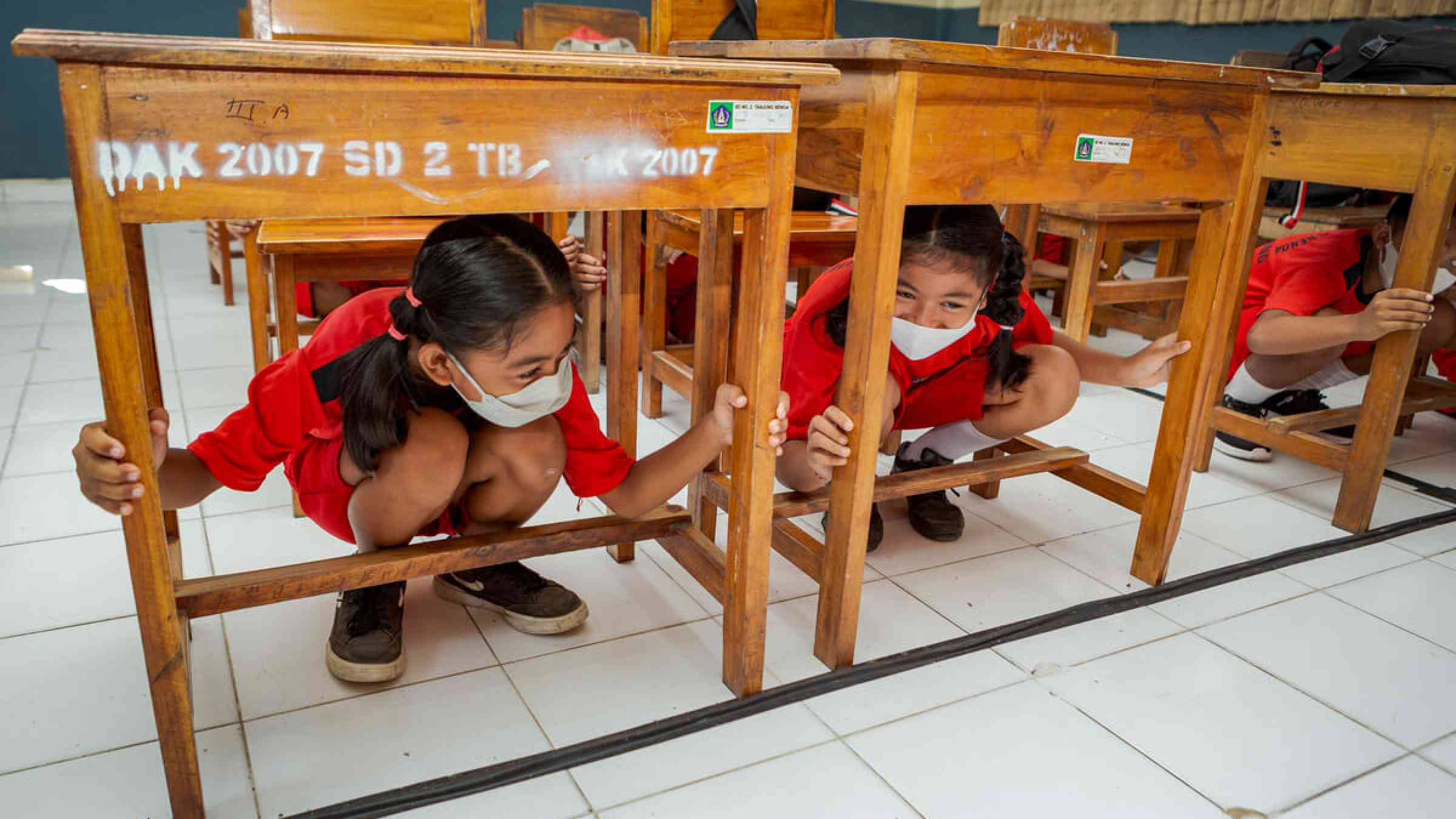
STOP DISASTERS is suitable for learners aged 9–17, as well as for academic, professional, and informal learning environments. It can be used in classrooms, trainings, workshops, and community settings to make disaster risk reduction practical, engaging, and accessible.
Players who successfully complete a scenario can download a certificate of completion.
Interested in using or contributing to the game?
The STOP DISASTERS game is used worldwide by educators, trainers, institutions, and communities. If you’re interested in using the game in your work — or contributing through translation or collaboration — you can learn more in the Get involved section below.
Are you a teacher or an educator? Discover the teacher's package. You will find guidance, key messages, and lesson plans to support resilient teaching.
Play the game in your language
The game has already been localised into more than 15 languages through the kind support of partners and volunteers.
If you want to translate the game into a new language, please get in touch with us.
New to Stop Disasters game?
Before you start playing, take a moment to explore the full “How to play” guide.
It walks you step by step through your mission, explains how risk levels work, how the advisor supports your decisions, and how your choices affect the community when the disaster strikes.
The guide also helps you understand the logic behind building, mitigating, and planning across different scenarios, so you can get the most out of the game and focus on what really matters: reducing risk before disaster happens.
If you tried the tsunami scenario you may wish to view the earthquake scenario walkthrough.
Learning impact and outcomes
STOP DISASTERS is more than a game — it is a strategic learning experience with real-world relevance.
Players are challenged to make decisions under pressure, balancing limited resources while protecting people, infrastructure, and essential services. The game encourages critical thinking, systems thinking, and an understanding of the trade-offs involved in disaster risk management.
A 2014 study with elementary school students showed that nearly all participants understood what a risk map is after playing the game, and most expressed a desire to replay in order to improve their results.
What players gain is not only skills, but a shift in how they think about disasters.
"The game made me realise that disaster preparedness isn’t just about strategy —
it’s about empathy, awareness, and protecting the lives behind every building and plan."
from the game survey
From natural hazards to disaster risk
Earthquakes, floods, wildfires, and cyclones are natural hazards.
Disasters occur when people, infrastructure, and systems are exposed and vulnerable.
STOP DISASTERS helps break the cycle of disaster → response → recovery → repeat by shifting the focus to risk reduction before disaster strikes. Players learn that careful planning, coordinated action, and long-term investment can reduce vulnerability and limit the need for costly emergency response.
This reinforces a key principle of disaster risk reduction:
there is no such thing as a “natural disaster.”
Understanding this shift is essential — but learning how to apply it requires more than theory alone.
Why an online game on disaster risk reduction?
Understanding disaster risk is not only about knowing facts — it is about making decisions under uncertainty, balancing competing priorities, and seeing how choices made today shape outcomes tomorrow. An online game allows people to experiment safely with these challenges, testing decisions and seeing consequences without real-world harm.
By simulating real-world constraints such as limited time, limited budgets, and competing priorities, STOP DISASTERS helps learners understand how disaster risk reduction works in practice — not just in principle.
At UNDRR, we envision a world where disasters no longer threaten the well-being of people and the future of the planet. Strengthening risk awareness and preparedness at all levels — from classrooms and communities to institutions and governments — is essential to achieving the 2030 Agenda for Sustainable Development and building long term resilience.
The game was originally developed as part of the 2006–2007 World Disaster Reduction Campaign, “Disaster Risk Reduction Begins at School,” and continues to support education and capacity-building efforts worldwide.
If you would like to be part of this effort, there are several ways to engage.
Get involved
We welcome interest in contributing to the STOP DISASTERS game.
You can get involved by:
- Helping translate the game into new languages;
- Using the game in classrooms, trainings, or community activities;
- Sharing feedback to improve future versions;
- Supporting outreach in disaster-prone regions;
By contributing, you help expand access to disaster risk reduction education and support the development of more resilient communities worldwide.
Contact us to start the conversation or learn more.
Related content



Game credits
Many experts and organisations participated in the contents and the making of this game. UNDRR secretariat would like to thank particularly:
- Ana Trehoan, expert on education.
- Charles Kelly, Disaster Management Expert for the flood and hurricane scenario.
- Johann G. Goldammer, from the Global Fire Monitoring Center (GFMC),
Fire Ecology Research Group, Freiburg University / United Nations University (UNU) Freiburg GERMANY for the wildfire scenario - Scott Kiser, and Dennis Feltgen, National Weather Service, Tropical Cyclone Program Leader for the hurricane scenario
- Laura S. L. Kong, Director, UNESCO/IOC International Tsunami Information Centre, Honolulu, for the tsunami scenario
- Melanie Ashby, from the Emergency Management Australia
for the wildfire scenario and the pilot testing - Terry Jeggle and many other UNDRR colleagues for their constant help, support and useful remarks
- Many organizations, which supported the initiative from the beginning such as:
- M. Rimjhim from Southern Eastern Efforts Developing Sustainable Spaces, India
- The International Federation of Red cross and Red Crescent Societies
Action Aid, - The United States Agency for International Development ,
- The United Nations Educational, Scientific and Cultural Organisation,
- The Center for Research on the Epidemiology of Disasters,
- Jacques Faye, from the French Ministry of Ecology and sustainable development
- With thanks to the following people for the use of their photographs: Kevin Conners, Michelle Kwajafa, Carlos and Leah.
- And last but not least Playerthree, in particular Pete Everett and David Streek.
The game was initially released in March 2007 and received a technical refresh in 2019 and May 2024.