
Urban Risk to Resilience Analytics

From Building Blind to Building Resilience
The urbanisation of risk
The United Nations World Urbanization Prospects 2025 report points to future growth being overwhelmingly urban. Whereas 20% of the population was urban in 1950, the figure now stands at 45%, or 3.5 billion people: more than double in both share and absolute terms.1
Cities are becoming larger and more numerous, particularly in Asia and Africa. In the mid-seventies, there were only 8 megacities. This figure soared to 33 in 2025. While these rapidly urbanising regions are the world's primary centres for innovation and investment, they also concentrate assets and infrastructure in hazard-prone areas.
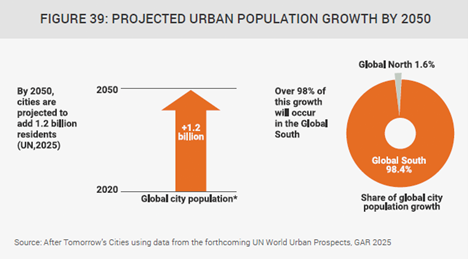
The economic and social impacts of disasters are increasingly concentrated in urban centres, where assets and infrastructure are at their most dense. The UN Global Assessment Report 2025 says that while hazard events are growing in frequency and intensity, the surge in direct disaster losses—which averaged US$ 180–200 billion annually between 2001 and 2020—is also driven by rapid urbanisation.2 As population and infrastructure density increase, so too does the volume of value exposed to risk, effectively "locking in" higher potential costs for every major event.3 Projections say that by 2050, 1.2 billion more residents will live in cities, while over 98% of this growth will occur in the Global South.
From hindsight to foresight
Modern technology and advances in multi-hazard modelling capabilities are now enabling a better understanding of these complex urban environments. Hazard, risk and resilience modelling is rapidly improving, with capability enhancement being accelerated by increased computational power and artificial intelligence tools. While traditional urban planning often treated urban hazards in isolation, advanced analytical tools now allow us to map cities as interconnected systems. This enables planners to better identify strategic intervention points where a single resilience investment can safeguard multiple critical networks—such as power, transit, and water—against cascading failures.
By analysing how projected hazard trends interact with each other and with future exposure, vulnerability, and building footprints, planners can better estimate future potential urban disaster loss hotspots before disasters occur. Equally important, they can also better evaluate options for reducing this risk so that infrastructure is protected, and disaster-related shocks are avoided.
This transformation of analytics capabilities comes just in time. Not only are cities being created more quickly than ever before, but there is a growing scientific consensus that assessing historical disaster losses and impacts is no longer sufficient to understand our changing global hazard landscape. New systems build on vital historical loss data, but combine it with forward-looking risk analysis to help address a dangerous blind spot: prioritising locations where damage has already occurred while overlooking emerging areas where risk is projected to grow. Relying on the rearview mirror of past events fails to account for the shifting realities of a changing climate and wider development trends.
Retraining the Invisible Hand
The "invisible hand"4 of the financial markets continues to misprice urban climate risk, largely because it relies on short-term backward-looking data and incomplete information. This creates a structural misalignment: short-term savings from lower upfront investment are prioritised, while long-term risks remain unaccounted for.
The result is a cycle in which underinvestment in resilience today leads to higher fiscal and economic costs in the future.
Forward-looking risk and resilience analytics provide a means to correct this imbalance. By quantifying both expected losses and the benefits of specific interventions, they enable risk to be priced more accurately and consistently. In doing so, they help "retrain" market behaviour so that resilience is not treated as an optional add-on, but as a core determinant of asset value and economic stability. It helps urban investment go where it needs to now to protect jobs and essential services, but it also makes sure that big-ticket infrastructure is fit for purpose for the long term.
At a practical level, these analytics act as a compass for capital, allowing decision-makers to align financing with actual risk conditions. This has several implications.
First, it enables more targeted allocation of finance. Rather than applying generic solutions, cities can direct specific instruments—such as resilience bonds, green credit lines, or blended finance—toward the most vulnerable assets and urban nodes. This increases the effectiveness of each unit of investment.
Second, it helps avoid the creation of stranded assets. Infrastructure designed without accounting for future climate conditions risks becoming uninsurable, unfinanceable, or non-operational well before the end of its intended lifecycle. By embedding forward-looking risk into project design, cities can ensure that assets, and the communities they support, remain viable over 30–50 years.
Third, it supports macroeconomic stability. Climate shocks can trigger sudden increases in public expenditure, disrupt economic output, and lead to spikes in debt-to-GDP ratios. By reducing the likelihood and severity of these shocks, resilience investments help protect national creditworthiness and fiscal balance. Cities such as Mumbai and São Paulo function as critical engines of national and regional economies. In such contexts, resilience is not only a local concern, but a matter of broader economic security. When risk is properly understood and priced, capital flows more naturally toward investments that protect productivity, trade, and labour markets.
The tools now exist to calculate the costs of inaction in the face of more frequent and intense future hazards in an increasing risk world. Decision-makers no longer operate in a fog of uncertainty; the contrast between paths is stark and quantifiable. The cost of inaction results in compounding financial losses, crippling debt, and social instability. Conversely, the value of action is measured in sustained growth, investor confidence, and protected lives. Overall, the report makes clear:
- Forward-looking climate risk analysis makes it possible to identify where resilience investments can have the greatest impact. By analysing damage risk to buildings and infrastructure at an approximate one-square-kilometre scale, this report highlights priority locations in each city where targeted action can help safeguard essential services and economic activity.
- With the right information and targeted investment, cities can safeguard development gains while continuing to grow. The approach demonstrated in this report shows how forward-looking risk analysis can help cities prioritise resilience actions that protect infrastructure, support economic stability and strengthen long-term urban resilience.
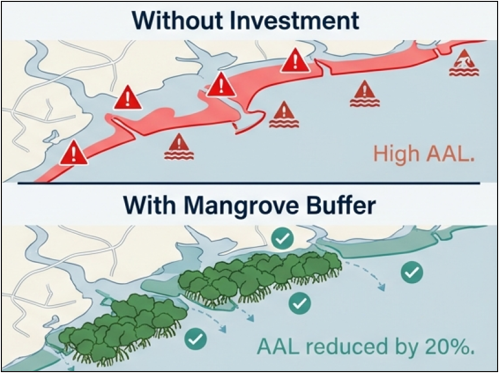
- Strengthening infrastructure resilience could substantially reduce future losses. XDI modelling indicates that improved resilience measures could significantly reduce projected property damage, saving hundreds of millions of US$ in damage costs in each city.
- Climate and disaster risk hotspots can now be identified before major losses occur. The analysis highlights areas which carry high risk of damage, today and/or into the future, even if they have not yet experienced a severe weather event. This enables cities to act proactively rather than reactively.
- Protecting critical infrastructure can help maintain essential services during extreme events. An analysis of hospitals and key public assets in each city creates opportunities to improve critical infrastructure resilience.
- Resilience investments can also deliver social benefits. Many areas facing elevated climate risk also contain dense populations and vulnerable communities, meaning targeted resilience measures can help protect livelihoods and reduce disruption to everyday life.
- Climate risk is increasing over time—but the trajectory can be changed by reducing carbon emissions and investing in disaster prevention and resilience.
The Risk and Resilience Metrics Facility is committed to working with partners to help take the next generation of urban analytics to a global scale at high granularity and lower cost. Working with leading providers of risk information, city networks and other stakeholders, the metrics framework is being tested as a way of allowing cities across the globe to better understand their risk and to signpost the way to a resilient future.
References
1. United Nations, Department of Economic and Social Affairs, Population Division (2025). World Urbanization Prospects 2025: Summary of Results. New York: United Nations, p. 5. https://population.un.org/wup/
2. UNDRR (2025). Global Assessment Report on Disaster Risk Reduction (GAR) 2025: Resilience Pays: Financing and Investing for Our Future. Geneva: United Nations, p. xi. https://www.undrr.org/gar/gar2025
3. UNDRR (2025). Global Assessment Report on Disaster Risk Reduction 2025: Summary for Policymakers. p. 1.
4. The "invisible hand" is a metaphor introduced by Adam Smith in The Wealth of Nations (1776), describing how the self-interested actions of individuals in a free market can lead to beneficial social and economic outcomes for society as a whole.