Disaster resilience of small- and medium-sized enterprises (SMEs)
Small- and Medium-sized Enterprises (SMEs) are the backbone of our economies. They create jobs, support livelihoods, and sustain local supply chains. Yet, when disasters strike, SMEs are often hit harder, suffer longer, and are slower to recover than larger businesses. Many never reopen after a disaster.
The Sendai Framework for Disaster Risk Reduction calls for the integration of disaster risk management, including business continuity, into business models and practices. It emphasizes disaster-risk-informed investments, particularly for micro, small and medium-sized enterprises.
Furthermore, the UNDRR Strategic Framework for 2026-2030 recognizes the vital role of resilient MSMEs in poverty reduction and highlights the broader importance of resilient businesses and supply chains for sustainable development.
The call to action is clear
To safeguard livelihoods and local economies, action must be taken to build disaster resilience at the enterprise level:
- Integrate risk management: Embed disaster risk management and business continuity directly into business models and daily practices.
- Make risk-informed decisions: Base planning and investments on a clear understanding of disaster risks and the measures needed to reduce them.
- Shift the mindset: View resilience not as a business cost, but as a critical investment in long-term sustainability and competitiveness
What we do
This is why UNDRR is committed to advancing resilience thinking throughout the private sector - across regions, sectors and business sizes. By engaging both public and private stakeholders, UNDRR is strengthening the capacity of SMEs to plan, invest, and make decisions based on a clear understanding of risk and the possible measures to reduce it.
- Providing actionable guidance and resources
Providing actionable guidance and resources
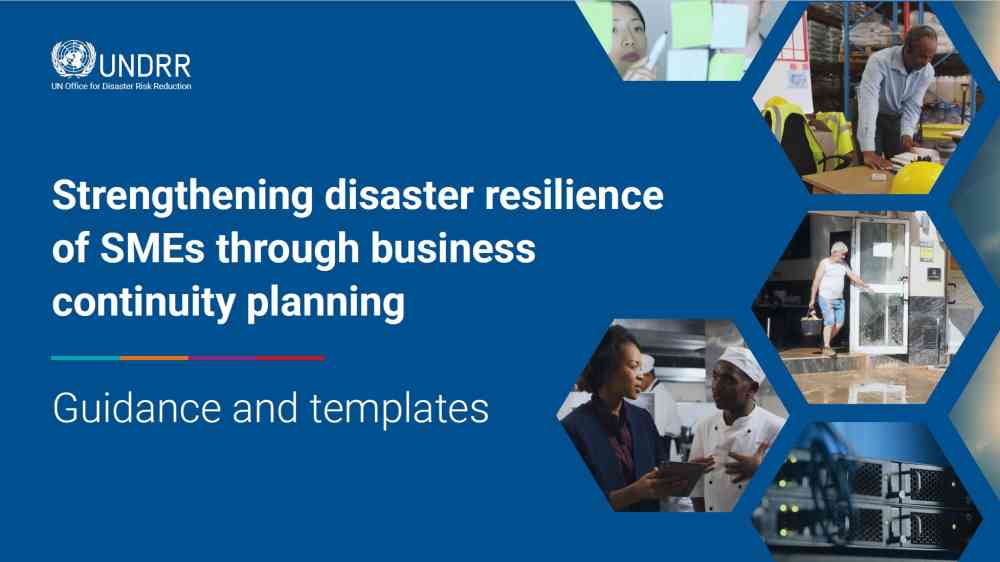
Together with partners, UNDRR has developed practical guidance and tools to help SMEs implement effective business continuity measures, but also resources that offer actionable recommendations for municipalities and business support organizations on delivering appropriate technical assistance.
- Capacity-building through accessible training
Capacity-building through accessible training
Recognizing that guidance and tools may not be sufficient to build SME confidence in applying them, UNDRR has developed short and accessible training videos on business continuity to support their learning.
What happens to a business when a disaster strikes?
This introductory video frames business continuity planning in the broader resilience context, explaining how resilient businesses anticipate risks, absorb shocks, adapt to change, and recover faster.
Business continuity planning for SMEs: How to prepare for disasters | Training
This training video explains business continuity planning (BCP) and how it helps small and medium enterprises (SMEs) keep operating, protect employees, and recover faster during disasters such as floods, storms, earthquakes, or cyberattacks.
You’ll learn:
- What business continuity planning is and why it matters
- How a BCP helps businesses absorb shocks and reduce downtime
- Why BCPs are cost-effective and practical for SMEs
- How to identify key risks, critical activities, and business lifelines
- How to plan for response, recovery, and “build back better”
- Why communication, testing, and regular updates are essential
- Fostering peer to peer learning and impact
Fostering peer to peer learning and impact
Recognizing the power of learning from peers, UNDRR has captured SME voices and testimonials from other partners who see resilience not as a cost, but as an investment to long-term sustainability and competitiveness.
Stories about SME experience in building resilience:
Building disaster resilience in Barbados' tourism sector: Lessons from Atlantis Submarines
From insight to action: Strengthening business resilience at Malcolm Investment Holdings