
Managing water-related disasters and risks for resilient futures
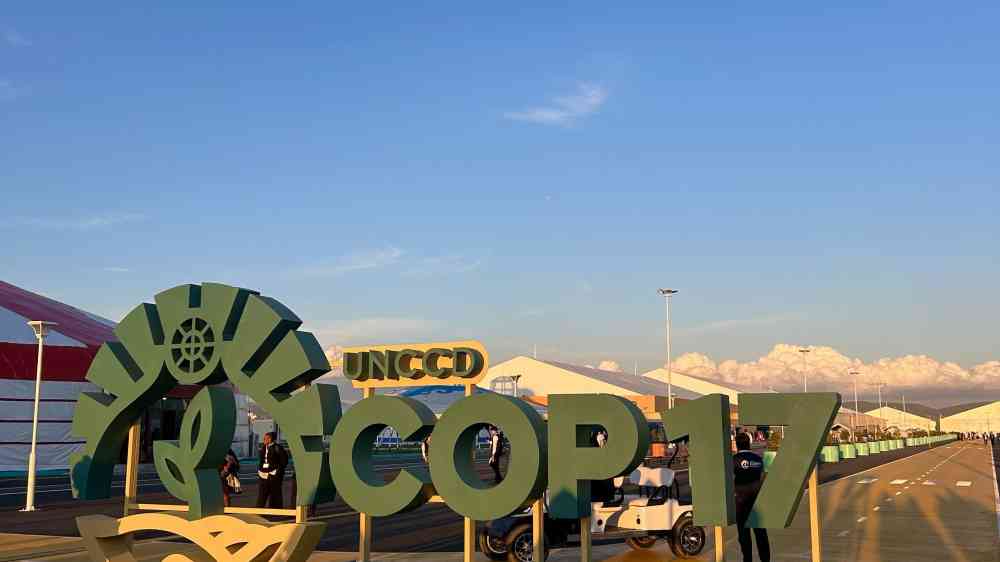
Ulaanbaatar, 25 August 2026 | Droughts and floods may appear to be opposite extremes, but they are often part of the same risk landscape. As climate change intensifies water-related hazards around the world, governments and communities increasingly need integrated approaches that connect disaster risk data, early warning systems and long-term planning. The need to understand and manage these risks in an integrated, evidence-based way—across time horizons and institutional boundaries—was the central message of the UNDRR Water Day side event, “Managing water-related disasters and risks for resilient futures,” held during the 17th session of the Conference of the Parties to the United Nations Convention to Combat Desertification (UNCCD COP17) in Ulaanbaatar, Mongolia.
The event brought together government, parliamentary, scientific, regional and development-cooperation perspectives to examine how disaster data can strengthen water resilience. Moderated by Animesh Kumar, Head of the UNDRR Bonn Office, the discussion connected lessons from past losses with present-day vulnerabilities and future risk, while keeping implementation and investment firmly in view.
Interconnected water risks require strong institutions
Opening the event, H.E. Munkhtamir Batbayar, Vice Minister of Environment and Climate Change of Mongolia, underscored how quickly climate, land and water pressures can compound. The country's average annual temperature has risen by approximately 2.5°C over the past 80 years, while drought risk has intensified across nearly the entire country. The 2023-2024 dzud, a severe winter disaster often following drought, resulted in the loss of more than 8.1 million livestock and demonstrated how climate extremes can trigger cascading impacts across livelihoods, food security, ecosystems and the economy.
H.E. Amira Saber, Member of the Egyptian Senate and Secretary General of the Human Rights and Social Solidarity Committee, used examples from across the Arab region to show why drought and floods cannot be understood in isolation. Recalling Morocco's transition from seven years of drought to severe flooding within weeks, she pointed to the way dry soils, degraded vegetation and reduced catchment capacity can amplify runoff when rain returns.
Her keynote also highlighted the governance dimension of water risk: laws, public budgets, parliamentary oversight, monitoring systems and cooperation across shared river basins determine whether knowledge is converted into preparedness. Risk intelligence is therefore not only a technical exercise. It depends on institutions that can sustain monitoring, disclose information, act on warnings and remain accountable over time.
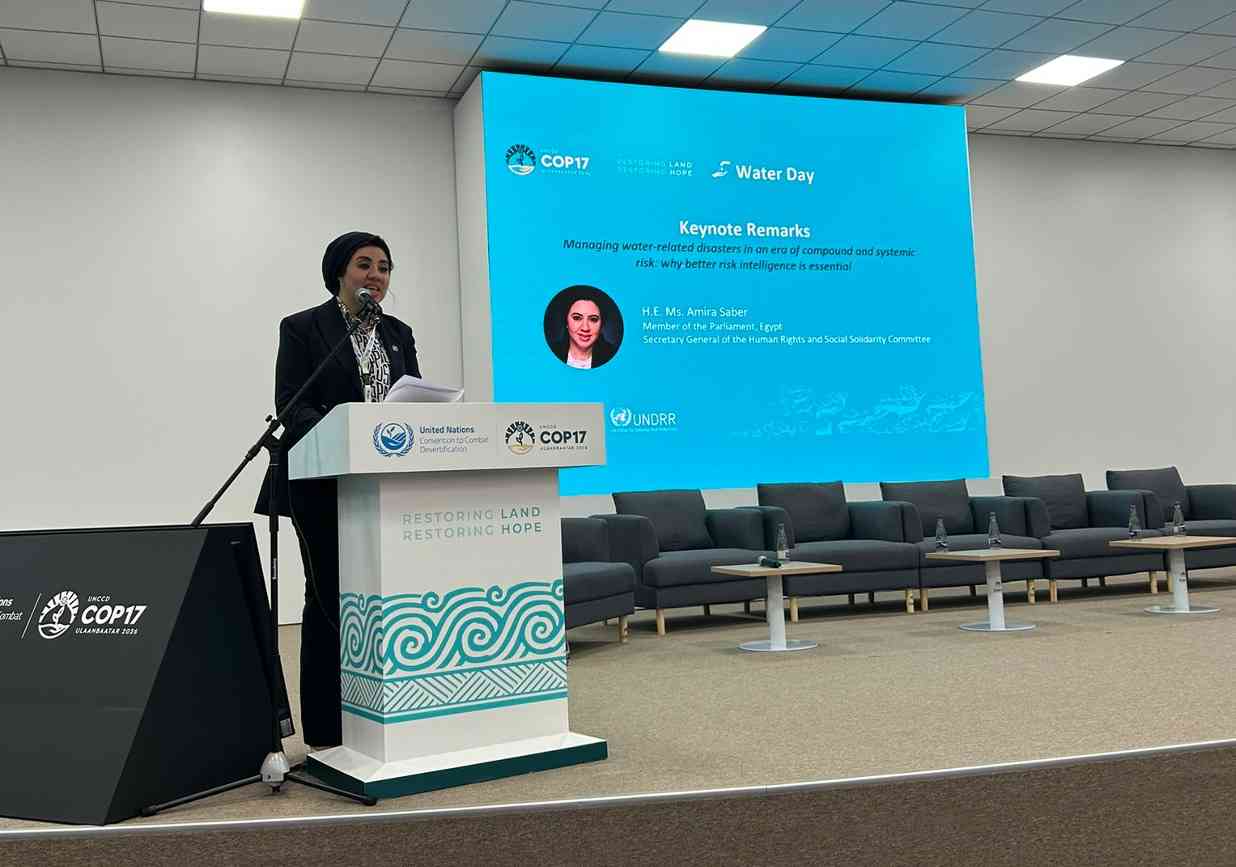
"Families in Kafr El-Sheikh have now been through storm seasons without flooding for the first time in decades. The building part was simple. Knowing where to build was the hard part.” H.E. Amira Saber, Member of the Egyptian Senate
Data as the foundation for risk-informed decision-making
Setting the scene, Animesh Kumar highlighted the scale of disaster impacts and the need for a more integrated understanding of risk across temporal and spatial scales. UNDRR is, hence, strengthening the evolving disaster data ecosystem that connects monitoring of progress in implementing the Sendai Framework with the tracking of disaster impacts. The Sendai Framework Monitor generates official statistics in 176 countries, while 113 countries have established national loss and damage databases.
Building on this legacy, UNDRR, UN Development Programme and World Meteorological Organization (WMO) have jointly developed DELTA Resilience, that combines common data standards, technical support, capacity development and open-source tools to help countries build nationally owned disaster-loss tracking systems and translate risk information into action.
The scene-setting emphasized that building resilience to water-related risks and disasters requires a more integrated understanding of risk across temporal and spatial scales: learning from historical losses and damage; understanding present impacts, vulnerabilities and resilience; and anticipating future risks. Connecting these perspectives can help decision-makers understand how risk is evolving, identify who and what is exposed, and compare policy and investment choices before losses occur.
From Uganda's national experience, Catherine Ahimbisibwe, Assistant Commissioner and Principal Disaster Management Officer in the Office of the Prime Minister, guided the discussion on how a robust country-owned disaster-risk data ecosystem, including forecasts and impact assessments, can support evidence-based preparedness measures at national and subnational level. At the continental level, Jihane El Gaouzi, Head of the Sustainable Environment Division and Acting Head of the Blue Economy Division at the African Union Commission, stressed the countries’ need for dynamic drought risk information capturing the interaction between climate variability and socioeconomic vulnerability—and for a shift from treating risk information as a product to using it as an input into planning and action. Connecting hydrological and climate information with standardized event and impact data is essential.
Valentin Aich, Senior Water and Climate Specialist at WMO, emphasized the need for consistent standards for observations, impact recording and post-event analysis. Of 35 national roadmaps reviewed under the Early Warnings for All initiative, 33 identified floods and 29 identified drought as priority hazards—alongside a much wider set of interconnected threats. Connecting hydrological and climate information with standardized event and impact data is essential to understanding the complete risk picture and improving warning services.
Speakers agreed that reliable and interoperable data systems are fundamental for understanding evolving water risks. Integrating climate, hydrological and impact data, including through disaster tracking systems like DELTA Resilience, can help governments identify vulnerabilities, strengthen early warning systems and target investments where they will have the greatest resilience benefits.

Anticipating future risk and directing investment
Risk is not static. Climate change, land degradation, biodiversity loss, urbanization and socioeconomic change are altering both hazards and exposure. Andrea Toreti, Senior Scientist at the European Commission’s Joint Research Centre, stressed the need for novel assessment and foresight tools capable of capturing these shifts, including high-impact, low-likelihood events. Such tools must also account for how the impacts of droughts and floods can build upon and compound one another, generating cascading consequences for financial systems. Integrating these dynamics into risk and resilience metrics is essential to inform forward-looking policy, planning and investment decisions.
The panel also examined what it takes for risk information to influence development planning at scale. Marco Riccardo Rusconi, Director of the Italian Agency for Development Cooperation (AICS), illustrated how international cooperation can help bridge the gap between risk knowledge and implementation. Through a €17 million contribution, Italy is supporting the Africa Multi-Hazard Early Warning and Early Action System (AMHEWAS), led by the African Union Commission in partnership with UNDRR and the CIMA Foundation. The programme has supported a network of continental, regional and national situation rooms that bring together information on hazards, exposure and vulnerability to enable impact-based decision-making and early action. The situation room established in Tanzania has also provided a model for replication in other African countries through South–South cooperation.
Resilience is not built through better forecasts alone. It is built when risk information becomes a routine and trusted part of planning, financing, and investment decisions. That is how we move from understanding risk to reducing it—and from managing disasters to managing risk.” Dr. Marco Riccardo Rusconi, Director of the Italian Agency for Development Cooperation (AICS)
The exchange with the audience reinforced the practical focus of the discussion. Representatives from the Italian Civil Protection Department and Mongolia's National Emergency Management Agency discussed approaches to data validation and good practices for water-related risk reduction measures.
Across these perspectives, a common implementation sequence emerged: identify gaps systematically; strengthen the underlying observations and data; transform information into decision-ready evidence; direct finance towards the most consequential risks; and evaluate whether interventions and warning services are working. This creates a feedback loop through which new data and lessons from implementation strengthen preparedness and inform future planning and investment.
Bringing infrastructure and Nature together
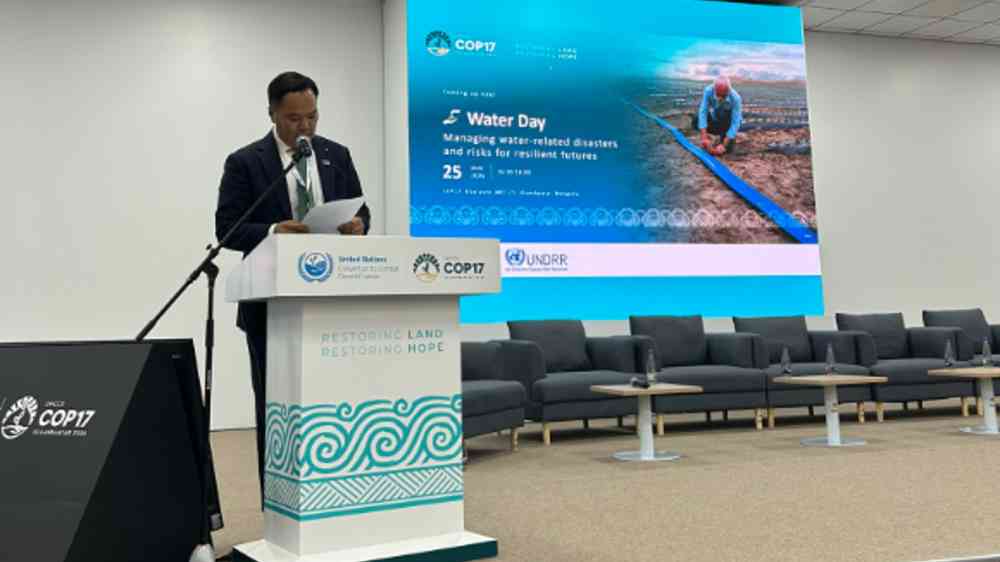
The event also marked the official launch of the Nature-based Solutions for Sustainable Infrastructure Initiative (NbS4SII) by Vice Minister Batbayar. The initiative advances an integrated approach in which hard, soft, digital and natural infrastructure reinforce one another from the outset.
Reservoirs, drainage and irrigation systems, protective structures, and resilient public facilities remain essential. So do capable institutions, clear regulations, risk financing, early-warning systems, community preparedness, interoperable data platforms and responsible AI-enabled decision support. Natural infrastructure—including forests, grasslands, wetlands, watersheds and healthy soils—complements these systems by regulating water, reducing flood peaks, improving groundwater recharge, limiting erosion, conserving biodiversity and supporting livelihoods.
“Intelligence must lead to implementation.” H.E. Mr. Munkhtamir Batbayar, Vice Minister of Environment and Climate Change, Mongolia
A shared agenda for resilient futures
Animesh Kumar distilled the pathway from risk knowledge to implementation in a simple concluding message: “Data drives decision, and decision drives action.” The priority is now to strengthen this chain.
The discussion at UNCCD COP17 showed that managing water-related disasters requires more than isolated forecasts. It requires an integrated approach that recognizes the connections among land, water, climate and development; links lessons from historical losses with present-day monitoring and future risk scenarios; aligns science, policy and finance; and combines national action with transboundary cooperation.
As climate change intensifies both droughts and floods, the challenge is no longer simply to respond to disasters. It is to understand risk before crises occur and use that knowledge to shape development choices. The discussion at UNCCD COP17 highlighted a shared commitment to turning risk intelligence into practical action for more resilient and sustainable futures. These messages and commitments were also echoed across all substantive events with UNDRR’s engagement at the COP.