
G20 DRR Working Group convenes in South Africa to advance global resilience financing
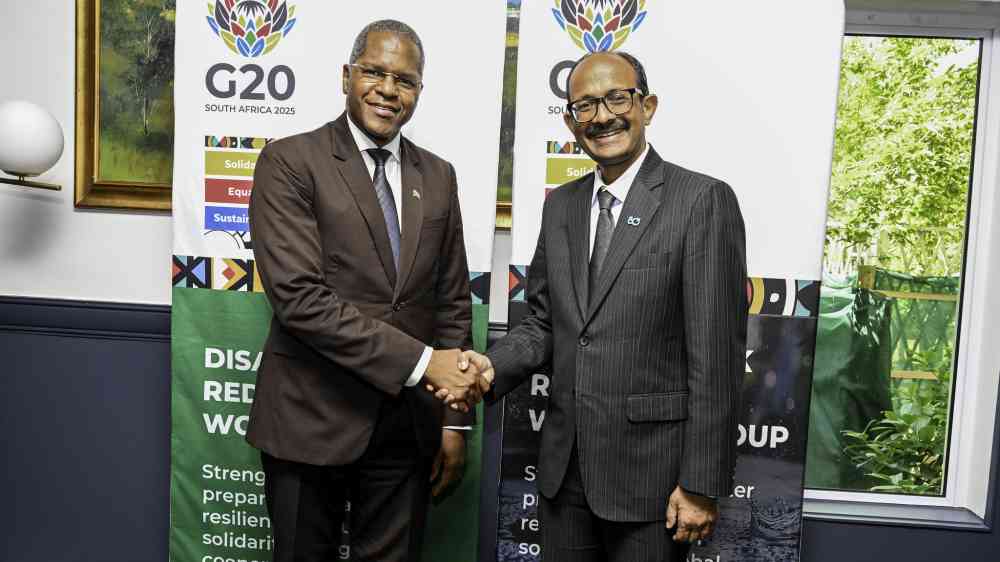
The Hon. Velenkosini Hlabisa, Minister of Cooperative Governance and Traditional Affairs (CoGTA), who presided over the G20 Disaster Risk Reduction Working Group Ministers' Meetings, with SRSG Kamal Kishore.
Under the South African Presidency, the G20 Disaster Risk Reduction (DRR) Working Group held a two-part meeting in Cape Town, South Africa, culminating in a Ministerial Meeting on the International Day for Disaster Risk Reduction (IDDRR).
The meeting began with a technical segment from 8-11 October, where experts and officials from G20 member states and invited partners negotiated outcomes, conducted site visits and discussed strategies to scale up investment in disaster risk reduction. This was followed by a ministerial segment from 12-13 October, where Ministers gathered to share national experiences and endorse key outcomes aimed at strengthening global resilience.
Key outcomes
The meeting concluded with three major outcomes that signal a strengthened global commitment to investing in resilience and preparedness.
First, G20 Ministers adopted a Ministerial Declaration reaffirming their shared resolve to reduce disaster risk and promote sustainable development through enhanced investment and international cooperation. Recognizing the escalating human and economic costs of disasters, the Declaration called for stronger national and global action and cooperation in disaster risk reduction, especially around expanding early warning systems, promoting resilient infrastructure, and scaling up nature-based solutions.
Kamal Kishore, Special Representative of the UN Secretary-General for Disaster Risk Reduction and the Head of UNDRR, which serves as the Secretariat of the Working Group,welcomed the adoption of the Declaration, saying the G20 Ministers "sent a clear and powerful signal: that building disaster resilience is critical to protecting lives, livelihoods and economic prosperity. "
Second, Ministers endorsed the Voluntary High-Level Principles for Investing in Disaster Risk Reduction, developed under the South African Presidency. The seven principles form a flexible framework that countries can adapt to their national contexts. They emphasize the importance of improving risk information and innovation, developing comprehensive financing strategies, integrating disaster risk into sectoral and budgetary planning, empowering local investment, arranging finance before shocks occur, engaging the private sector, and strengthening international cooperation. Together, they aim to shift disaster risk management from a reactive to a proactive approach-placing prevention and preparedness at the heart of policy and financial planning.
Finally, Ministers recognized the Recovery Readiness Assessment Framework as a valuable voluntary tool to support proactive, inclusive, and sustainable recovery planning. By emphasizing early readiness and inclusive processes, the framework helps countries strengthen their ability to build back better and reduce long-term vulnerability. The Priority Actions to Enhance Readiness for Resilient Recovery, launched at the World Resilient Recovery Conference, were also acknowledged as a Presidency Document underscoring the importance of preparing for recovery before disaster strikes. Ministers further encouraged continued international collaboration to expand investment in DRR and ensure that recovery efforts are timely, risk-informed, and equitable.
South Africa's Leadership and EW4All Roadmap
To mark the occasion, South Africa launched its Early Warnings for All (EW4All) Roadmap, contributing to the global goal of achieving universal early warning coverage by 2027. The roadmap underscores South Africa's commitment to innovation through the use of advanced technologies and data analytics, enabling more proactive and effective responses to environmental risks and disasters.
"The Early Warnings for All Roadmap represents a bold step towards a future where early warning systems are seamlessly integrated into disaster management practices," said Velenkosini Hlabisa, Minister of Cooperative Governance and Traditional Affairs.
The Ministerial Roundtable reaffirmed the G20 DRR Working Group as a cornerstone for sustained dialogue, shared learning, and long-term investment in resilience. To maintain momentum, the Ministers called on the incoming Troika to engage the support of UNDRR to review the progress achieved and identify potential areas for future collaboration.
As disasters grow in frequency and intensity, the G20's collective action on DRR financing charts a path forward-inclusive, proactive, and grounded in solidarity.