
Arab States strengthen fire-risk preparedness through real-time simulation and regional cooperation in Tunis
- Arabic
- English
As urbanization, industrial development and infrastructure expansion increase the complexity of fire risks across the Arab region, preventive planning and effective coordination among emergency services, infrastructure operators and public authorities have become essential to protecting lives, critical facilities and development gains. Fire risks in industrial and petroleum facilities can develop rapidly and require institutions to test their systems, clarify responsibilities and make coordinated decisions under significant operational pressure.
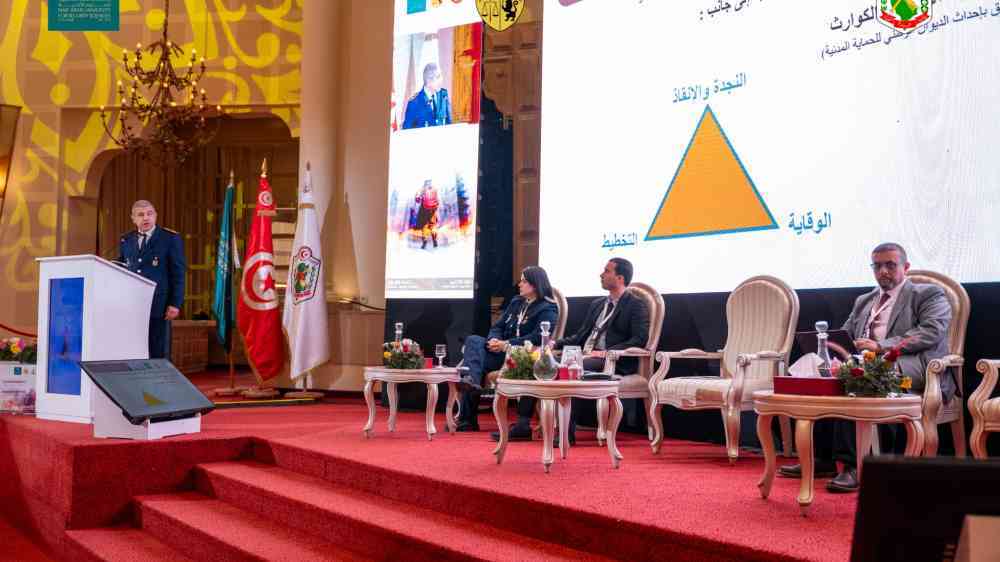
A regional workshop on preventive planning and the protection of facilities from fire risks was held in Tunisia from 6 to 8 April 2026. The workshop was organized by Naif Arab University for Security Sciences in collaboration with Tunisia’s civil-protection authorities and brought together representatives of ministries of interior, civil-protection agencies, infrastructure operators and technical institutions from across the Arab region. UNDRR ROAS contributed to the regional dialogue by promoting integrated, preventive and risk-informed approaches aligned with the Sendai Framework.
A central component of the programme was a large-scale simulated emergency, or “white operation,” at a high-risk petroleum facility in Radès. The exercise enabled participants to test inter-agency coordination, emergency-response procedures, preventive planning frameworks and real-time decision-making. It also helped identify institutional and operational gaps that could affect preparedness and response during an actual emergency. Technical sessions addressed the use of artificial intelligence and predictive tools, engineering standards, business-continuity planning, risk-assessment methodologies and smart systems for the early detection and monitoring of fires.
The workshop emphasized that technology alone cannot ensure effective fire-risk management. Participants highlighted the need for strong institutional coordination, trained personnel, compliance with safety standards, continuous learning from past incidents and greater awareness among public and private stakeholders. The regional exchange encouraged countries to expand preventive planning, strengthen cross-sector cooperation and scale up innovative tools for protecting critical infrastructure. By combining technical knowledge with real-world simulation, the workshop supported a shift from reactive emergency response towards proactive risk prevention and preparedness across the Arab States.