1. Home
  2. Our work
Capacitación
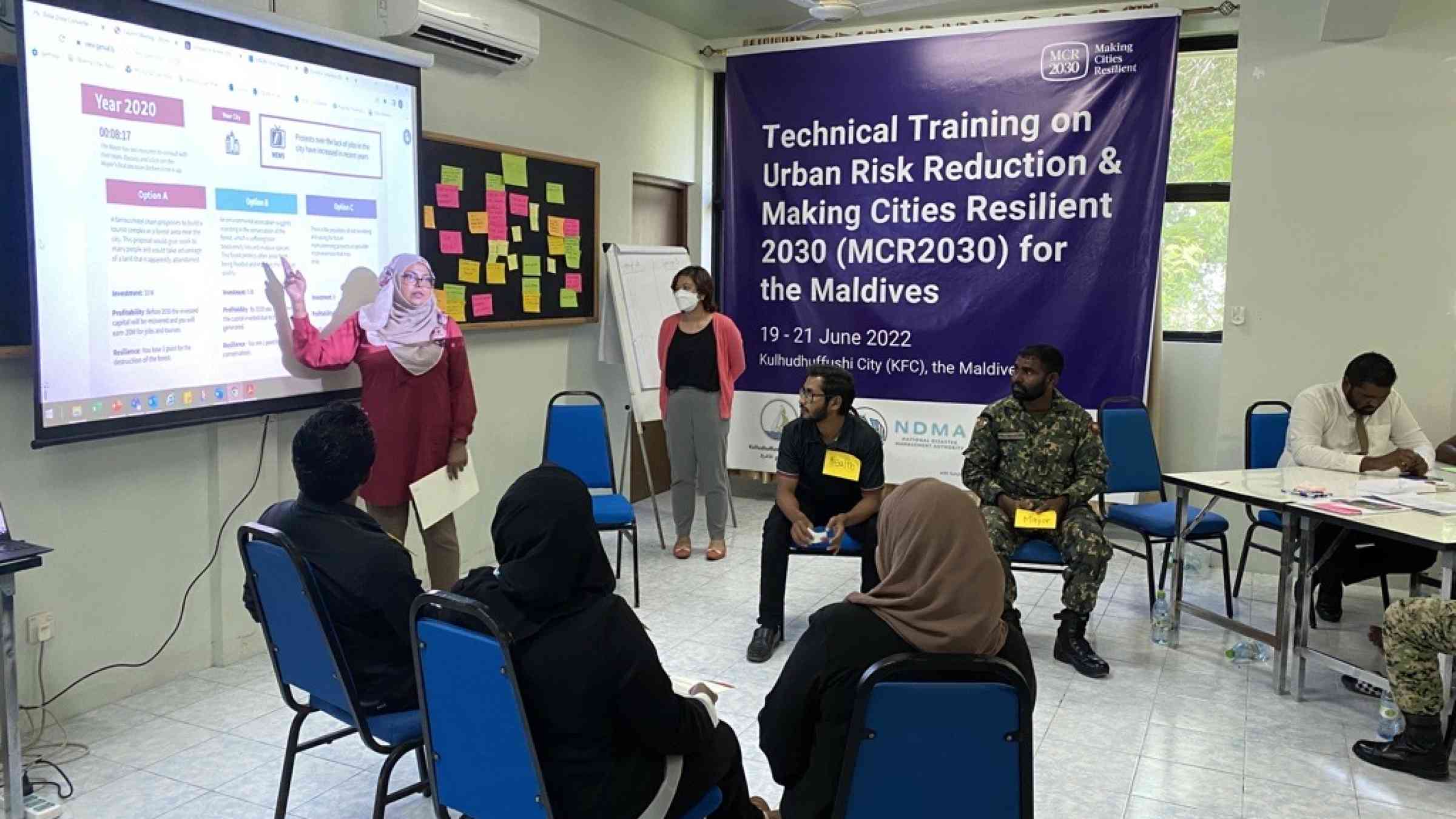
UNDRR trabaja a nivel mundial con gobiernos, instituciones y con el sector privado y la sociedad civil para capacitar e incorporar la reducción del riesgo de desastres y la adaptación al cambio climático en el desarrollo sostenible.

El riesgo es un asunto de todas las personas. UNDRR no puede reducir el riesgo de forma solitaria.

El Global Education and Training Institute (GETI) de UNDRR, situado en Incheon, República de Korea, trabaja globalmente con los gobiernos, instituciones, el sector privado y la sociedad civil para fomentar la capacidad de incorporar la reducción del riesgo de desastres y la adaptación al cambio climático en el desarrollo sostenible.

A través de nuestra campaña Desarrollando Ciudades Resilientes, convocamos y apoyamos el aprendizaje interurbano para fortalecer la resiliencia y proporcionar apoyo para la capacitación de las instituciones nacionales que trabajan en temas de resiliencia, apoyando el intercambio de mejores prácticas.

Contáctenos para aprender más sobre nuestros cursos personalizados bajo solicitud.


Próximos programas de formación UNDRR

No results found.

Capacitaciones bajo demanda

Case study
Ubicación: Ethiopia
Ethiopia is a LDC and LLDC in East Africa. It’s climate is traditionally divided into 3 zones: Dega area with its alpine vegetated cool zones; Woina Dega zone, which is temperate; and the Qola zone which is hot and encompasses tropical and arid regions
  • United Nations Office for Disaster Risk Reduction (UNDRR)
Case study
Ubicación: Antigua and Barbuda
Antigua and Barbuda is a SIDS which is highly vulnerable and exposed to natural, social and socio-natural hazards, particularly hurricanes, floods, droughts, earthquakes and tsunamis.
  • United Nations Office for Disaster Risk Reduction (UNDRR)
Case study
Ubicación: Indonesia
This contribution details the successes and challenges encountered by those currently pushing for better warning from non-seismically induced tsunamis.
  • United Nations Office for Disaster Risk Reduction (UNDRR)
Case study
Ubicación: Japan
This paper focuses on the question of how to link science, communities, and public policy to address the structural challenges as seen in cascading disaster risks and deep uncertainty through cases in Japan from resilience perspectives.
  • United Nations Office for Disaster Risk Reduction (UNDRR)
Case study
Ubicación: China
This paper explains how the city of Wuhan has implemented a comprehensive disaster resilience strategy that integrates policy formulation, scientific research, and public communication in response to severe floods.
  • United Nations Office for Disaster Risk Reduction (UNDRR)
Case study
Ubicación: Kenya
This paper explores CRA in light of the description of the flooding challenge in informal settlements, particularly Kibera, Nairobi, providing CRA solutions, results, and outcomes, as well as lessons learned, key takeaways, and recommendations.
  • United Nations Office for Disaster Risk Reduction (UNDRR)
Case study
Ubicación: Colombia
This case study presents the Inform@Risk project which aimed at developing innovative strategies to strengthen resilience against landslides in informally urbanized areas in Colombia.
  • United Nations Office for Disaster Risk Reduction (UNDRR)
Case study
Ubicación: Slovenia
This text discusses case law on liability in the context of disasters triggered by natural hazards, with a particular focus on risk communication, and highlights the relationships among the various actors in disaster management.
  • United Nations Office for Disaster Risk Reduction (UNDRR)
Case study
Ubicación: South Africa
This paper describes a project that brought together government stakeholders, members of an informal settlement community, academics from different disciplines, and the private sector to identify alarms appropriate for the conditions in informal dwellings
  • United Nations Office for Disaster Risk Reduction (UNDRR)
Case study
Ubicación: Ecuador
This article addresses the main results of a project, obtained from this particular inter-institutional collaborative ecosystem that includes local decision-makers, academia, international cooperation, and community risk management committees.
  • United Nations Office for Disaster Risk Reduction (UNDRR)

Muestras de cursos

Relacionado