Global Framework for Disaster-Related Statistics
A core foundation of risk-informed sustainable development is an evidence-based approach to policy and investment decisions. Policymakers rely on official statistics because they are compiled and analyzed with empirical rigour across all areas of governance, including disaster risk reduction (DRR).
Without a shared statistical foundation, comparisons across space and time—and interoperability between national and regional data platforms—remain difficult. This limits how well countries can track risk trends, understand drivers of impacts, and translate data into prevention-focused action.
The Global Disaster-Related Statistics Framework (G-DRSF) responds to this challenge by providing a universally accepted statistical framework, grounded in the Fundamental Principles of Official Statistics, and building on comprehensive initiatives advanced at regional level.
Why disaster statistics are central to DRR
asters are not isolated incidents. Impacts and losses reflect long-term patterns of exposure, vulnerability, and development choices. Strong disaster-related statistics help countries:
- identify where risk is building, even before disasters occur
- understand why impacts are uneven across populations, places, and sectors
- track trends in losses and damages over time
- support more coherent planning, financing, and prevention efforts
- improve the evidence base for risk modelling and forward-looking analysis
A key feature of the global framework is the inclusion of non-event statistics—such as exposure, vulnerability, and coping capacity—so risk can be measured and understood between disasters, not only after impacts occur.
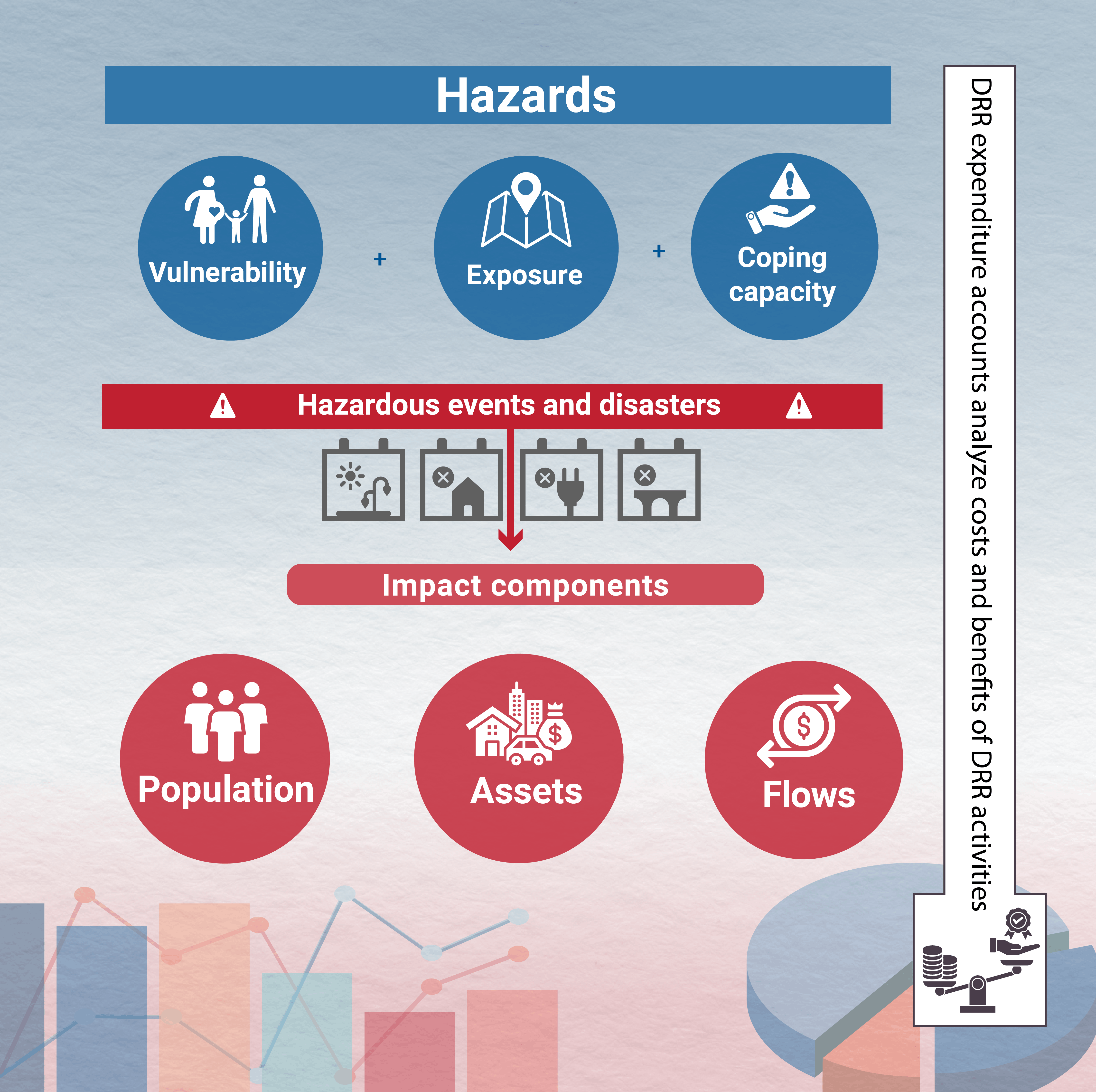
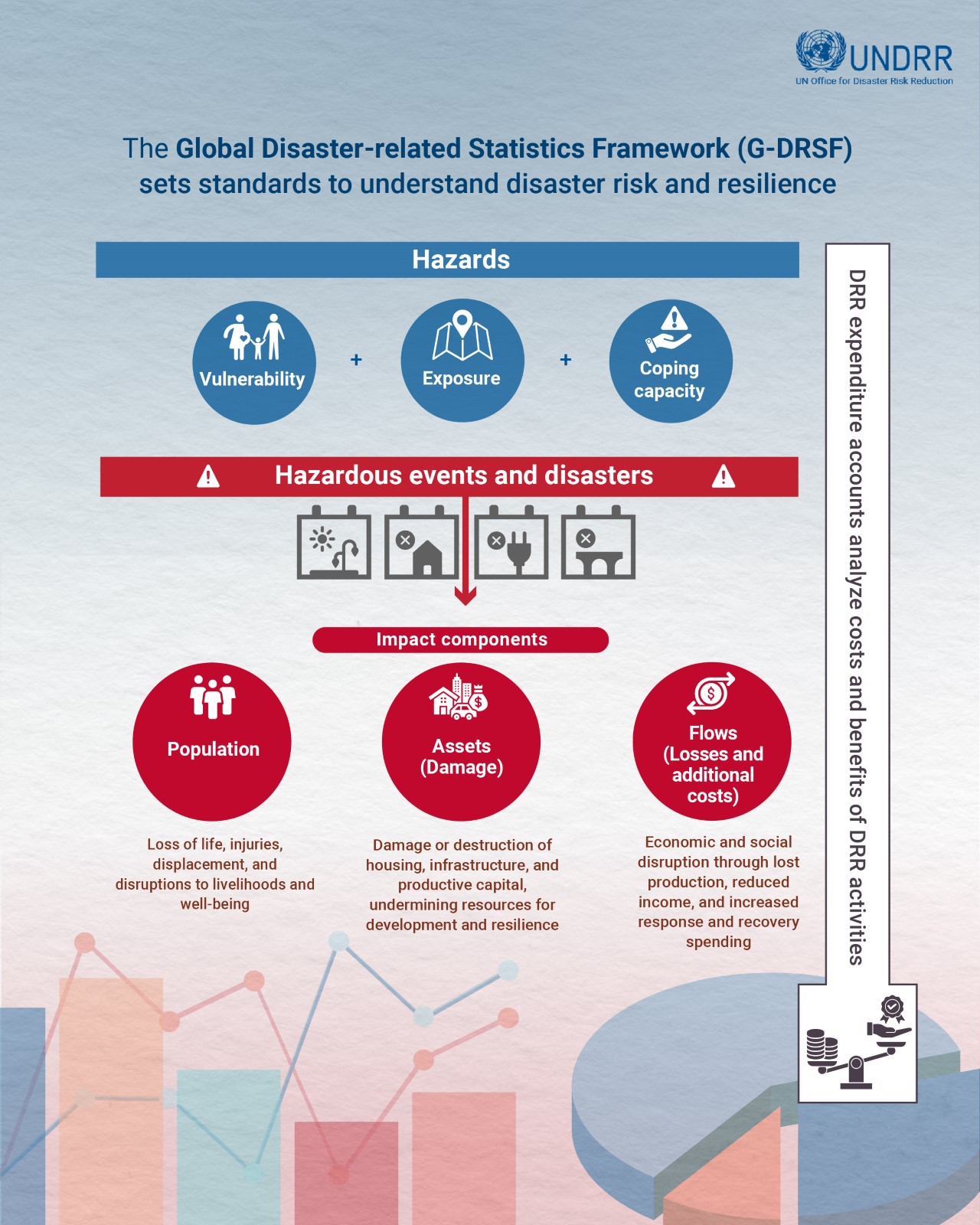
Disasters are not isolated incidents. Impacts and losses reflect long-term patterns of exposure, vulnerability, and development choices. Strong disaster-related statistics help countries:
- identify where risk is building, even before disasters occur
- understand why impacts are uneven across populations, places, and sectors
- track trends in losses and damages over time
- support more coherent planning, financing, and prevention efforts
- improve the evidence base for risk modelling and forward-looking analysis
A key feature of the global framework is the inclusion of non-event statistics—such as exposure, vulnerability, and coping capacity—so risk can be measured and understood between disasters, not only after impacts occur.
A common framework, aligned with global agendas
The G-DRSF supports coherence across international frameworks and national reporting systems. It strengthens the statistical foundations that enable countries to track progress and support analysis across:
- Climate adaptation agendas, including the Belém Adaptation Indicators for the Global Goal on Adaptation
The framework is designed to build on existing national data sources and systems. It improves consistency and comparability, rather than introducing a new global reporting burden.

Frequently asked questions on the Global Disaster-Related Statistics Framework(G-DRSF)
This compilation gives responses to frequently asked questions about the Global Disaster-Related Statistics Framework.
Background on the development of the framework
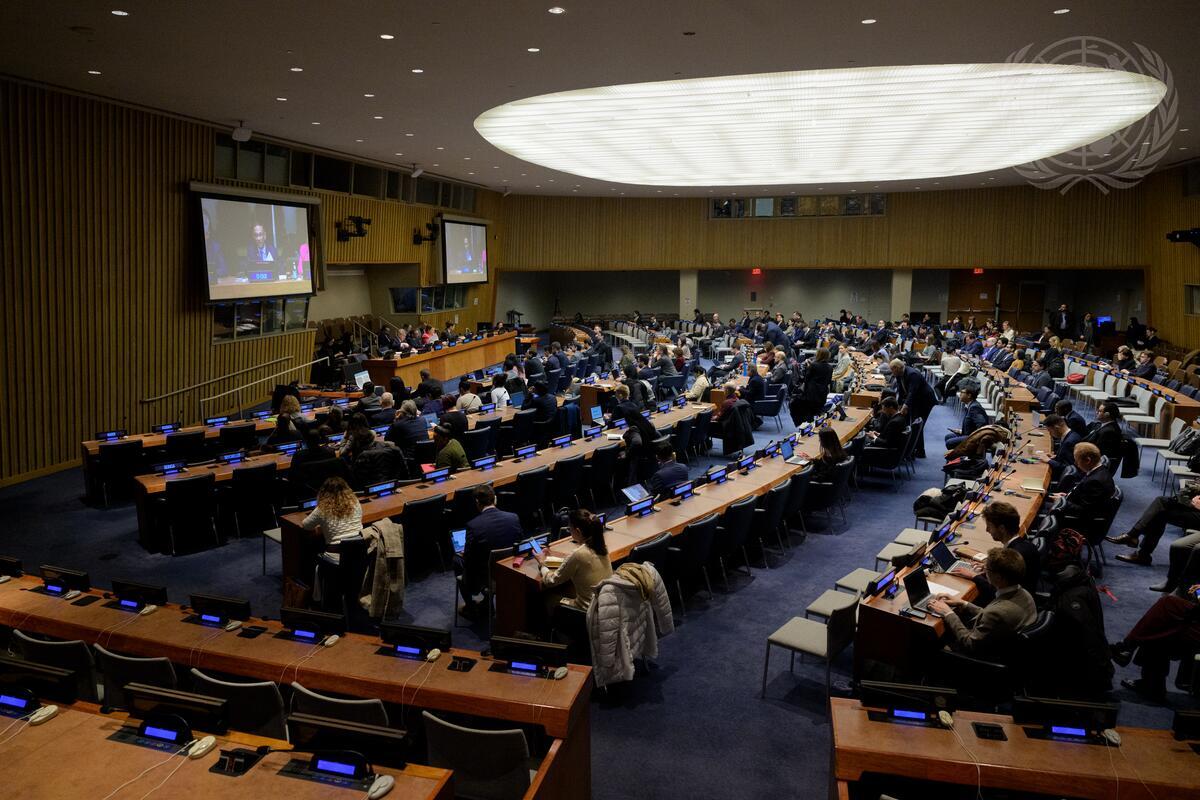
The Open-ended Intergovernmental Expert Working Group (OIEWG) on indicators and terminology related to disaster risk reduction recommended developing standards for disaster-related data and statistics, including through engagement of national disaster risk reduction offices and national statistical offices. The OIEWG report was endorsed by the UN General Assembly (A/71/276) in 2017.
The UN Statistical Commission welcomed greater focus on disaster-related statistics at its 49th Session (2018). At its 50th Session (2019), the Commission requested the UN Statistics Division (UNSD), UNESCAP, UNECE, UNECLAC, and UNDRR to establish a mechanism to develop a common framework on disaster-related statistics.
An Inter-agency and Expert Group on Disaster-related Statistics (IAEG-DRS) was established, with Terms of Reference approved by the Bureau of the UN Statistical Commission in 2020.
The IAEG-DRS is governed by a core group consisting of the five UN regional commissions, UN Statistics Division, UK Health Security Agency (UKHSA), and UNDRR. The Expert Group is co-chaired by UNDRR, UNESCAP and UKHSA. UNDRR serves as its Secretariat.
To strengthen collaboration between producers and users of disaster-related statistics, the UN regional commissions have convened a global expert forum in rotation since 2021:
- UNECE hosted the first global Expert Forum (June 2021)
- UNESCWA organized the second Expert Forum (September 2022)
- UNESCAP organized the third Expert Forum (Bangkok, June 2023)
- UNECA hosted the fourth Expert Forum (Addis Ababa, October 2024)
- UNECLAC hosted the fifth Expert Forum (Santiago, October 2025, virtual)
In addition, annual meetings of the IAEG-DRS have been convened, alongside side events at recent sessions of the UN Statistical Commission.
Resources
- The Global Disaster-Related Statistics Framework (G-DRSF)
- Measuring disaster-related economic losses (Working paper)
- Disaster Risk Reduction Expenditure Satellite Account (Working paper)
- Environmental and ecosystem-related disaster losses (Working paper)
Related work: strengthening risk data ecosystems
UNDRR supports countries to strengthen nationally owned risk data ecosystems that connect hazard information, impacts, and investments—helping translate data into actionable insights.
This includes: