
Q&A with Apri Susanto Astra
Coordinator of Nature-based Solutions Programme, Wetlands International Indonesia
“Building with Nature solutions offer a resilient alternative, or complement, to conventional hard water infrastructure in reducing the risks of disasters and adapting to climate change. These solutions can deliver sustainable water infrastructure to protect coasts, deltas, rivers and lakes under rapidly changing conditions, while benefiting nature, society and the economy. In particular, BwN solutions can meet the need to repair and protect landscapes that lack protective vegetation and are wide open to erosion and flooding.”
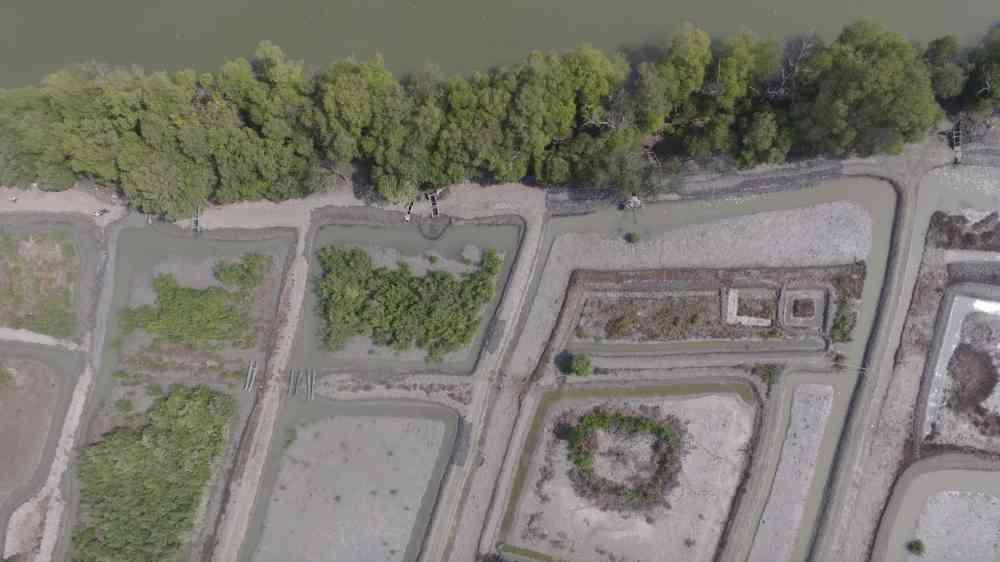
Natural mangroves recovery in riverine aquaculture ponds ©Apri Susanto
What is Building with Nature Indonesia about? Why is this initiative important?
Indonesia’s muddy shorelines have suffered from severe erosion and flooding, caused in part by the removal of a protective belt of mangroves and their replacement by ponds for aquaculture. The coastal communities of Demak have in recent decades generated considerable income through aquaculture in ponds created by sacrificing mangroves. But yields and financial returns have declined. By 2015, the western part of Demak had lost most of its aquaculture ponds to coastal erosion. Further east, ponds remained, but productivity was reduced by erosion, flooding and pollution. Income from aquaculture in Demak had decreased by 60-80 per cent. A typical pragmatic response was to maintain income by converting yet more mangroves to ponds, exacerbating the problems.
Other factors of coastal erosion are subsidence due to excessive groundwater extraction, river engineering that deprives coastlines of riverine mud, and ill-judged hard infrastructure such as seawalls that disrupt the sediment and water flows that previously maintained shorelines. To make matters worse, climate change is rising sea levels and increasing the frequency and intensity of storm surges. As a result, more than 30 million people in Java alone are currently at risk of flooding and salt water invading their fields.
In Demak district, Northern Java, the coast has already retreated in places by several kilometres, consuming rice fields and more than 500 hectares of aquaculture ponds. Both agriculture and aquaculture have suffered production losses worth many billions of Euros. Invading waters have also drowned several villages and left others surrounded by water and connected to the mainland by raised causeways.
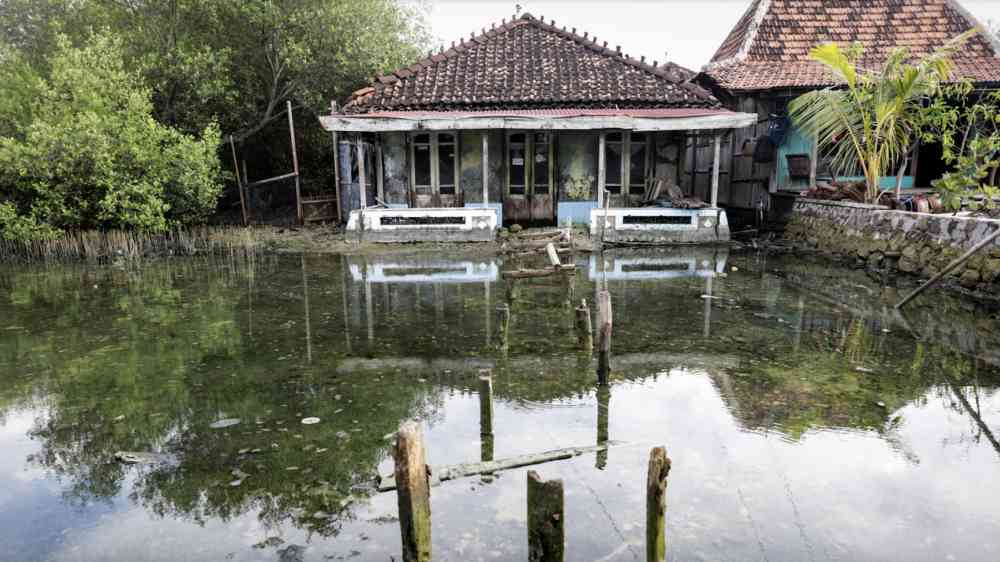
Flooding and land subsidence in Demak ©Cynthia Boll
The construction of sea walls to protect the coast has proved both ineffective and expensive and failed to prevent erosion and thus protect the coast. Furthermore, they don’t bring any economic, environmental and social benefits that healthy mangrove coastlines can provide.
Altogether some 70,000 people and 6,000 hectares of aquaculture ponds in Demak were exposed to future invasions by the sea. A Deltares’ modelling report states that based on a 10 year forecast scenario without measures the high subsidence rates will result in rapid loss of coastal areas.
Faced with this ongoing crisis, local authorities, communities and other stakeholders sought a new approach. There was potential to do better, and restored mangroves to be a key part of this. For instance, restored mangroves can protect the ponds from waves, and filter sea-borne toxins such as industrial waste. In addition, they can deliver firewood and fertiliser, and provide nursery and feeding grounds for wild fish. So, rather than being competing land uses, mangroves and aquaculture can be complementary. The key to breaking the damaging cycle of declining pond yields and further mangrove destruction has been to realise these potential gains. We did this by introducing coastal field schools to train villagers in better aquaculture techniques and appreciation of the value of mangroves, and by providing incentives through Bio-rights, a financial system that reconciles livelihoods with environmental conservation and restoration.
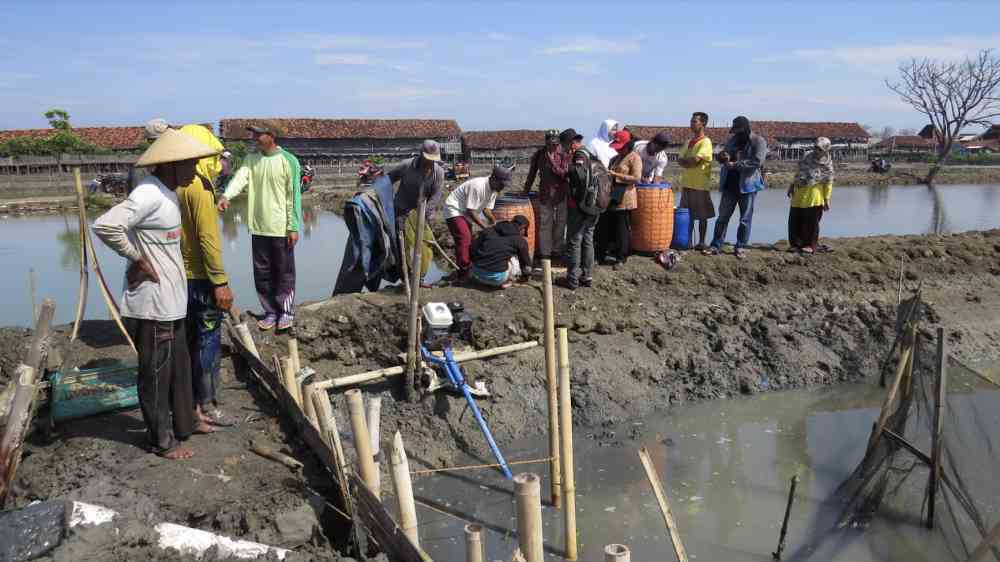
Coastal Field School members in Surodadi are preparing to harvest their first experiment using LEISA system 2016 ©Blue Forests
We argued that the Building with Nature (BwN) approach could help. Building with Nature is a design approach to develop Nature-based Solutions for water-related infrastructure such as flood defences, sustainable port development and for the restoration of ecosystems. It harnesses the forces of nature to benefit the economy, society and the environment. Through the BwN approach we can develop sustainable infrastructure as well as contribute to the Sustainable Development Goals.
From 2015 to 2021, we worked with local communities to design and implement solutions to land loss in Demak by stimulating the return of mangroves, while at the same time revitalising aquaculture, and other livelihoods.
One novel technology has been the placement of mud-trapping semi-permeable structures to stabilise the coastline by local communities. To restore the mangrove system, it was not possible to simply plant mangroves, as the wave exposure, submersion time and sediment conditions in the eroded area are not optimal anymore. Planting mangroves is often not preferable, especially if the right mangrove species are not planted at the right location which will impair natural mangrove formation and result in a fragile mangrove forest or no forest at all. Instead, we built temporary semi-permeable barriers from poles and brushwood to dampen the waves and capture sediment, creating sheltered areas near the coast for accretion. Once the nearshore bed level rises enough and mangrove seedlings are naturally available, mangroves will regenerate naturally, developing a natural defence that will protect the hinterland from further erosion. Where the coastline was not yet eroded, we encouraged the conversion of ponds into mangrove forests in close collaboration with local communities.
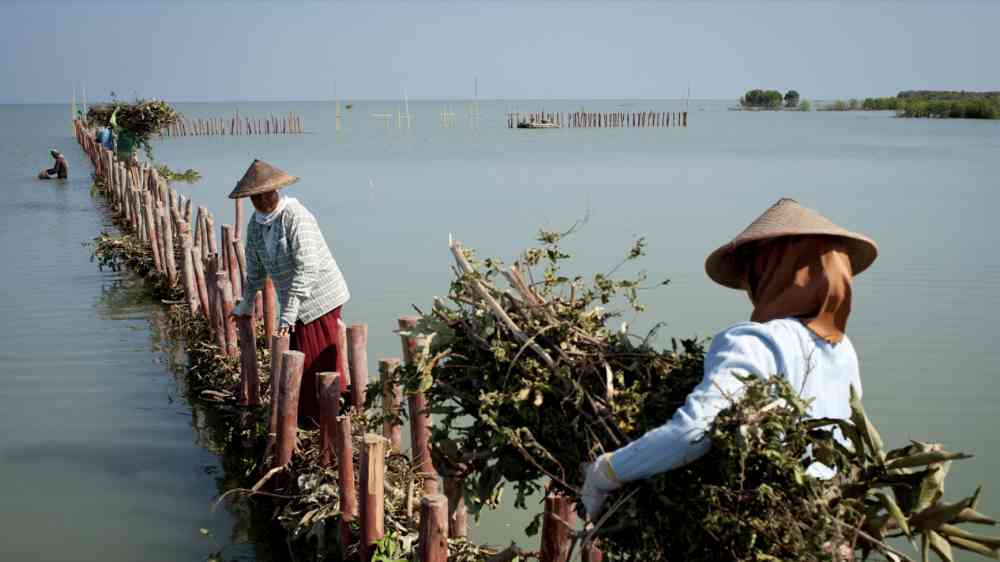
Community groups constructing permeable structures ©Nanang Sujana
Another innovation has been the use of an incentives system known as the Bio-rights mechanism to encourage local communities to adopt more sustainable livelihoods, including forms of aquaculture that preserve and restore the mangroves. So, our coastal protection efforts were integrated with the introduction of aquaculture practices that support mangrove restoration instead of damaging the ecosystem. They also helped boost the local economy. In such ways, we aligned economic development with care for the environment. The programme organised Coastal Field Schools (CFS) in which 277 farmers were trained with more sustainable aquaculture practices and on the importance of mangrove greenbelts. These practices were adopted by 85% of the farmers which, compared to the baseline, tripled their shrimp yields. This motivated farmers to give up (part of their) ponds for mangroves. The programme among others introduced the innovative Associated Mangrove Aquaculture (AMA) systems, which replace traditional sylvo-aquaculture systems that are often applied in Indonesia. In AMA systems, part of the aquaculture pond is given up to make space for riverine mangroves. As such AMA’s can restore mangrove greenbelts in the estuary along inland waterways and protect adjoining fishponds. In contrast, sylvo-fishery systems only have mangroves on dikes, do not protect the land, offer few ecosystem services and may even have negative effects on aquaculture. In Demak we demonstrated that through AMA’s aquaculture productivity and local incomes can be boosted while increasing hazard resilience.
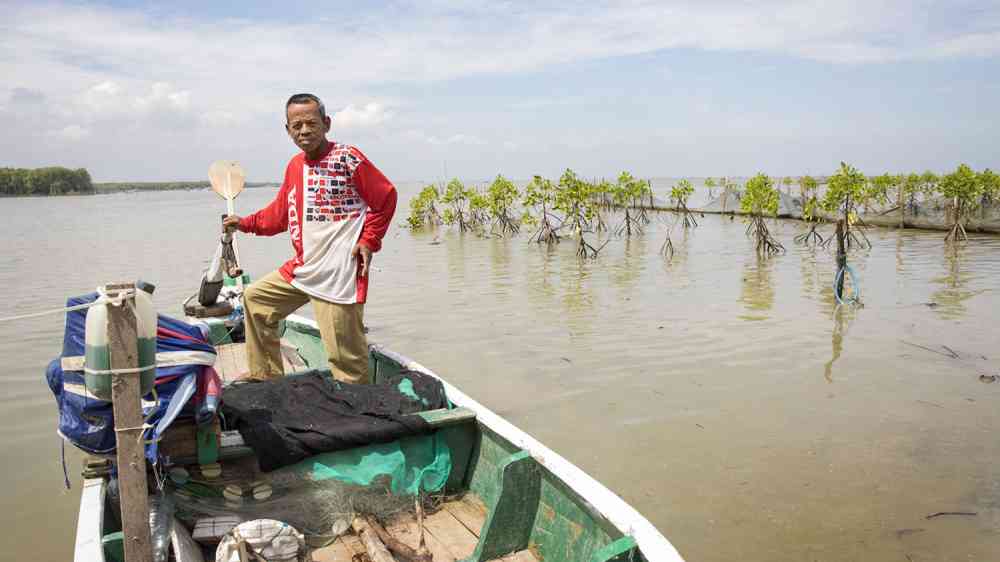
"This is our home and we plan to stay. We are putting back the mangroves," says Slamet, a local fisherman ©Cynthia Boll
Many of these ideas were developed jointly with local and national stakeholders during a series of workshops during the project’s inception phase in 2015. We are now using these experiences to share lessons, develop technical guidelines, build local capacity, ignite policy dialogues and connect multiple actors, to help solve landscape problems in other settings.
For a summary of the interventions and insights into the Building with Nature approach between in Demak, please see:
In what ways has the project helped reduce risks from natural, climate or human-caused disasters?
1) Erosion has been halted with permeable structures
The risk reduction goal of the project was to stop coastal erosion, so stop the process of land loss and restore the mangrove belt for natural coastal defence. The permeable structures have been successful in capturing mud. They have stopped erosion, delaying marine invasion and land loss. This is a significant achievement, and provided they are maintained, structures can continue in this role.
2) Mangrove recovery severely challenged by land subsidence
But mangroves may not return on the scale anticipated until land subsidence is substantially reduced. The structures may need to be maintained in place for longer than once thought. The idea was for mangroves to take root and grow in the newly trapped sediment behind the permeable structures. In some places that happened, with mangroves reaching about 1 metre in height. But in 2017, we noticed that some new mangroves were disappearing, and monitoring poles in the water were becoming submerged. We diagnosed the problem as subsidence of the land and foreshore, which was wiping out the gains from mud accumulation. The subsidence was worst in the west of the project area near the city of Semarang, where it reached eight centimetres or more per year in places, but it spread right along the Demak coast. The cause is the extraction of groundwater, mainly by industry in the city and along the highway. Groundwater extraction resulted in compaction of the deep soil layers that are underlying the delta, lowering the land surface.
This was a serious setback to coastal restoration. Still, the benefits are tangible, and they have happened because of the actions of the community participants. Besides providing their labour to construct and maintain the structures, they have become ever more involved in planning. During the project, they proposed and implemented structural improvements, and organised to amend existing local regulations to protect newly gained land from future exploitation for ponds. In 2018, the communities formally took ownership of the structures. Our role is now restricted to providing advice and funding maintenance. We see this successful transfer as being of equal value to the technical innovation, providing a social and institutional model that can be replicated in other Building with Nature projects elsewhere.
How has the project benefited people?
1) Behind permeable structures extensive sediments have accumulated and mangrove seedlings have started to emerge everywhere. Communities have allocated land along the coast and rivers for mangrove restoration and the permeable structures have now been handed over to them to maintain, with local-government finance. While land subsidence has limited mangrove restoration in villages close to Semarang, the permeable structures have stopped erosion, and that is a big gain for the villagers and promising for other villages along Northern Java’s delta shorelines where in the long run millions of people may be affected by coastal erosion.
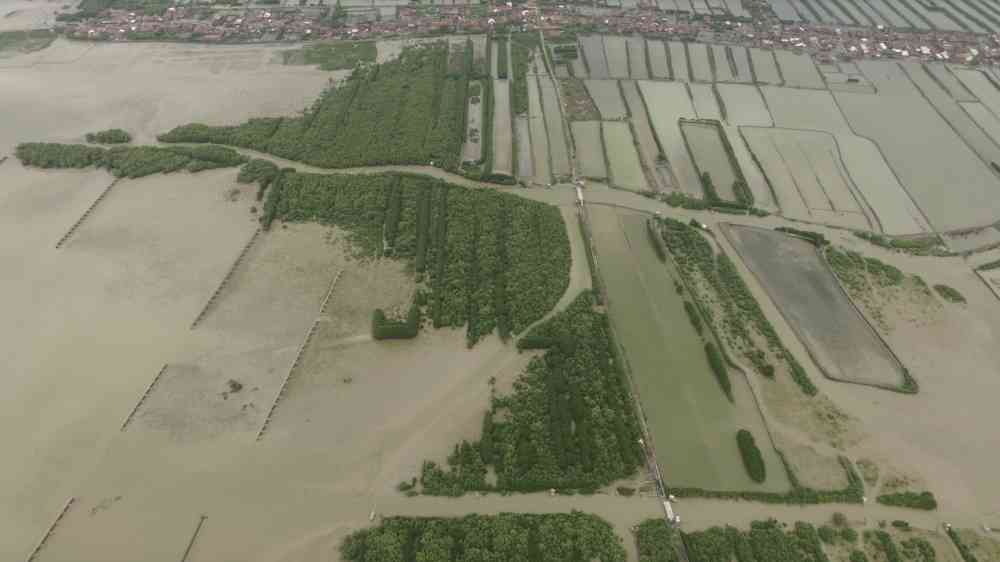
Drone picture permeable structures in front of Demak coast ©Witteveen+Bos
2) Over time, the participants in field schools and Bio-rights projects have learned to manage their ponds in ways that contribute to mangrove restoration, coastal protection and biodiversity and increasing yield and income. Having previously regarded regular flooding and low pond productivity as inevitable, communities are now much more optimistic, creative in their thinking and collaborative in making strategic decisions to improve their lives and sustain their surroundings.
Farmers used their new knowledge to debate with their colleagues about best practice, design aquaculture production systems, and make informed decisions about management of their own ponds. Thus, besides gaining knowledge, they acquired “soft” skills in critical thinking about adapting to changing environments, and learned to have more confidence in making decisions and public speaking. The trained villagers passed on their insights through new training in other villages. Over 80 per cent of the field-school participants in Demak have adopted best practices in 464 hectares of ponds, with sometimes spectacular success for their livelihoods. Milkfish yields reportedly rose threefold, and average shrimp yields sixfold. Profit margins were typically three times higher. The gains might have been even greater but for land subsidence, which lowered water levels in many ponds, causing flood damage to the surrounding bunds, especially during storms, damaged water quality, and washed away fish and prawns. For this reason, we supported bund heightening and explored alternatives such as netted aquaculture and ponds in freshwater basins. We also supported the introduction of early warning systems, so that farmers can harvest their ponds before storms.
3) Thanks to one Bio-rights investment, the regent of Demak opened a 350-metre boardwalk through new mangroves in Bedono village, earmarked for enjoyment by tourists, and for educational purposes and local meetings.
4) We have also supported farmers with equipment to harvest wild fish from in and around the resurgent mangroves. Subsequent research has confirmed the sustainability of these alternative livelihoods. More than 80 per cent of fishers report better near-shore catches, with incomes now as good as those from aquaculture. A study of nearshore catches associated with mangrove restoration in eastern Demak, carried out by Wageningen and Diponegoro universities, found both a clear recovery in fish populations and rapid increases in fish catches.
5) Through the field schools and Bio-rights incentives, we gave community groups and their individual members the knowledge, skills and authority to engage in policy dialogues in their villages and with government officials at district and other levels. We have encouraged their participation to embed Building with Nature into coastal planning and the development of a new spatial plan for Demak district. As a result of this work, appreciation of mangroves and the services they provide has increased enormously. We see this locally in community efforts at mangrove restoration outside the project itself, in the enactment by villages of new regulations that protect mangroves, and in commitments to give up aquaculture ponds for mangrove rehabilitation. Village development plans and associated land-use regulations incorporating Building with Nature have been adopted by communities and formalised within the local government of the 9 villages involved. These developments have received government support and resulted in enhanced funding for the maintenance of permeable structures, mangrove rehabilitation and improved aquaculture.
Are these solutions scalable? Why or why not?
The challenges in Demak are typical for many low-lying muddy coasts in Indonesia and across Asia along which mangroves have been converted into aquaculture ponds. Such coasts often face severe erosion and catastrophic floods that leave millions of people at risk of losing their houses, land, roads and income. For many such places, Building with Nature is a feasible, replicable and scalable solution. But it requires the right conditions, including the presence of involved and committed stakeholders from different sectors and disciplines, and a favourable and well-understood bio-physical environment. The principles of Building with Nature are universal. They can be applied in other environments besides muddy mangroves coasts.
Indonesia has been a trail-blazer in replication of the success of Demak. Following the collaboration in Demak, the Indonesian Ministry of Marine Affairs and Fisheries (MMAF) altogether installed 23.5 kilometres of structures in 13 districts between 2015 and 2019 across Indonesia (see Table 1). PusAir, the research department of the Indonesian Ministry of Public Works and Housing, has developed and tested new semi-permeable structure designs, and is producing technical guidelines on their use that are being accepted nationally.
The need for BwN solutions is great. For example, a risk assessment of flooding on the north coast of Java, conducted by Deltares found that 2.5 million people – a fifth of the population -- live in hotspots where subsidence of up to a metre could cause widespread flooding during storm surges. But the assessment concluded that the conservation of mangroves in rural areas would be a more effective approach than embankments, especially if combined with limiting groundwater extraction. In urban areas with less potential for mangrove cover, it found that hybrid strategies combining hard engineering and natural regeneration might work best.
Despite our successes, however, many actors are still unaware of the benefits of Building with Nature. There is a need to raise awareness amongst policy makers, planners, investors and engineers about both the advantages of a nature-based approach and the environmental downsides of hard infrastructure. The project contributes to this among others through technical guidelines, scientific publications and events.
5 technical guidelines produced by the project can be downloaded here:
How important have partnerships been to the success of Building with Nature Indonesia?
Building with Nature Indonesia was implemented through a public private partnership under leadership of the Indonesian government, Wetlands International and Ecoshape. This partnership connected international expertise and experience with local knowledge on engineering, aquaculture, ecosystems, capacity building and governance. Such interdisciplinary collaboration has been essential to our success, with each partner bringing specific knowledge, experience and skills. Partners include government agencies, not-for-profit organisations, knowledge institutes, the private sector and local communities in Demak.
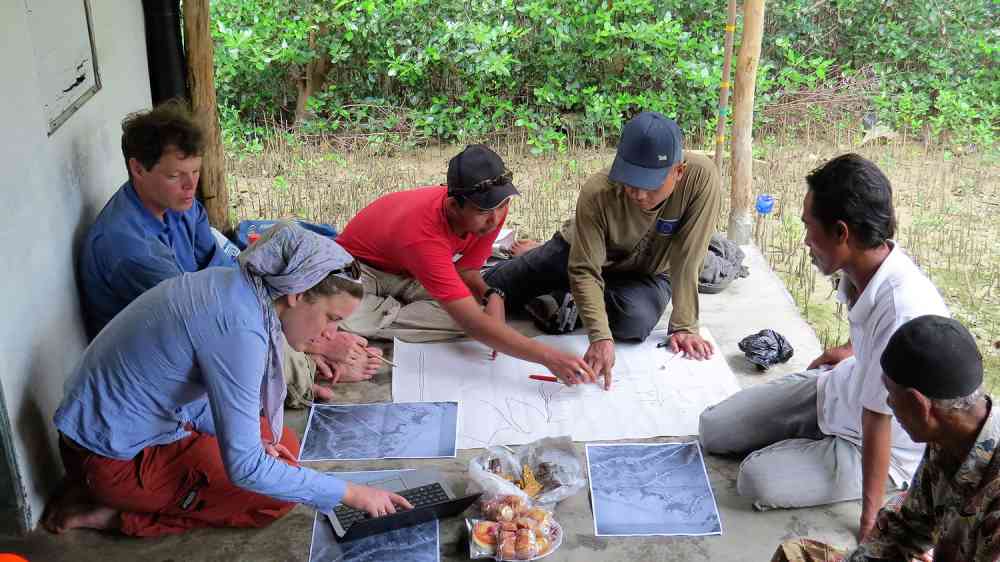
Multi-stakeholder collaboration ©Yus Rusila Noor/Wetlands International
The roles of each partner have been described in this leaflet:
Is Wetlands International participating in any other restoration projects in the region? Can you tell me more about them?
All our offices in Asia are involved in wetlands restoration projects for many years. We are currently as a region working on scaling up the Building with Nature approach in Indonesia, Malaysia, Philippines, India and China. To learn more about this, please see www.wetlands.org/buildingwithnatureasia
Find a few other projects are described in the following leaflets:
Why is Building with Nature the ideal approach to climate change adaptation and mitigation?
Building with Nature solutions offer a resilient alternative, or complement, to conventional hard water infrastructure in reducing the risks of disasters and adapting to climate change. These solutions can deliver water infrastructure to protect coasts, deltas, rivers and lakes under rapidly changing conditions, while benefiting both nature, society and the economy. In particular, these solutions can meet the need to repair and protect landscapes that are wide open to erosion and flooding through lacking protective vegetation. Such naturally deprived landscapes can no longer protect our cities, infrastructure and other built assets, and they often fail to deliver food and other vital services derived from nature and to support biodiversity.
The project won two awards worth mentioning:
- Vernufteling award, 2016: a Dutch annual award for innovative engineering solutions in the Netherlands.
- Flood & Coast Excellence Award 2020: annual award that celebrates projects that set the standard for how to manage flood and coastal risk in the future in response to the climate and ecological emergency.
For more information about the Building with Nature approach, please see
- EcoShape’s Building with Nature narrative