
Maritime Accident
A maritime accident is an event, or a sequence of events, that has resulted in any of the following occurring directly in connection with the normal operation of a marine vessel: the death of, or serious injury to, a person; the loss of a person from a ship; the loss, presumed loss or abandonment of a marine vessel; material damage to a marine vessel; the stranding or disabling of a marine vessel, or the involvement of a marine vessel in a collision; material damage to the marine infrastructures external to a vessel, that could seriously endanger the safety of the vessel or another vessel or an individual; and severe damage to the environment, or the potential for severe damage to the environment, brought about by the damage of a marine vessel (United Nations, European Union and the International Transport Forum at the OECD, 2019).
Primary reference(s)
United Nations, European Union and the International Transport Forum at the OECD, 2019. Glossary for transport statistics. 5th Edition. Accessed 11 February 2025.
Annotations
Additional scientific description
Statistically agreed definitions for Marine Accident (United Nations, European Union and the International Transport Forum at the OECD, 2019) are as follows:
- Fatal accident: any injury resulting in a person killed.
- Non-fatal accident: any injury incident other than a fatal accident.
- Person killed: Any person killed immediately or dying within 30 days as a result of an injury accident. For countries that do not apply the threshold of 30 days, conversion coefficients are estimated so that comparisons on the basis of the 30 day-definition can be made.
- Person lost at sea: A person missing at sea, being presumed to have gone overboard.
- Person Injured: Any person who as result of an injury accident was not killed but sustained an injury.
- Serious injury: An injury which is sustained by a person in a casualty resulting in incapacitation for more than 72 hours commencing within seven days from the date of injury.
- Person seriously injured: Any person who as result of an injury accident was seriously injured.
- Person slightly injured: Any person who as result on an injury accident was not seriously injured. Very serious marine casualty: A casualty to a marine vessel which involves the total loss of the marine vessel, loss of life or severe damage to the environment.
- Serious marine casualty: A casualty which does not qualify as a very serious casualty and which involves a fire, explosion, grounding, contact, heavy weather damage, ice damage, hull cracking or suspected hull defect, etc., resulting in: structural damage rendering the marine vessel not navigable, such as penetration of the hull underwater, immobilisation of the main engines, extensive accommodation damage etc.; or pollution (regardless of quantity); and/or a breakdown necessitating towage or shore assistance.
- Marine incident: An occurrence or event being caused by, or in connection with, the operations of a marine vessel in motion at sea, other than a marine casualty that endangered, or, if not corrected, would endanger the safety of the vessel, its occupants or any other person or the environment.
Metrics and numeric limits
International Maritime Organization (IMO) is the United Nations agency with responsibility for the safety and security of shipping and the prevention of marine and atmospheric pollution by ships. The IMO's work supports the United Nations Sustainable Development Goals (IMO, 2019). Reporting to IMO of marine safety investigations and marine casualties and incidents are based on the following IMO instruments (IMO, no date a):
- Code of International Standards and Recommended Practices for a Safety Investigation into a Marine Casualty or Marine Incident (Casualty Investigation Code), 2008 edition (resolution MSC.255(84)).
- Safety of fishermen at sea, resolution A.646(16), paragraph 3.
- Reports on casualty statistics concerning fishing vessels and fishermen at sea, MSC/Circ.539/Add.2.
- Report on fishing vessels and fishermen statistics, MSC/Circ.753.
- Provision of preliminary information on serious and very serious casualties by rescue co-ordination centres, MSC/Circ.802.
- Guidance on near-miss reporting, MSC-MEPC.7/Circ.7, paragraph 4.
- Casualty-related matters, Reports on marine casualties and incidents, MSC-MEPC.3/Circ.4/Rev.1.
- Guide on the process of Reporting a marine casualty and incident to IMO; and reviewing the analysis of a marine safety investigation report submitted to IMO, which is a user guidance for the Global Integrated Shipping Information System (GISIS) module on marine casualties and incidents.
- Guide on the process to Associate interest to a Marine Safety Investigation report, which is regarding how Member States can be associated to a Marine Safety Investigation report previously uploaded into GISIS-MCI.
- Global Integrated Shipping Information System summarises key metrics such as number of very serious casualties/year (IMO, no date b)
Key relevant UN convention / multilateral treaty
United Nations Convention on the Law of the Sea (United Nations, 1982).
International Convention for the Safety of Life at Sea, (SOLAS) 1974 (IMO, 1974)
Drivers
The causes of marine accidents include collision, close quarters and contact accidents; grounding; fire; explosion; lifeboat (lack of training and/or maintenance); inadequate risk management; operational failure; cargo-related; human error; third party deficiency; technical failure and weather and other environmental factors (Acejo et al., 2018).
The most common kind of accident was identified as 'collision, close quarters and contact' (35.8%). This was followed by grounding which constituted 17% of the cases. About 9.8% of cases were associated with fire and explosion, 3.3% of cases were related to lifeboats and 34.2% were described by investigators as being other kinds of accidents. These disparate events included, for example, crane failure, man overboard, cargo loss, engine room flooding, trip and fall, parting of mooring lines, and oil spills. (Acejo et al., 2018).
Impacts
Acejo et al. (2018) report ed a total of 693 accident reports which were analysed to help users gauge the severity of. total fatalities or injury counts. These were identified from an analysis of accident investigation reports that were published on line by the (UK) Marine Accident Investigation Branch (MAIB), the Australian Transport Safety Bureau (ATSB), the (US) National Transportation Safety Board (NTSB), the Federal Bureau of Maritime Casualty Investigation in Germany, and the Danish Maritime Accident Investigation Board (DMAIB) in the period 2002-2016 (inclusive) and accident investigation reports from Maritime New Zealand from 2002-4, as this publication was discontinued in 2004. (Acejo et al., 2018).
The most common kind of accident was identified as ‘collision, close quarters and contact’ (35.8%). This was followed by grounding which constituted 17% of the cases. About 9.8% of cases were associated with fire and explosion, 3.3% of cases were related to lifeboats and 34.2% were described by investigators as being other kinds of accidents. These disparate events included, for example, crane failure, man overboard [sic], cargo loss, engine room flooding, trip and fall, parting of mooring lines, and oil spills. ‘Inadequate risk management’ was most identified as both an immediate and a contributory cause of accidents when all types were aggregated with third- party deficiency’ is the second most common accident cause identified by investigators. ‘Failure in communication’ was the third most identified cause of accidents (Acejo et al., 2018).
It needs to be acknowledged that the 695 accident reports dataset was primarily from developed maritime nations; global applicability might be limited without further regional context.
Multi-hazard context
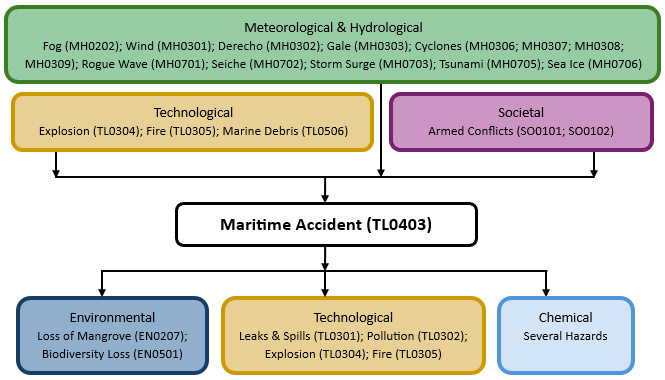
The figure below summarises common interactions between maritime accidents and other hazards. This information should be used with caution and not be solely relied upon in Disaster Risk Management, particularly as some interactions may not have been included. Note that hazardous events occurring together or locally in space or time may not necessarily cause, amplify, or be otherwise related to each other. Specific examples of multi-hazard context can be found in the ‘Hazard drivers’ and ‘Impacts’ sections above.
Multi-hazard diagram
Risk Management
The IMO has established an International Safety Management (ISM) Code that seeks to establish systems for the safe operation and management of ships and for pollution prevention (IMO, 1993). The Code’s origins go back to the late 1980s, when there was mounting concern about poor management standards in shipping. Investigations into accidents revealed major errors on the part of management, and in 1987 the IMO Assembly adopted resolution A.596(15), which called upon the Maritime Safety Committee to develop guidelines concerning shore-based management to ensure the safe operation of ro-ro passenger ferries. The procedures required by the Code should be documented and compiled in a Safety Management Manual, a copy of which should be kept on board (IMO, 1998).
Clarify how the ISM Code’s implementation is monitored (e.g., through audits or port state control). Consider briefly referencing Safety Management Certificates (SMCs) issued to vessels.
IMO Safety Management Certificates (SMCs) are issued to vessels to verify their compliance with the International Safety Management (ISM) Code, which outlines standards for safe ship operation and management (IMO, 1995). An SMC signifies that the vessel's company and shipboard management operate according to an approved Safety Management System (SMS). The certificate is valid for five years and requires at least one intermediate verification within that period.
The ISM Code's implementation is monitored through various mechanisms, including audits and port state control. Audits, conducted by the Administration (flag state) or Recognized Organizations (ROs), verifying compliance with the ISM Code's requirements (IMO, no date e). Port state control involves inspections of ships in foreign ports to ensure they meet international standards, including the ISM Code. (IMO, no date f)
IMO has various guidelines that contribute to real-time risk mitigation including the threat posed by piracy and armed robbery against ships has been on the IMO's agenda since the early 1980s (IMO, no date g).
Monitoring
AIS (Automatic Identification System) and VDR (Voyage Data Recorder) as essential components in real-time monitoring and investigations.
The Automatic Identification System (AIS) is a maritime safety and navigation tool that uses radio communication to exchange information between vessels and shore stations. It helps vessels avoid collisions, track vessel movements, and provide information to authorities for traffic management. AIS transponders are designed to be capable of providing position, identification and other information about the ship to other ships and to coastal authorities automatically (IMO, no date c).
Voyage Data Recorders (VCR) Passenger ships and ships other than passenger ships of 3000 gross tonnage and upwards constructed on or after 1 July 2002 must carry voyage data recorders (VDRs) to assist in accident investigations, under regulations adopted in 2000, which entered into force on 1 July 2002. The mandatory regulations are contained in Chapter V on Safety of Navigation of the International Convention for the Safety of Life at Sea, 1974 (SOLAS). Like the black boxes carried on aircraft, VDRs enable accident investigators to review procedures and instructions in the moments before an incident and help to identify the cause of any accident. (IMO, no date d)
The European Marine Casualty Information Platform (EMCIP) was operational from June 2011. The European Marine Casualty Information Platform (EMCIP) is a database and a data distribution system operated by the European Maritime Safety Agency (EMSA), the European Commission and the EU/EEA Member States (EMSA, no date). It aims to deliver a range of potential benefits at national and European relevance by:
- Improving the information background about marine casualties and incidents;
- Widening and deepening the analysis of the results of casualty investigations;
- Providing at-a-glance information, enabling general risk identification and profiling;
- Sharing lessons learned and safety issues detected in the course of safety investigations.
References
Acejo, I., Sampson, H., Turgo, N., Ellis, N., & Tang, L., 2018. The causes of maritime accidents in the period 2002–2016. Seafarers International Research Centre, Cardiff University. Accessed 21 May 2025.
European Maritime Safety Agency (EMSA), no date. European Marine Casualty Information Platform (EMCIP). Accessed 21 May 2025.
International Maritime Organization (IMO), no date a. Reporting. Accessed 21 May 2025.
International Maritime Organization (IMO), no date b. Global Integrated Shipping Information System (GISIS). Accessed 21 May 2025.
International Maritime Organization (IMO), no date c. Automatic Identification Systems (AIS) transponders. Accessed 21 May 2025.
International Maritime Organization (IMO), no date d. Voyage Data Recorders (VDR). Accessed 21 May 2025.
International Maritime Organization (IMO), no date e. Implementation of Instruments Support (III). Accessed 21 May 2025.
International Maritime Organization (IMO), no date f. Port State Control. Accessed 21 May 2025.
International Maritime Organization (IMO), no date g. Maritime Security and Piracy. Accessed 21 May 2025.
International Maritime Organization (IMO), 1974. International Convention for the Safety of Life at Sea (SOLAS). Accessed 21 May 2025.
International Maritime Organization (IMO), 1993. The International Safety Management Code (ISM Code). Accessed 21 May 2025.
International Maritime Organization (IMO), 1995. Guidelines on implementation of the International Safety Management (ISM) Code by administrations. Resolution A 19/Res. 788. Accessed 21 May 2025.
International Maritime Organization (IMO), 1998. International Safety Management (ISM) Code and Guidelines on Implementation of the ISM Code. Accessed 11 March 2025.
International Maritime Organization (IMO), 2019. IMO and the Sustainable Development Goals. Accessed 11 March 2025.
Pratama, F.W., Hermawan, Y.A., & Nugroho, S., 2024. Framework design for an early warning system to prevent ship collisions. Marine Technology. Accessed 11 March 2025.
Wang, W., Li, X., & Gu, J., 2024. Exploring an early warning system for maritime security risks: An approach based on compressed remote sensing. Expert Systems with Applications, 249(Part C), 123670. Accessed 11 March 2025.
United Nations, 1982. United Nations Convention on the Law of the Sea of 10 December 1982. Overview and full text. Accessed 11 March 2025.
United Nations, European Union and the International Transport Forum at the Organisation for Economic Co-operation and Development (OECD), 2019. Glossary for Transport Statistics, 5th Edition. Accessed 11 March 2025.