
Road Traffic Accident
A road traffic accident involving at least one road vehicle in motion on a public road or private road to which the public has right of access, resulting in at least one injured or killed person. Approximately 1.19 million people die each year as a result of road traffic crashes, which are the leading cause of death for children and young adults aged 5-29 years with 92% of the world's fatalities on the roads occurring in low- and middle-income countries, even though these countries have around 60% of the world's vehicles (adapted from UNECE, Eurostat, ITF, 2019 and WHO, 2023a).
Primary reference(s)
UNECE, Eurostat, ITF 2019. Glossary for transport statistics. 5th Edition. United Nations, European Union and the International Transport Forum at the OECD (2019). Accessed 21 February 2025
WHO 2023a Road Traffic Injuries. World Health Organization (WHO). Accessed 17 March 2025
Annotations
Additional scientific description
More than 90% of road traffic deaths occur in low- and middle-income countries. Road traffic death rates are highest in the WHO African Region and lowest in the European Region. Even within high-income countries, people from lower socioeconomic backgrounds are more likely to be involved in road traffic crashes. Road traffic injuries are the leading cause of death for children and young adults aged 5-29 years. Two- thirds of road traffic fatalities occur among people of working age (18-59 years), Males are typically 3 times more likely to be killed in road crashes than females (WHO 2923 a).
Statistically agreed definitions for road transport accidents (United Nations, European Union and the International Transport Forum at the OECD (2019) are as follows: Injury accident: Any accident involving at least one road vehicle in motion on a public road or private road to which the public has right of access, resulting in at least one injured or killed person. (A suicide or an attempted suicide is not an accident, but an incident caused by a deliberate act to injure oneself fatally. However, if a suicide or an attempted suicide causes injury to another road user, then the incident is regarded as an injury accident.)
Injury accidents include collisions between road vehicles; between road vehicles and pedestrians; between road vehicles and animals or fixed obstacles and with one road vehicle alone. Included are collisions between road and rail vehicles. Multivehicle collisions are counted as only one accident provided that any successive collisions happen within a very short period. Injury accidents exclude accidents incurring only material damage. Injury accidents exclude terrorist acts but include:
- Fatal accident: Any injury accident resulting in a person killed.
- Non-fatal accident: Any injury accident other than a fatal accident.
- Casualty: Any person killed or injured as a result of an injury accident.
- Person killed: Any person killed immediately or dying within 30 days as a result of an injury accident, excluding suicides. (A killed person is excluded if the competent authority declares the cause of death to be suicide, i.e., a deliberate act to injure oneself resulting in death. For countries that do not apply the threshold of 30 days, conversion coefficients are estimated so that comparisons on the basis of the 30 day-definition can be made.)
- Person injured: Any person who as result of an accident was not killed immediately or not dying within 30 days, but sustained an injury, normally needing medical treatment, excluding attempted suicides. (Persons with lesser wounds, such as minor cuts and bruises are not normally recorded as injured. An injured person is excluded if the competent authority declares the cause of the injury to be attempted suicide by that person, i.e., a deliberate act to injure oneself resulting in injury, but not in death.)
- Person seriously injured: Any person injured who was hospitalized for a period of more than 24 hours.
- Person slightly injured: Any person injured excluding persons killed or seriously injured. (Persons with lesser wounds, such as minor cuts and bruises are not normally recorded as injured.)
- Maximum abbreviated injury scale (MAIS): The Maximum Abbreviated Injury Scale is a medical classification on the severity of injuries. MAIS 1-2 is regarded as slight injuries and 3-6 as serious injuries. (Other classifications can be used if they can be transcoded to MAIS.)
- Driver involved in an injury accident: Any person involved in an injury accident who was driving a road vehicle at the time of the accident.
- Passenger involved in an injury accident: Any person involved in an injury accident, other than a driver, who was in or on a road vehicle, or in the process of getting in or out of a road vehicle.
- Pedestrian Involved in an injury accident: Any person involved in an injury accident other than a passenger or driver as defined above. (Included are occupants or persons pushing or pulling a child's carriage, an invalid chair, or any other small vehicle without an engine. Also included are persons pushing a cycle, moped, roller-skating, skateboarding, skiing or using similar devices.)
- Accident between road vehicle and pedestrian: Any injury accident involving one or more road vehicles and one or more pedestrians. (Included are accidents irrespective of whether a pedestrian was involved in the first or a later phase of the accident and whether a pedestrian was injured or killed on or off the road.)
- Single-vehicle road accident: Any injury accident in which only one road vehicle is involved. (Included are accidents of vehicles trying to avoid collision and veering off the road, or accidents caused by collision with obstruction or animals on the road. Excluded are collisions with pedestrians and parked vehicles.)
- Multi-vehicle road accident: Any injury accident involving two or more road vehicles. The following types of injury accidents involving two or more road vehicles are:
- Rear-end collision: collision with another vehicle using the same lane of a carriageway and moving in the same direction, slowing or temporarily halted. (Excluded are collisions with parked vehicles.)
- Head-on collision: collision with another vehicle using the same lane of a carriageway and moving in the opposite direction, slowing or temporarily halted. (Excluded are collisions with parked vehicles.)
- Collision due to crossing or turning: collision with another vehicle moving in a lateral direction due to crossing, leaving or entering a road. (Excluded are collisions with vehicles halted and waiting to turn which should be classified under (a) or (b).)
- Other collisions, including collisions with parked vehicles: collision occurring when driving side by side, overtaking or when changing lanes; or collision with a vehicle which has parked or stopped at the edge of a carriageway, on shoulders, marked parking spaces, footpaths or parking sites, etc. Included in B.VI-15 (d) are all collisions not covered by (a), (b) and (c). The constituent element for classification of accidents between vehicles is the first collision on the carriageway, or the first mechanical impact on the vehicle.)
- Accident with drivers reported to be under the influence of alcohol, drugs or medication: Any injury accident where at least one driver is reported to be under the influence of alcohol, drugs or medication impairing driving ability, according to national regulations.
- Suicide: An act to deliberately injure oneself resulting in death, as recorded and classified by the competent national authority. (Designation of individual suicide must be determined by a coroner, public police officer or other public authority. (Attempted suicide as an act of deliberately injuring oneself (not leading to the death) is excluded. Only the death of the individual(s) who committed suicide is to be reported as suicide. Therefore, a fatality caused to a person by another person who committed suicide or who attempted to commit suicide is not to be reported as a suicide.)
- Attempted suicide: Act to deliberately injure oneself resulting in serious injury, but not in death, as recorded and classified by the competent national authority.
Metrics and numeric limits
Approximately 1.19 million people die each year as a result of road traffic crashes which are the leading cause of death for children and young adults aged 5-29 years with 92% of the world's fatalities on the roads occurring in low- and middle-income countries, even though these countries have around 60% of the world's vehicles. (adapted from UNECE, Eurostat, ITF, 2019 and WHO, 2023a)
Key relevant UN convention / multilateral treaty
Hague Conference on Private International Law 19: Convention of 4 May 1971 on the Law Applicable to Traffic Accidents (1971).
United Nations Treaty Collection TRANSPORT AND COMMUNICATIONS B. Road Traffic 14. Agreement concerning the International Carriage of Dangerous Goods by Road (ADR) Geneva, 30 September 1957
Drivers
Human factors and unsafe conditions are the primary causes of accidents. It was estimated that human errors accounted for 95% of the causes of 5519 road traffic accidents in China from 2008 to 2012. Accidents caused by driver fatigue accounted for approximately 40% of major traffic accidents; Traffic rule violations were the main factors affecting road traffic safety. Additionally, external factors such as seasonal variations in weather can also influence road traffic safety; about 5% of road traffic accidents occurred because of factors related to various weather conditions, such as the effects of rainfall, fog, windy weather and the amount of sunshine (Yan et al., 2021). Geological hazards such as earthquakes (Mason & Brabhaharan, 2021) and landslides (Yao et al., 2023).
Risk factors also include speeding, driving under the influence of alcohol and other psychoactive substances, non-use of motorcycle helmets, seatbelts and child restraints, distracted driving such as driving whilst using mobile phones, unsafe road infrastructure, unsafe vehicles, inadequate post-crash care, and inadequate law enforcement of traffic laws (WHO 2023 a).
Urban layout and the built environment significantly influence road traffic accident patterns. Research has demonstrated that street network design, land use mix, and urban density are associated with traffic accident frequency and severity (Fang et al, 2024).
While electric vehicles (EVs) offer numerous benefits, concerns about the safety of their lithium-ion batteries have been raised, particularly regarding potential fire risks and explosions. Although EV fires are relatively rare compared to gasoline vehicle fires, the potential for toxic gases and the challenges of extinguishing them have prompted safety protocols and research into improving battery safety (DfT, 2023).
Impacts
As a leading cause of death and a major contributor to disability, road traffic injuries also impose an enormous economic cost on societies, estimated to be between 1 and 3 percent of Gross Domestic Product (GDP) and in some instances, as high as 6 percent (WHO, 2023). As such, they are an important health and development challenge (WHO 2023 b)
More than half of all road traffic deaths are among vulnerable road users, including pedestrians, cyclists and motorcyclists. Road traffic crashes cost most countries 3% of their gross domestic product. (WHO, 2023a) .
Multi-hazard context
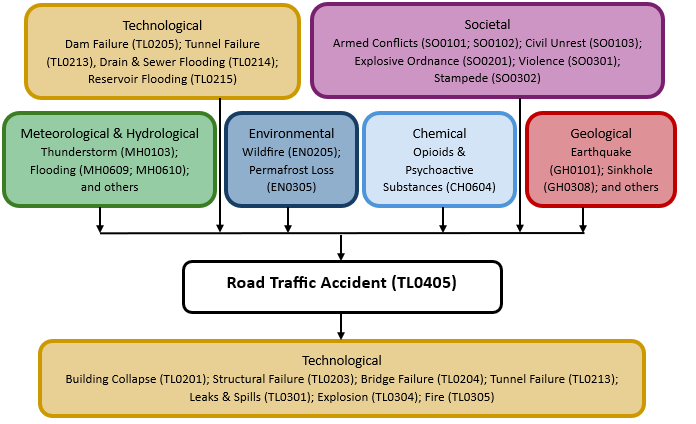
The figure below summarises common interactions between road traffic accidents and other hazards. This information should be used with caution and not be solely relied upon in Disaster Risk Management, particularly as some interactions may not have been included. Note that hazardous events occurring together or locally in space or time may not necessarily cause, amplify, or be otherwise related to each other. Specific examples of multi-hazard context can be found in the ‘Hazard drivers’ and ‘Impacts’ sections above.
Multi-hazard diagram
Risk Management
The safe system approach to road safety aims to ensure a safe transport system for all road users. This approach takes into account people’s vulnerability to serious injuries and recognizes that the system should be designed to accommodate human error. The cornerstones of this approach are safe roads and roadsides, safe speeds, safe vehicles, and safe road users, all of which must be addressed in order to eliminate fatal crashes and reduce serious injuries (WHO, 2023 a).
The 2030 Agenda for Sustainable Development has set an ambitious target of halving the global number of deaths and injuries from road traffic accidents by 2020 (United Nations, no date). The United Nations General Assembly has set an ambitious target of halving the global number of deaths and injuries from road traffic crashes by 2030 (A/RES/74/299) (UNGA 2020).
The WHO’s Global Status Report on Road Safety 2023, presents information on road safety from 172 countries and territories (WHO 2023). This report is the fifth in a series and provides an overview of the road safety situation globally. The global status reports are the official tool for monitoring the Decade of Action for Road Safety (2021-2030). The World Health Organization (WHO) reported that approximately 1.19 million people lost their lives on the world’s roads in 2021 - a 5% drop when compared to the 1.25 million deaths in 2010 – and up to 50 million are injured (WHO 2023).
In September 2020, the UN General Assembly adopted resolution A/RES/74/299 "Improving global road safety", proclaiming the Decade of Action for Road Safety 2021-2030, with the ambitious target of preventing at least 50% of road traffic deaths and injuries by 2030. WHO and the UN regional commissions, in cooperation with other partners in the UN Road Safety Collaboration, have developed a Global Plan for the Decade of Action, which was released in October 2021 (WHO 2021).
The Global Plan aligns with the Stockholm Declaration, by emphasizing the importance of a holistic approach to road safety and calling on continued improvements in the design of roads and vehicles; enhancement of laws and law enforcement; and provision of timely, life-saving emergency care for the injured (WHO 2021). The Global Plan also reflects the Stockholm Declaration’s promotion of policies to promote walking, cycling and using public transport as inherently healthy and environmentally sound modes of transport (WHO 2020). Progress made during the previous Decade of Action for Road Safety 2011-2020 has laid the foundation for accelerated action in the years ahead. Among the achievements are the inclusion of road safety on the global health and development agenda, broad dissemination of scientific guidance on what works, strengthening of partnerships and networks, and mobilization of resources. This new Decade of Action provides an opportunity for harnessing the successes and lessons of previous years and building upon them to save more lives.
In summary, WHO works with Member States and partners across sectors to support road safety evaluation, implementation and planning. As the lead agency for road safety in the United Nations, WHO plays a key role in guiding global efforts by advocating for road safety at the highest levels, compiling and sharing good practices and raising awareness of road safety (WHO 2023 a). WHO serves as the secretariat for the United Nations Decade of Action for Road Safety 2021–2030, which aims to reduce road traffic deaths and injuries by at least 50% by 2030. This includes convening a global network of heads of national road safety agencies, producing global status reports to track progress, and providing technical assistance (WHO 2023 b). WHO works with a range of partners to provide technical support to countries. For example, WHO works with the Bloomberg Initiative for Global Road Safety (BIGRS) to reduce fatalities and injuries from road traffic crashes in a range of low- and middle-income countries (WHO 2023 a). WHO chairs the UN Road Safety Collaboration mechanism and organizes and hosts, with key partners, high- profile advocacy events such as UN Rroad Ssafety Wweeks and the annual World Day of Remembrance for Road Traffic Victims (WHO 2023a).
The 4th Ministerial Conference, hosted by the Government of Morocco in February 2025, made new national road safety commitments and ministers from 100 countries and endorsed the Marrakech Declaration that calls on governments to make road safety a political priority, ensure sustained funding and to advance actions to achieve the goal of halving road deaths by 2030 (WHO, 2025).
Many accidents involving the transport of dangerous goods still occur in countries all around the world. UNECE is ready to support all countries to implement proven United Nations instruments to prevent such accidents from occurring and to reduce the severity of their consequences (UNECE, 2023). For 75 years, UNECE has provided an intergovernmental platform where countries around the world come together to forge tools for economic cooperation and negotiate and adopt UN conventions and recommendations on inland transport and elaborate updates and implementation of the conventions. The 59 UN conventions are considered indispensable for developing safe, efficient and sustainable inland transport systems. Among them, seven conventions provide legal frameworks that build safer roads and safer vehicles, safe handling of dangerous goods and ensure that we have safer drivers and safe road users (UNECE 2023). The Agreement concerning the International Transport of Dangerous Goods by Road (ADR) is one of these seven UN conventions to improve global road safety United Nations Treaty Collection 1957 (UN Treaty Collection 2025).
Urban planning strategies to reduce traffic accidents include traffic calming measures, complete streets design, and integration of transportation and land use planning. Predictive models can help identify high-risk areas for targeted interventions before accidents occur (Yu et al., 2024; Fang et al. 2022).
Monitoring
24-hour surveillance cameras and other sensors are available on many roads. However, increasingly effective road traffic accident monitoring requires both sophisticated data integration and advanced analytical tools. Research demonstrates that combining traditional travel surveys with location-based big data and discrete choice models can produce more accurate travel pattern estimates (Wan et al., 2021), which are essential for understanding traffic flow contexts where accidents occur. These multi-source data approaches should be complemented by AI-powered planning intelligence systems that can evaluate street network configurations for safety implications (Fang et al., 2022). Together, these methodologies enable the creation of dynamic monitoring systems that not only identify current accident hotspots but can predict emerging risk areas based on changing travel patterns and infrastructure configurations, allowing for proactive rather than reactive safety interventions.
References
Department for Transport (DfT), 2023. Recovery operators: working with electric vehicles. [online]. Accessed 21 May 2025.
Hague Conference on Private International Law (HCCH), 1971. Convention on the law applicable to traffic accidents [online]. February 2025.
Fang, Z., Jin, Y. and Yang, T., 2021. Incorporating planning intelligence into deep learning: A planning support tool for street network design. Journal of Urban Technology, 29(2), pp.99–114 [online]. DOI: 10.1080/10630732.2021.2001713 Accessed 21 May 2025.
Fang, Z., Jin, Y. and Yang, T., 2022. Incorporating planning intelligence into deep learning: A planning support tool for street network design. Journal of Urban Technology, 29(2), pp.99–114 [online]. DOI: 10.1080/10630732.2021.2001713 Accessed 21 May 2025.
Fang, Z., Jin, Y., Zheng, S., Zhao, L. and Yang, T., 2024.
Mason, D. and Brabhaharan, P., 2021. Characterisation of transport resilience and measures to enhance resilience in the recovery after the 2016 Kaikōura earthquake. Bulletin of the New Zealand Society for Earthquake Engineering, 54(2), pp.69–81. [online]. DOI: 10.5459/bnzsee.54.2.69-81 Accessed 21 February 2025.
United Nations (UN), no date. Transforming Our World: The 2030 Agenda for Sustainable Development. United Nations Department of Economic and Social Affairs (UNDESA). [online]. Accessed 21 February 2025.
United Nations General Assembly (UNGA), 2020. Resolution 74/299: Improving global road safety. [online]. Accessed 17 March 2025.
United Nations Treaty Collection (UNTC), 2025. Agreement concerning the International Carriage of Dangerous Goods by Road (ADR), Geneva, 1957. [online]. Accessed 17 March 2025.
United Nations Economic Commission for Europe (UNECE), 2021. Injury accidents in road traffic - Data Portal. [online]. Accessed 21 February 2025.
United Nations Economic Commission for Europe (UNECE), 2023. Transport of dangerous goods. [online]. Accessed 21 February 2025.
United Nations Economic Commission for Europe (UNECE), European Union (EU) and International Transport Forum (ITF), 2019. Glossary for transport statistics, 5th ed. [online]. Accessed 21 February 2025.
Wan, L., Yang, T., Jin, Y., Wang, D., Shi, C., Yin, Z. and Pan, H., 2021. Estimating commuting matrix and error mitigation – A complementary use of aggregate travel survey, location-based big data and discrete choice models. Travel Behaviour and Society, 25, pp.102–111. [online]. DOI: 10.17863/CAM.71814. Accessed 21 May 2025.
World Health Organization (WHO), 2021. WHO kicks off a Decade of Action for Road Safety. [online]. Accessed 21 February 2025.
World Health Organization (WHO), 2013a. Road traffic injuries. [online]. Accessed 21 February 2025.
World Health Organization (WHO), 2023b. Global status report on road safety 2023. Geneva: World Health Organization. [online]. Accessed 21 February 2025.
World Health Organization (WHO), 2025. Fourth Global Ministerial Conference on Road Safety. [online]. Accessed 17 March 2025.
Yan, M., Chen, W., Wang, J., Zhang, M. and Zhao, L., 2021. Characteristics and causes of particularly major road traffic accidents involving commercial vehicles in China. International Journal of Environmental Research and Public Health, 18(8), 3878. [online] DOI: 10.3390/ijerph18083878. Accessed 17 March 2025.
Yao, Y., Cheng, L., Chen, S., Chen, H., Chen, M., Li, N., Li, Z., Dongye, S., Gu, Y. and Yi, J., 2023. Study on road network vulnerability considering the risk of landslide geological disasters in China’s Tibet. Remote Sensing, 15(17), 4221. [online] DOI: 10.3390/rs15174221. Accessed 17 March 2025.
Yu, X., Ma, J., Tang, Y., Yang, T. and Jiang, F., 2024. Can we trust our eyes? Interpreting the misperception of road safety from street view images and deep learning. Accident Analysis & Prevention, 197, 107455. [online] DOI: 10.1016/j.aap.2023.107455 Accessed 21 May 2025.