
Ice Flow
Ice flow is the motion of ice driven by gravitational forces, ice stress or, for sea ice, wind, water currents and tide (AMS, 2012).
Primary reference(s)
AMS, 2012. Ice flow. Glossary of Meteorology. American Meteorological Society (AMS). Accessed 16 May 2025.
Annotations
Additional scientific description
Ice flow in a marine setting includes ice as glaciers which terminate in the ocean in the form of floating ice tongues or ice shelves, sea ice, and river and lake ice.
Floating ice is defined as any form of ice found floating on water. The principal types of floating ice are lake ice, river ice, and sea ice which form by the freezing of water at the surface. Sea ice can occur in the form of fast ice or drift/pack ice (AMS, 2012a). Floating ice can also be found where glacier ice, which flows under gravitational forces or ice stress, terminates in the ocean. This can create floating ice in the form of floating ice tongues, which are narrow extensions of a glacier (AMS, 2012b) or floating ice shelves, thick ice formation with a fairly level surface, formed along a polar coast and in shallow bays, and inlets where it is attached to the shore (AMS, 2012c).
Ice flow of marine origin is a hazard for navigation in the form of floating ice in motion and the use of ice surfaces as transport routes. This includes icebergs which calve from marine terminating glaciers, ice jams, ice floes and ice edge.
Metrics and numeric limits
Not identified.
Key relevant UN convention / multilateral treaty
Antarctic Treaty System (ATS) (Secretariat of the Antarctic Treaty, 1959).
Arctic Council (Arctic Council Secretariat, 2025).
International Maritime Organization (IMO) Polar Code (IMO, 2017).
Drivers
Glacial ice flow is primarily driven by gravity-induced internal deformation and basal processes, including sliding and deformation of subglacial sediments. Internal deformation occurs as ice, under its own weight, slowly creeps downslope, a process influenced by ice thickness, surface slope, temperature, and crystal structure (IPCC, 2007). Basal sliding is activated when meltwater or deformable sediments reduce friction at the ice–bed interface, leading to accelerated flow—particularly in temperate glaciers and those terminating in the ocean (IPCC, 2007).
Impacts
Ice flow can have significant impacts economically, environmentally, and socially, with these impacts particularly evident in the navigation and shipping industries. Despite new technologies, ice poses serious risks to navigation and hardships, particularly when ice begins to converge around a ship. Wind and water currents can cause ice cover against a land boundary, resulting in increased compression or ice pressure as “ice cover compresses and ice accumulates to form ridges” (Kubat et al., 2015). In these circumstances, ships may encounter serious risks due to increased pressure on the hull and hinderances to ship progress owing to the ridges. In extreme cases, this may lead to ship damage, and the lifting of smaller vessels onto the ice (Kubat et al., 2015).
Ice flow can pose a risk to the safety of offshore structures, as well as ships. In the Arctic, for example, ships and offshore structures encounter complex environments, “where ice floe impact load including icebergs, bergy bits, isolated sea ice floe and other ice conditions, is a crucial factor for their design” (Zhao et al., 2023).
Multi-hazard context
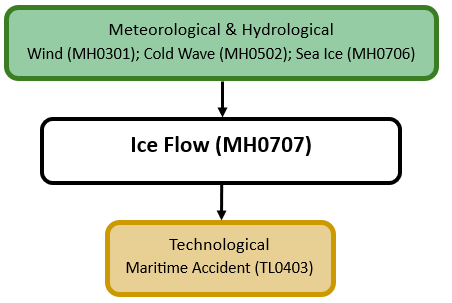
The figure below summarises common interactions between ice flow and other hazards. This information should be used with caution and not be solely relied upon in Disaster Risk Management, particularly as some interactions may not have been included. Note that hazardous events occurring together or locally in space or time may not necessarily cause, amplify or be otherwise related to each other. Specific examples of multi-hazard context can be found in the ‘Hazard drivers’ and ‘Impacts’ sections above.
Multi-hazard diagram
Risk Management
No Information Available
Monitoring
The section above and the table below offer an overview of monitoring ice flow. This information can be used for forecasting within a national early warning system (EWS). Since EWS capacities and processes differ across countries, the most current and specific information regarding EWS should be obtained from the appropriate national or regional agency/authority responsible for disaster management.
| Which institution(s) produce(s) Disaster Risk Data/Information? |
|
| How is the Hazard Observed/Monitored/Forecast? | Ice flows are monitored using satellites, radar, and ocean buoys to track their movement, thickness, and melting rates. Scientists analyse temperature changes, wind patterns, and ocean currents to predict how ice will shift over time. Computer models simulate ice flow behaviour, helping forecasters issue warnings for shipping, offshore industries, and flood-prone areas. These early alerts support navigation safety, infrastructure protection, and climate research. |
References
AMS, 2012a. Ice flow. Glossary of Meteorology. American Meteorological Society (AMS). Accessed 16 May 2025.
AMS, 2012b. Ice tongue. Glossary of Meteorology. American Meteorological Society (AMS). Accessed 16 May 2025.
AMS, 2012c. Ice shelf. Glossary of Meteorology. American Meteorological Society (AMS). Accessed 16 May 2025.
Arctic Council Secretariat, 2025. Arctic Council. Accessed 16 May 2025.
International Maritime Organization (IMO), 2017. International Code for Ships Operating in Polar Waters (Polar Code). International Maritime Organization. Accessed 16 May 2025.
Kubat, I., Sayed, M., Timco, G.W. and Sudom, D.,2015. ‘Chapter 18 – Floating ice and ice-pressure challenge to ships’, in Haeberli, W. and Whiteman, C. (eds.) Snow and Ice-related Hazards, Risks, and Disasters. 2nd edn. Amsterdam: Elsevier, pp. [insert page range if known]. Accessed 16 May 2025.
Secretariat of the Antarctic Treaty (1959). Antarctica Treaty. Accessed 16 May 2025.
Zhao, Y., Zhang, J., Li, H., Wang, J. and Zhou, Y. (2023) ‘Experimental and numerical studies on hydrodynamic effects of ice floe drift and impact process in uniform current’, Cold Regions Science and Technology, Article ID: 104011. Accessed 16 May 2025.