
Groundwater Flooding
A groundwater flood is the emergence of groundwater at the ground surface away from perennial river channels or the rising of groundwater into man-made ground, under conditions where the ‘normal’ ranges of groundwater level and groundwater flow are exceeded (BGS, 2010).
Primary reference(s)
BGS, 2010. Groundwater flooding research overview. British Geological Survey (BGS).. Accessed 16 May 2025.
Annotations
Additional scientific description
Groundwater flooding is a different type of hazard than river or surface water flooding in that the onset is not an immediate process where water suddenly encroaches areas not normally inundated. In contrast, the water levels within permeable strata will gradually rise over time giving rise to the formation of springs and ephemeral streams, areas of ponding, surcharging of wells and boreholes, and water ingress in basements, tunnels, or other below- ground structures. Water levels can remain high for many weeks or even months, depending on the nature of the underlying strata and meteorological and hydrological conditions (WMO, 2007).
Groundwater flooding occurs when the natural underground drainage system cannot drain rainfall away quickly enough, causing the water table to rise above the ground surface. It can pose a significant flood hazard for many rural communities, and its increased frequency in recent years highlights the need for further research (Geological Survey Ireland, 2021).
Both perched groundwater and periodic springs can be causes of floods:
- Perched groundwater: a groundwater body, generally of moderate dimensions, supported by a relatively impermeable stratum and which is located between a water table and the ground surface (WMO, 2012).
- Periodic spring: a spring flowing irregularly in relation to the hydrological regime of groundwater or in connection with karstic conditions is generally known as a periodic or seasonal spring (WMO, 2012).
Metrics and numeric limits
Not identified.
Key relevant UN convention / multilateral treaty
European Union Floods Directive (2007/60/EC): The Directive on the assessment and management of flood risks entered into force on 26 November 2007. It requires member states to assess if all water courses and coastlines are at risk from flooding, to map the flood extent and assets and humans at risk in these areas, and to take adequate and coordinated measures to reduce this flood risk. The Directive also reinforces the rights of the public to access this information and to have a say in the planning process (European Commission, 2007).
Drivers
No Information Available
Impacts
Floods are one of the most common hazards. Due to their usually slow onset, groundwater flooding’s main health effects are related to water-borne and vector-borne diseases.
The effects of flooding on health are extensive and significant, ranging from mortality and injuries resulting from trauma and drowning to infectious diseases and mental health problems (acute and long- term). While some of these outcomes are relatively easy to track, ascertaining the human impact of floods is still weak. For example, it has been reported that two-thirds of deaths associated with flooding are from drowning, with the other third from physical trauma, heart attacks, electrocution, carbon monoxide poisoning and fire. Often, only immediate traumatic deaths from flooding are recorded (WHO, 2013).
Morbidity associated with floods is usually due to injuries, infections, chemical hazards and mental health effects (acute as well as delayed) (WHO, 2013). Hypothermia may also be a problem, particularly in children, if trapped in floodwaters for lengthy periods (WHO, no date). There may also be an increased risk of respiratory tract infections due to exposure (loss of shelter, exposure to flood waters and rain). Power cuts related to floods may disrupt water treatment and supply plants, thereby increasing the risk of water-borne diseases, as well as affecting the proper functioning of health facilities, including cold chain (WHO, no date). Floods can potentially increase the transmission of the following communicable diseases: water-borne diseases (such as typhoid fever, cholera, leptospirosis and hepatitis A) and vector-borne diseases (such as malaria, dengue and dengue haemorrhagic fever, yellow fever, and West Nile fever) (WHO, no date).
The longer-term health effects associated with a flood are less easily identified. They include effects due to displacement, destruction of homes, delayed recovery and water shortages (WHO, 2013).
Multi-hazard context
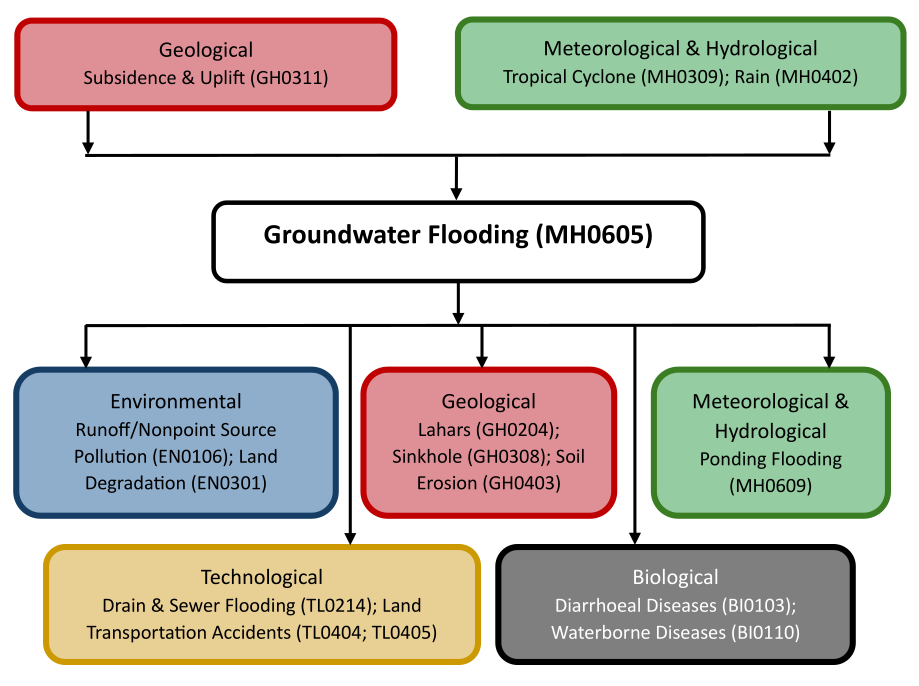
The figure below summarises common interactions between groundwater flooding and other hazards. This information should be used with caution and not be solely relied upon in Disaster Risk Management, particularly as some interactions may not have been included. Note that hazardous events occurring together or locally in space or time may not necessarily cause, amplify or be otherwise related to each other. Specific examples of multi-hazard context can be found in the ‘Hazard drivers’ and ‘Impacts’ sections above.
Multi-hazard diagram
Risk Management
Effective risk management involves continuous groundwater monitoring, hydrological modelling, and restricting development in high-risk zones. Sustainable drainage systems and early warning mechanisms can help mitigate impacts, particularly for infrastructure, basements, and agricultural land. Long-term resilience depends on coordinated planning among local authorities, environmental agencies, and water management institutions. (Environment Agency, 2012)
Monitoring
The section above and the table below offer an overview of monitoring groundwater flooding. This information can be used for forecasting within a national early warning system (EWS). Since EWS capacities and processes differ across countries, the most current and specific information regarding EWS should be obtained from the appropriate national or regional agency/authority responsible for disaster management.
| Which institution(s) produce(s) Disaster Risk Data/Information? |
|
| How is the Hazard Observed/Monitored/Forecast? | Groundwater floods are monitored using boreholes, groundwater sensors, and satellite data to track rising water tables and soil moisture levels. Hydrologists analyse prolonged rainfall, snowmelt, and aquifer recharge rates to assess flood risks. Forecasting groundwater floods involves computer models that simulate underground water movement based on weather patterns and geological conditions. Since groundwater flooding develops slowly but lasts longer than surface floods, early warnings help communities, infrastructure managers, and planners prepare for prolonged waterlogging and its impacts. |
References
Environment Agency. (2012). Groundwater flooding. UK Government. Accessed 15 May 2025.
European Commission, 2007. The EU Floods Directive (2007/60/EC). Accessed 15 May 2025.
Geological Survey Ireland, 2021. What is groundwater flooding?. Accessed 15 May 2025.
Malmgren, K.A.; Neves, M.C.; Gurdak, J.J.; Costa, L.; Monteiro, J.P., 2022, Groundwater Response to Climate Variability in Mediterranean Type Climate Zones with Comparisons of California (USA) and Portugal. Hydrogeol. J. 30, 767–782.
WHO, no date. Flooding and communicable diseases fact sheet. World Health Organization (WHO). Accessed 15 May 2025.
WHO, 2013. Floods in the WHO European Region: Health effects and their prevention. World Health Organization (WHO), Regional Office for Europe. Accessed 15 May 2025.
WMO, 2007. Flood Management Tool Series, Technical Document. World Meteorological Organization (WMO). Conducting Flood Loss Assessments. Accessed 15 May 2025.
WMO, 2012. Definition numbers 1063 and 1069. International Glossary of Hydrology. WMO-No. 385. World Meteorological Organization (WMO). Accessed 15 May 2025.