
Dzud
A dzud (a Mongolian term that describes ‘severe winter conditions’’, sometimes spelled zud) is a cold-season disaster in which anomalous climatic (i.e., heavy snow and severe cold) and/or land-surface (snow/ ice cover and lack of pasture) conditions lead to reduced accessibility and/or availability of forage/pastures, and ultimately to high livestock mortality during winter–spring (Natsagdorj & Dulamsuren, 2001).
Primary reference(s)
Natsagdorj, L. and J. Dulamsuren, 2001. Some aspects of assessment of the dzud phenomena. Pap Meteorol Hydrol 23:3-18 [in Mongolian].
Annotations
Additional scientific description
There is a conventional classification of dzud types based on direct factors contributing to conditions that prevent animals from grazing for consecutive days, finally resulting in their starvation. These include (Fernandez-Gimenez et al., 2011):
- White dzud: defined as conditions during which grasses that grow during the summer and decay during the subsequent cold season are covered by deep snow, preventing grazing. The snow depth during these conditions substantially exceeds plant height. This is the most common and disastrous dzud type.
- Iron (or glass) dzud: happens when grasses are covered with impenetrable ice that is produced through melted and refrozen snow (most likely occurring during spring and autumn).
- Black dzud: refers to freezing temperatures and lack of snow in winter (essential for livestock and human water) and limited forage/pasture due to preceding summer drought.
- Storm and cold dzuds: both tend to result from strong winds and blizzard, and cold surge conditions. These weather patterns reduce the intake of pasture by livestock, which is determined by the availability of phytomass (i.e., not covered by snow and ice) and grazing time.
- Hoof dzud: is primarily associated with lack of pasture, often caused by overgrazing. This may occur when an excessive number of animals are concentrated in relatively good but limited pasturelands. A Dzud can occur as a cascading hazard to succeeding climatic hazards such as summer drought.
A combined (or multiple) dzud occurs when two or more of the above types of dzud occur together.
Note: human-induced vulnerability, including inadequate pasture management, lack of herder experience, poverty, and insufficient winter preparedness can increase the risks of dzud impacts.
Metrics and numeric limits
Not available.
Key relevant UN convention / multilateral treaty
Sendai Framework for Disaster Risk Reduction 2015-2030.
Drivers
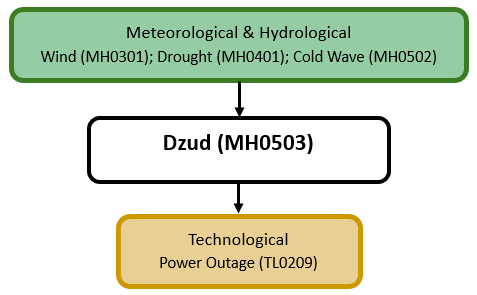
A dzud is a compound hazard occurring in a cold dry climate, and encompassing drought, heavy snowfall, extreme cold, and windstorms. Severe dzuds (high mortality) result from a combination of growing-season drought and severe weather (Natsagdorj and Dulamsuren, 2001; Nandintsetseg et al., 2017, 2018a,b).
Impacts
Dzud can last all year round and can cause mass livestock mortality and dramatic socioeconomic impacts – including unemployment, poverty, and mass migration from rural to urban areas, giving rise to heavy pressure on infrastructure and social and ecosystem services (Murray et al., 2012). Dzuds occurred in Mongolia in 1944–1945, 1954–1955, 1956–1957, 1967–1968, 1976–1977, 1986–1987, 1993–1994, and 1996–1997. The dzud of 1944–1945 was a record for the 20th century with mortality of one-third of Mongolia’s total livestock, with the 2009–2010 dzud causing similarly high animal mortality (Murray et al., 2012).
Multi-hazard context
The figure below summarises common interactions between dzuds and other hazards. This information should be used with caution and not be solely relied upon in Disaster Risk Management, particularly as some interactions may not have been included. Note that hazardous events occurring together or locally in space or time may not necessarily cause, amplify, or be otherwise related to each other. Specific examples of multi-hazard context can be found in the ‘Hazard drivers’ and ‘Impacts’ sections above.
Multi-hazard diagram
Monitoring
The section above and the table below offer an overview of monitoring dzuds. This information can be used for forecasting within a national early warning system (EWS). Since EWS capacities and processes differ across countries, the most current and specific information regarding EWS should be obtained from the appropriate national or regional agency/authority responsible for disaster management.
| Which institution(s) produce(s) Disaster Risk Data/Information? |
|
| How is the Hazard Observed/Monitored/Forecast? | Dzud is monitored using satellites, weather stations, and ground sensors to track extreme cold, heavy snowfall, and vegetation conditions that impact livestock survival. Meteorologists analyse polar air movements, jet stream shifts, and moisture levels and advanced weather models to predict extreme cold events, enabling forecasters to issue early warnings. These warnings help herders, policymakers, and emergency responders prepare for livestock losses, food shortages, and energy demands in affected regions. |
References
Fernandez-Gimenez, M., B. Batjav and B. Baival, 2011. Understanding Resilience in Mongolian Pastoral Social-ecological Systems. Accessed 16 May 2025.
Murray, V., G. McBean, M. Bhatt, S. Borsch, T.S. Cheong, W.F. Erian, S. Llosa, F. Nadim, M. Nunez, R. Oyun, and A.G. Suarez, 2012. Case studies. In: Managing the Risks of Extreme Events and Disasters to Advance Climate Change Adaptation. A Special Report of Working Groups I and II of the Intergovernmental Panel on Climate Change (IPCC). Cambridge University Press, pp. 487-542. Accessed 16 May 2025.
Nandintsetseg, B., M. Shinoda and B. Erdenetsetseg, 2017. Contributions of multiple climate hazards and overgrazing to the 2009/2010 winter disaster in Mongolia. Natural Hazards, 92:109- 126. Accessed 16 May 2025.
Nandintsetseg, B., M. Shinoda, Ch. Du and E. Munkhjargal, 2018a. Cold-season disasters on the Eurasian steppes: Climate-driven or man-made. Scientific Reports, 8:14769. Accessed 16 May 2025.
Nandintsetseg, B., M. Shinoda and B. Erdenetsetseg, 2018b. Developing an early warning system of Dzud (cold-season disaster) in Mongolia. International Federation of Red Cross and Red Crescent Societies. Accessed 16 May 2025.