
Heatwave
A heatwave is a marked, unusual period of hot weather over a region persisting for at least two or three consecutive days and nights during the hot period of the year based on local climatological conditions, with thermal conditions recorded above given thresholds (WMO and WHO, 2015).
Primary reference(s)
WMO and WHO, 2015. Heatwaves and Health: Guidance on Warning-System Development. World Meteorological Organization (WMO) and World Health Organization (WHO). Accessed 16 May 2025.
Annotations
Additional scientific description
The World Meteorological Organization (WMO) uses a definition that has practical utility in addressing human health impacts. It defines heatwaves as, “periods of unusually hot and dry or hot and humid weather that have a subtle onset and cessation, a duration of at least two to three days and a discernible impact on human activities” (WMO and WHO, 2015), however, heatwave cessation can also be abrupt (e.g. Engel et al., 2013). Temperature thresholds for heatwaves are often defined using percentile thresholds, typically the 90th or 95th percentile (e.g. Nairn and Fawcett, 2015).
The above definition is not sufficient to guide National Meteorological and Hydrological Services in developing practical methods and tools for a heatwave monitoring system that would allow comparisons across regional or international borders. Common characteristics of heatwaves, such as magnitude, duration, extent, severity, and timing of the event during the heat season(s), are often used to compare heatwave events (Global Heat Health Information Network, 2020).
Similar to heatwaves, warm spells are defined as persistent periods of abnormally warm weather relative to time of year and the local climatology, but they are not confined to the hot season(s) (WMO, 2020). A warm spell can similarly be defined in terms of the 90th or 95th percentile of daily maximum temperature (Tmax).
Anthropogenic climate change has resulted in an increase in the intensity, frequency, and duration of heatwaves (Perkins et al., 2012) and extremely hot days (Rogers et al., 2021), with these trends projected to continue (Seneviratne et al., 2012).
Metrics and numeric limits
It is not possible to adopt universal numeric limits to characterise extreme heat because heatwave impacts are locally defined and can vary significantly at sub-national scales, due to influences of geography and topography, built environment, acclimatisation of the local population, and atmospheric and other conditions. International technical efforts instead focus on the adoption of consistent approaches for allowing countries to define and monitor extreme heat on an operational basis, based on their local conditions, applications requirements, and other descriptive characteristics.
National warning systems use a range of diverse indices and locally defined thresholds to describe excessive or dangerous heat conditions. Since extreme temperatures can be influenced by other meteorological conditions, such as humidity, wind, and solar radiation, many extreme heat indices consider multiple thermal variables. Examples of national parameters used to define heat warnings include those for Canada (Environment and Climate Change Canada, 2019), China (China Meteorological Administration, 2012), United States (NOAA, 2019), Republic of Korea (KMA, 2019), India (Government of India, 2020), and Australia (Bureau of Meteorology, 2025; Nairn and Fawcett, 2015).
Many warning definitions use bio-meteorological or holistic indices to better characterise heat risk, including:
- Bio-meteorological Indices: heat index, humidex, apparent temperature, excess heat index, human energy-budget based indices (e.g., standard effective temperature, perceived temperature, physiological equivalent temperature, universal thermal climate index) (Zare et al., 2018).
- Holistic approach: wet-bulb globe temperature, health-related assessment of the thermal environment, Heat Stress Index, and environmental assessment of cumulative heat, Excess Heat Index-acclimatization, Excess Heat Factor (Zare et al., 2018).
The WMO guidelines on the definition and monitoring of extreme weather and climate events (WMO, 2021) seek to provide guidance on defining, characterising, monitoring and reporting information on extreme weather and climate events on an operational basis. It is expected that adherence to these guidelines by the meteorological community will provide a basis for attributing extreme weather and climate events and for verifying forecasting and prediction services (WMO, 2020).
Key relevant UN convention / multilateral treaty
United Nations Framework Convention on Climate Change (UNFCCC) (UN General Assembly, 1994).
Sendai Framework for Disaster Risk Reduction (UNDRR, 2015).
United Nations Framework Convention to Combat Desertification (UNCCD, 1994).
Drivers
Persistent, abnormally high temperatures can be caused by a variety of climate and weather phenomena, but the principal driver of a heatwave is a strong and slow-moving high-pressure system that remains in place over an area for an extended period of time. In some cases, these systems are held in place by an atmospheric blocking pattern, such as an omega block, which is a pair of low-pressure zones that surround a high-pressure zone and lock it in place. Other drivers of heatwaves include land surface interactions and soil moisture, nearby sea surface temperatures, weather extremes such as tropical storms, climatic extremes such as droughts, and longer-term climate patterns, such as the El Niño-Southern Oscillation (ENSO), the Southern Annular Mode (SAM), the Indian Ocean Dipole (IOD), the Atlantic Multidecadal Oscillation (AMO), and the Madden-Julian Oscillation (MJO) (Global Heat Health Information Network, 2020; Perkins, 2015).
Impacts
Heatwaves, warm spells, extreme temperatures, and high humidity can have significant impacts on human and animal health, worker productivity, agricultural production, ecosystems, and economies. The built environment and critical infrastructure that supports society, such as buildings, water, transportation and energy systems, are also adversely affected by heatwaves (Boyle et al., 2010). The United Nations Secretary-General’s Call to Action on Extreme Heat underscored the grave human and economic impacts of extreme heat. According to the report, approximately 489,000 heat-related deaths occurred each year from 2000 to 2019, and heat exposure-related loss in labour capacity resulted in average potential income losses equivalent to US$863 billion in 2022 (United Nations, 2024).
Multi-hazard context
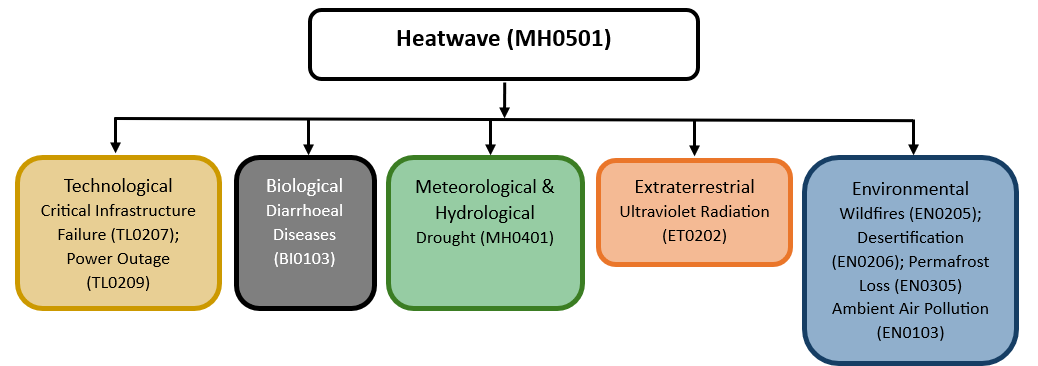
The figure below summarises common interactions between heatwaves and other hazards. This information should be used with caution and not be solely relied upon in Disaster Risk Management, particularly as some interactions may not have been included. Note that hazardous events occurring together or locally in space or time may not necessarily cause, amplify, or be otherwise related to each other. Specific examples of multi-hazard context can be found in the ‘Hazard drivers’ and ‘Impacts’ sections above.
Multi-hazard diagram
Risk Management
Heatwaves interact with and amplify the impacts, magnitude, and severity of other hazards such as wildfire, drought, flash flooding, urban heat islands, and hazardous air quality. A multi-hazard risk management approach is therefore recommended for heatwaves, including forecast services, early warning systems and planning. In urban areas, consideration of night-time temperatures and urban heat island effects is important for determining appropriate thresholds for heatwave advisories. Essential components of health impact-orientated warning systems and early action for heatwaves, include assessments of heatwaves and health impacts, definitions and methodologies, communication of warnings, intervention strategies, and longer-term planning perspectives for managing heatwave events (WMO and WHO, 2015).
Heatwave impacts can be exacerbated when they co-occur with other heatwaves (e.g. Kornhuber et al., 2020), with other hazards (Zscheischler et al., 2018), or when they occur in urban areas (e.g. Rogers et al., 2019). For example, drought can severely reduce soil moisture, thus intensifying heatwaves. Further, anthropogenic climate change is driving an increase in the frequency, intensity, and spatial extent of concurrent heatwaves (Rogers et al., 2022).
Monitoring
The section above and the table below offer an overview of monitoring heatwaves. This information can be used for forecasting within a national early warning system (EWS). Since EWS capacities and processes differ across countries, the most current and specific information regarding EWS should be obtained from the appropriate national or regional agency/authority responsible for disaster management.
| Which institution(s) produce(s) Disaster Risk Data/Information? |
|
| How is the Hazard Observed/Monitored/Forecast? | Heatwaves are monitored using weather observation stations and satellites to track extreme heat and humidity levels. Meteorologists use weather models to forecast the intensity and duration of humidity and heatwaves to issue early warnings. These warnings assist public health officials, energy providers, and communities in preparing for heat-related risks, including dehydration, power outages, and crop damage. |
References
Boyle, C., Mudd, G., Mihelcic, J.R., Anastas, P., Collins, T., et al., 2010. Delivering sustainable infrastructure that supports the urban built environment. Environmental Science & Technology, [online]. Accessed 16 May 2025.
Bureau of Meteorology, 2025. Heatwave service for Australia. [online]. Accessed 16 May 2025.
China Meteorological Administration, 2012. Weather Warnings: Heatwave. Accessed 16 May 2025.
Environment and Climate Change Canada, 2019. Meteorological Service of Canada heat warning criteria [online]. Accessed 16 May 2025.
Global Heat Health Information Network, 2020. Understanding Heat. Accessed 16 May 2025.
Government of India, 2020. Forecast Demonstration Project (FDP) for Improving Heat Wave Warning over India. Implementation Report, 2019. India Meteorological Department [online]. Accessed 16 May 2025.
KMA, 2019. Criteria for advisory/warning information. Accessed 16 May 2025.
Kornhuber, K., Coumou, D., Vogel, E., Lesk, C., Donges, J.F., Lehmann, J. and Horton, R.M., 2020. Amplified Rossby waves enhance risk of concurrent heatwaves in major breadbasket regions. Nature Climate Change, 10(1), pp. 48-53.
Nairn, J.R. and Fawcett, R.J., 2015. The excess heat factor: A metric for heatwave intensity and its use in classifying heatwave severity. International Journal of Environmental Research and Public Health, 12(1), pp. 227-253.
National Oceanic and Atmospheric Administration (NOAA), 2019. Heat index. National Oceanic and Atmospheric Administration (NOAA). Accessed 16 May 2025.
Perkins, S.E., Alexander, L.V. and Nairn, J.R., 2012. Increasing frequency, intensity, and duration of observed global heatwaves and warm spells. Geophysical Research Letters, 39(20).
Perkins, S.E., 2015. A review on the scientific understanding of heatwaves—Their measurement, driving mechanisms, and changes at the global scale. Atmospheric Research, 164, pp. 242-267.
Rogers, C.D., Gallant, A.J. and Tapper, N.J., 2019. Is the urban heat island exacerbated during heatwaves in southern Australian cities? Theoretical and Applied Climatology, 137, pp. 441-457.
Rogers, C.D., Kornhuber, K., Perkins-Kirkpatrick, S.E., Loikith, P.C. and Singh, D., 2022. Sixfold increase in historical Northern Hemisphere concurrent large heatwaves driven by warming and changing atmospheric circulations. Journal of Climate, 35(3), pp. 1063-1078.
Rogers, C.D., Ting, M., Li, C., Kornhuber, K., Coffel, E.D., Horton, R.M., Raymond, C. and Singh, D., 2021. Recent increases in exposure to extreme humid-heat events disproportionately affect populated regions. Geophysical Research Letters, 48(19), p. e2021GL094183.
Seneviratne, S.I., and Coauthors, 2012. Changes in climate extremes and their impacts on the natural physical environment. In: Managing the Risks of Extreme Events and Disasters to Advance Climate Change Adaptation, C.B. Field, Eds., Cambridge University Press, pp. 109–230. Accessed 16 May 2025.
United Nations (UN) General Assembly, 1994. United Nations Framework Convention on Climate Change: Resolution adopted by the General Assembly, 20 January 1994. A/RES/48/189. Accessed 16 May 2025.
United Nations (UN), 2024. United Nations Secretary-General’s Call to Action on Extreme Heat. Accessed 16 May 2025.
United Nations Convention to Combat Desertification (UNCCD), 1994. UN Convention to Combat Desertification. Accessed 16 May 2025.
World Meteorological Organization (WMO), 2021. Definition and monitoring of extreme weather and climate events. World Meteorological Organization (WMO). In press.
World Meteorological Organization (WMO) and World Health Organization (WHO), 2015. Heatwaves and health: Guidance on warning-system development. World Meteorological Organization (WMO) and World Health Organization (WHO). Accessed 16 May 2025.
Zare, S., Hasheminejad, N., Shirvan, H., Hemmatjo, R., Sarebanzade, K. and Ahmadi, S., 2018. Comparing universal thermal climate index (UTCI) with selected thermal indices/environmental parameters during 12 months of the year. Weather and Climate Extremes, 19, pp. 49-57.
Zscheischler, J., and Coauthors, 2018. Future climate risk from compound events. Nature Climate Change, 8, pp. 469-477. Accessed 16 May 2025.