
Lightning (Electrical Storm)
Lightning is the luminous manifestation accompanying a sudden electrical discharge that takes place from or inside a cloud or, less often, from high structures on the ground or from mountains (WMO, 2017).
Primary reference(s)
WMO, 2017. International Cloud Atlas: Lightening. World Meteorological Organization (WMO). Accessed 15 May 2025.
Annotations
Additional scientific description
Lightning is a transient, high-current electric discharge with path lengths measured in kilometres. The most common source of lightning is the electric charge separated in ordinary thunderstorm clouds. Well over half of all lightning discharges occur within the thunderstorm cloud and are called intracloud discharges (AMS, 2012).
Lightning is a large electrical discharge caused by a thundercloud. It can occur within a cloud as intracloud lightning, between clouds as intercloud lightning, or between the cloud and the earth as cloud-to-ground lightning. A lightning discharge consists of pulses of electric current carried by electrons. The current is driven by a high voltage between the cloud's charge centres or between them and the earth. During the development of a thundercloud, negative charge is accumulated in the hail-forming region at the central part of the cloud, and positive charge in the top region, which consists of ice crystals (Finnish Meteorological Institute, 2019).
Lightning strikes are classified into different types according to their own characteristics. The two most common types are cloud-to-ground lightning and cloud-to-cloud lightning (WMO, 2017).
- Cloud-to-ground lightning is a lightning discharge between a cumulonimbus cloud and the ground. Of all types of lightning, cloud-to-ground lightning poses the greatest threat to people and facilities on the ground (WMO, 2017). The usual cloud-to-ground lightning has been studied more extensively than other lightning forms because of its practical interest (i.e., as a cause of injury and death, disturbances in power and communication systems, and ignition of forest fires) and because lightning channels below cloud level are more easily photographed and studied with optical instruments (AMS, 2012). Cloud-to-ground lightning can occur as either positively or negatively charged bolts. Positively charged bolts are considerably rare, more powerful (e.g., by an order of magnitude or more), and often can strike miles beyond the parent anvil of the thunderstorm (e.g., these positive strikes are referred to as a 'bolt out of the blue') (NOAA, 2019).
- Cloud-to-cloud lightning and cloud-to-air discharges are less common than intracloud or cloud-to-ground lightning. All discharges other than cloud-to-ground are often lumped together and called cloud discharges (AMS, 2012; WMO, 2017). Cloud-to-cloud lightning is the discharge between areas of the cloud without the discharge channel reaching the ground. Most of the time, it occurs between oppositely charged portions of the same cloud, but sometimes, it takes place between two separate clouds. Since the discharge channel of cloud-to-cloud lightning may be obscured by the cloud, it may or may not be visible to an observer on the ground. It may, therefore, be surprising to learn that cloud-to-cloud lightning is, in fact, the most frequently occurring type of lightning. It occurs around ten times more often than cloud-to-ground lightning. Cloud-to-cloud lightning does not threaten life and property on the ground. However, this type of lightning occurs in the sky and sometimes passes through the clear air between clouds; therefore, it is of great practical interest to those concerned with the safety of aircraft (WMO, 2017).
Ball lightning includes a fireball that sometimes appears after a lightning flash. Its diameter is usually between 10 and 20 cm and rarely attains 1 m. The fireball moves slowly through the air or along the ground, and may be distorted in passing through narrow places and usually vanishes suddenly with a violent explosion (WMO, 1992).
Metrics and numeric limits
Lightning is a transient, high-current electric discharge in the atmosphere, typically occurring during thunderstorms. It results from the separation of electric charges within clouds, leading to a rapid release of electrical energy.
Key Characteristics:
- Voltage: A typical lightning flash involves a potential difference of about 300 million volts (NOAA, 2024).
- Current: The peak current of a lightning discharge is approximately 30,000 amperes (NOAA, 2024).
- Temperature: The temperature within the lightning channel can reach up to 30,000 °C (54,000 °F) (Met Office, 2024).
- Speed: The return stroke of lightning travels at about one-third the speed of light, which is approximately 100,000 km/s (62,000 miles per second) (Britannica, 2024).
- Duration: A typical lightning flash lasts about 0.2 seconds, comprising multiple strokes, each lasting a few milliseconds (Britannica, 2024).
Lightning poses significant hazards, including fires, structural damage, and risks to life. Its high temperatures can ignite materials, and the immense electrical energy can cause severe injuries or fatalities to living beings.
Key relevant UN convention / multilateral treaty
Sendai Framework for Disaster Risk Reduction 2015-2030
Drivers
No Information Available
Impacts
Lightning strikes the earth more than 8 million times per day. The risk of being struck is low, but the consequences of lightning strike injuries are serious. During 2003–2012, lightning caused an average of 35 deaths per year in the United States (CDC, no date).
Lightning strikes alone cause numerous fatalities and injuries each year. According to the National Weather Service (NWS), an average of 20-30 people die annually in the United States due to lightning strikes, with many more suffering severe injuries (NOAA, 2023).
Lightning affects various sectors including electricity generation, transmission, and distribution; forestry; agriculture; telecommunications; transportation; and tourism and recreation (Mills et al., 2009). Lightning can ignite wildfires and damage electrical grids, resulting in power outages that may last for days (Alpay et al., 2020). In Canada, for example, annual lightning-related damage and disruption costs have previously been estimated between CA$600 million to CA$1 billion, with forestry and electricity damages accounting for over 85% of the total (Mills et al., 2009).
More recent studies have also demonstrated the significant lightning-related risks to the forestry sector. Studies of the extratropical forests have shown increasing risks to these forests due to lightning fires. The extratropical forests have experienced high fire-related losses, which in turn also carry long-term climate-related implications due to extratropical forests being of global importance for carbon storage (Janssen et al., 2023).
Multi-hazard context
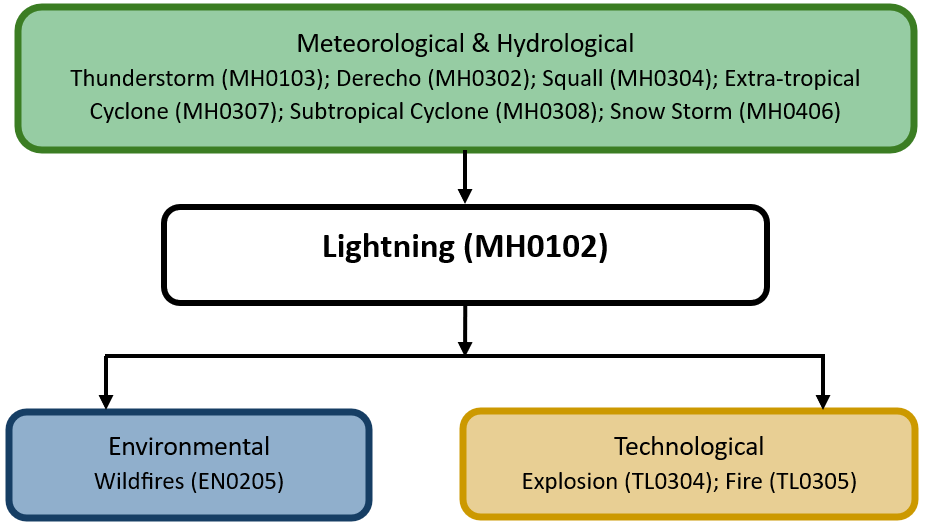
The figure below summarises common interactions between lightning and other hazards. This information should be used with caution and not be solely relied upon in Disaster Risk Management, particularly as some interactions may not have been included. Note that hazardous events occurring together or locally in space or time may not necessarily cause, amplify, or be otherwise related to each other. Specific examples of multi-hazard context can be found in the ‘Hazard drivers’ and ‘Impacts’ sections above.
Multi-hazard diagram
Risk Management
To reduce the risk of lightning-related injuries, individuals should seek shelter indoors or in a fully enclosed vehicle during thunderstorms and avoid open fields, tall trees, and bodies of water (CDC, 2023). Governmental authorities can mitigate exposure by implementing early warning systems, closing outdoor venues during lightning threats, and educating communities on lightning safety protocols (NOAA, 2023). Structurally, buildings and critical infrastructure should be equipped with lightning protection systems, including air terminals, grounding conductors, and surge protection devices, as outlined in the NFPA 780 standard (NFPA, 2024). These combined measures significantly lower lightning-related casualties and damage.
The Centres for Disease Control and Prevention also provides helpful fact sheets on lightning safety tips, first aid recommendations, lightning strike victim data, information for workers, information for outdoor recreation, information for organised sporting events, information for water activities, and information for pet owners (CDC, 2020).
As an example of a National Alerting Parameters, the China Meteorological Administration (2012) has three alerting thresholds and related preventative measures, including:
- Yellow: “In 6 hours, there will be thunder & lightning and likely to cause disasters.”
- Orange: “In 2 hours, the thunder & lightning is either occurring or will occur with a high likelihood, and it’s quite possible to cause disasters or accidents.”
- Red: “In 2 hours, the thunder & lightning is either occurring or will occur with the highest likelihood; it’s extremely possible to cause disasters or accidents.”
Monitoring
The section above and the table below offer an overview of monitoring lightning. This information can be used for forecasting within a national early warning system (EWS). Since EWS capacities and processes differ across countries, the most current and specific information regarding EWS should be obtained from the appropriate national or regional agency/authority responsible for disaster management.
| Which institution(s) produce(s) Disaster Risk Data/Information? |
|
| How is the Hazard Observed/Monitored/Forecast? | Lightning is monitored using ground-based detection networks, weather satellites, and Doppler radar (which can observe conditions conducive to lightning forecasting). Ground-based detection networks can detect lightning strikes in real-time, providing location, intensity, and frequency data. Meteorologists use this information to include the risk of lightning strikes within their thunderstorm forecasts, advisories, and warnings. Advancements in lightning research and weather modelling help improve predictions, reducing risks for aviation, outdoor activities, and infrastructure. |
References
Alpay, B.A., Wanik, D., Watson, P., Cerrai, D., Liang, G. and Anagnostou, E., 2020. ‘Dynamic modeling of power outages caused by thunderstorms’, Forecasting, 2(2), pp. 151–162. Accessed 15 May 2025.
American Meteorological Society (AMS), 2012. Lightning. Glossary of Meteorology. Accessed 15 May 2025.
Centers for Disease Control and Prevention (CDC), no date. Lightning. Accessed 15 May 2025.
Centers for Disease Control and Prevention (CDC), 2020. Lightning: Lightning safety tips Accessed 15 May 2025.
Centers for Disease Control and Prevention (CDC), 2023. Safety guidelines: Lightning Accessed 16 May 2025.
China Meteorological Administration, 2012. Weather warnings: Lightning Accessed 15 May 2025.
Finnish Meteorological Institute, 2019. Lightning and thunderstorm. Accessed 16 May 2025.
Mills, B., Unrau, D., Pentelow, L. and Spring, K., 2009. ‘Assessment of lightning-related damage and disruption in Canada’, Natural Hazards, 52(3), pp. 481–499. Accessed 15 May 2025.
National Oceanic and Atmospheric Administration (NOAA), 2023. Lightning safety. Accessed 16 May 2025.
National Oceanic and Atmospheric Administration (NOAA), 2024. Lightning safety: Power of lightning. National Weather Service Accessed 15 May 2025.
Met Office, 2024. Facts about lightning. UK Met Office. Accessed 15 May 2025.
Encyclopaedia Britannica, 2024. Lightning (meteorology). Accessed 15 May 2025.
Janssen, T.A.J., Jones, M.W., Finney, D., Van der Werf, G.R., Van Wees, D., Xu, W. and Veraverbeke, S., 2023. ‘Extratropical forests increasingly at risk due to lightning fires’, Nature Geoscience, 16, pp. 1136–1144. Accessed 15 May 2025.
Mills, B., Unrau, D., Pentelow, L. and Spring, K., 2009. ‘Assessment of lightning-related damage and disruption in Canada’, Natural Hazards, 52, pp. 481–499. Accessed 15 May 2025.
National Fire Protection Association (NFPA), 2024. NFPA 780 and protecting buildings from lightning strikes. Accessed 15 May 2025.
National Oceanic and Atmospheric Administration (NOAA), 2019. The positive and negative side of lightning. Accessed 15 May 2025.
World Meteorological Organization (WMO), 1992. International Meteorological Vocabulary. 2nd edn. Accessed 15 May 2025.
World Meteorological Organization (WMO), 2017. Lightning: Cloud discharge. Accessed 15 May 2025.