
Hail
Hail is precipitation in the form of particles of ice (hailstones). These can be either transparent or partly or completely opaque. They are usually spheroidal, conical or irregular in form, and generally 5−50 mm in diameter. The particles may fall from a cloud either separately or agglomerated in irregular lumps (WMO, 2017).
Primary reference(s)
WMO, 2017. International Cloud Atlas: Hail. World Meteorological Organization (WMO). Accessed 16 May 2025.
Annotations
Additional scientific description
Falls of hail always occur as showers. They are generally observed during heavy thunderstorms (WMO, 2017).
Hailstones usually form around a nucleus, which may not be at their geometric centre. The nucleus may be anywhere between a few millimetres and a centimetre in diameter. The nucleus is spheroidal or conical and is composed of ice that is usually opaque, but sometimes transparent (WMO, 2017).
Hailstones can occur with a great variety of forms and dimensions, even within a single fall. An ’onion skin’ formation, for example, consists of a nucleus surrounded by alternating layers of opaque and transparent ice. There are usually not more than five layers, except in very large hailstones, which have been found to have 20 or more layers. Some other hailstones do not have any layers and consist of transparent or opaque ice only. They typically have a density of between 0.85 g/cm3 and 0.92 g/cm3, but may have a lower density if they have large cavities filled with air. Some hailstones are partly composed of spongy ice, which is a mixture of ice, water, and air. In exceptional circumstances, large hailstones can stick together to form irregular lumps of giant hail (WMO, 2017).
Hailstones form when a nucleus collects cloud droplets or drops of rain. There is no general agreement on the nature of this nucleus; the tendency is, however, to admit that it is usually a particle of small hail that has formed around a snow pellet (WMO, 2017).
Metrics and numeric limits
Hail size is often estimated by comparing it to a known object. Details on scales are available from NOAA (2019).
Key relevant UN convention / multilateral treaty
Sendai Framework for Disaster Risk Reduction 2015-2030.
Drivers
Hail occurs during thunderstorms.
Impacts
Most hailstorms are made up of a mix of different sizes, and only the very largest hail stones pose serious risk to people caught in the open, as well as to agriculture, and vulnerable and exposed infrastructure.
The destructive effects of hailstorms upon plant and animal life, buildings and property, and aircraft in flight render them a prime object of weather modification studies (AMS, 2012).
Multi-hazard context
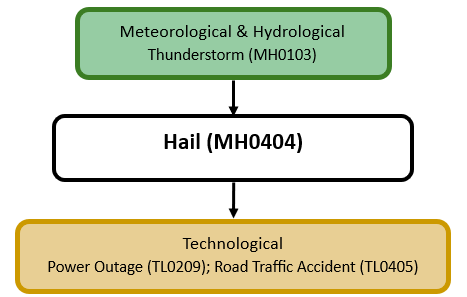
The figure below summarises common interactions between hail and other hazards. This information should be used with caution and not be solely relied upon in Disaster Risk Management, particularly as some interactions may not have been included. Note that hazardous events occurring together or locally in space or time may not necessarily cause, amplify, or be otherwise related to each other. Specific examples of multi-hazard context can be found in the ‘Hazard drivers’ and ‘Impacts’ sections above.
Multi-hazard diagram
Risk Management
Examples of National Alerting Parameters for hail include those issued in China (China Meteorological Administration, 2012) and the United States, where a severe thunderstorm warning is issued when hail is forecast to be one inch or more in diameter (NOAA, 2020).
Monitoring
The section above and the table below offer an overview of monitoring hail. This information can be used for forecasting within a national early warning system (EWS). Since EWS capacities and processes differ across countries, the most current and specific information regarding EWS should be obtained from the appropriate national or regional agency/authority responsible for disaster management.
| Which institution(s) produce(s) Disaster Risk Data/Information? |
|
| How is the Hazard Observed/Monitored/Forecast? | Hail is monitored using weather radar, satellites, and ground-based observations to detect thunderstorm clouds capable of producing hailstones. Meteorologists analyse temperature, wind patterns, and atmospheric instability to predict hail formation and intensity. Advanced computer models simulate thunderstorm development, helping forecasters issue early warnings. These alerts assist the public, farmers, drivers, airports, and emergency responders in preparing for possible hail impacts. |
References
American Meteorological Society (AMS), 2012. Hail. Glossary of Meteorology. American Meteorological Society (AMS). Accessed 16 May 2025.
China Meteorological Administration, 2012. Weather Warnings: Hail. Accessed 16 May 2025.
National Oceanic and Atmospheric Administration (NOAA), 2019. Severe Weather 101. National Severe Storms Laboratory, National Oceanic and Atmospheric Administration (NOAA). Accessed 16 May 2025.
National Weather Service, National Oceanic and Atmospheric Administration (NOAA), 2020. National Weather Service instruction 10-511. Accessed 16 May 2025.
World Meteorological Organization (WMO), 2017. International Cloud Atlas: Hail.. Accessed 16 May 2025.