
Solar Energetic Particles
Solar energetic particle (SEP) events occur when a large-scale magnetic eruption, often accompanied by a coronal mass ejection and/or a related solar flare, accelerates charged particles in the solar atmosphere to significant fractions of the speed of light. The primary particles of interest are protons. SEP arrive with diverse fluxes and energies at different geographic locations (NOAA, 2023).
Primary reference(s)
NOAA Space Weather Prediction Center, 2023. Solar Radiation Storm. Accessed 31 January 2025.
ESA, 2025. Solar orbiter. Solar orbiter top science questions: #3 How do solar eruptions produce energetic particle radiation that fills the heliosphere. Accessed 31 January 2025.
Annotations
Additional scientific description
Upon reaching Earth, the high-speed protons penetrate through the magnetosphere, which acts as a protective shield against lower-energy charged particles. Once inside the magnetosphere, the particles follow the guidance of magnetic field lines and primarily enter the Earth's atmosphere near the north and south poles. However, the more energetic particles can also reach the low-latitude upper atmosphere. SEP events can severely affect space hardware, disrupt radio communications, and cause conditions for re-routing commercial air traffic away from polar regions.
Neutron monitors can be used to record the particle flux intensity at different regions of the planet.
Metrics and numeric limits
Solar Energetic particle events are classified using a five-level scale introduced by the United States National Oceanic and Atmospheric Administration) in 1999 (NOAA, 2023). The scale is currently under review and presented below.
| Scale | Description | Effect | Physical measure (Flux >= 10 MeV particles/s·ster·cm2) | Average Frequency (1 cycle = 11 years) |
|---|---|---|---|---|
| S5 | Extreme | Biological: Unavoidable high radiation hazard to astronauts on EVA (extra-vehicular activity); passengers and crew in high- flying aircraft at high latitudes may be exposed to radiation risk. Satellite operations: Satellites may be rendered useless, memory impacts can cause loss of control, may cause serious noise in image data, star-trackers may be unable to locate sources; permanent damage to solar panels possible. Other systems: Complete blackout of HF (high frequency) communications possible through the polar regions, and position errors make navigation operations extremely difficult. | 105 | Fewer than 1 per cycle |
| S4 | Severe | Biological: Unavoidable radiation hazard to astronauts on EVA; passengers and crew in high-flying aircraft at high latitudes may be exposed to radiation risk. Satellite operations: May experience memory device problems and noise on imaging systems; star-tracker problems may cause orientation problems, and solar panel efficiency can be degraded. Other systems: Blackout of HF radio communications through the polar regions and increased navigation errors over several days are likely. | 104 | 3 per cycle |
| S3 | Strong | Biological: Radiation hazard avoidance recommended for astronauts on EVA; passengers and crew in high-flying aircraft at high latitudes may be exposed to radiation risk. Satellite operations: Single-event upsets, noise in imaging systems, and slight reduction of efficiency in solar panel are likely. Other systems: Degraded HF radio propagation through the polar regions and navigation position errors likely. | 103 | 10 per cycle |
| S2 | Moderate | Biological: Passengers and crew in high-flying aircraft at high latitudes may be exposed to elevated radiation risk. Satellite operations: Infrequent single-event upsets possible. Other systems: Small effects on HF propagation through the polar regions and navigation at polar cap locations possibly affected. | 102 | 25 per cycle |
| S1 | Minor | Biological: None. Satellite operations: None. Other systems: Minor impacts on HF radio in the polar regions. | 10 | 50 per cycle |
The Space Weather centres designated by the International Civil Aviation Organization (ICAO) are expected to provide airliners with advisories about enhanced radiation levels at flight altitudes when the dose rates due to a solar proton event exceed 30 µSievert/h (MOD) and 80 µSievert/h (SEV) (ICAO, 2019).
Key relevant UN convention / multilateral treaty
Not applicable. However, radiation exposure limits are indirectly governed by ICAO and ICRP guidelines.
Drivers
Solar eruptive events: Solar energetic particle events occur during large-scale magnetic eruptions on the Sun, often associated with coronal mass ejections (CMEs) and solar flares. These events result from the acceleration of charged particles, primarily protons, to high velocities.
Impacts
Particle exposure: Solar energetic particles, particularly high-energy protons, can pose hazards to astronauts in space and airline crew members during high-altitude flights. The increased flux of energetic particles during SEP events can lead to elevated flux levels that may exceed safety limits. Increased particle flux within the atmosphere may also impact software and hardware in aircraft avionics, causing transient or permanent malfunctions.
Satellite anomalies and failures: Solar energetic particles can cause disruptions and damage to satellites. When high-energy particles collide with sensitive electronic components onboard satellites, especially electronics and solar panels it can deteriorate or prevent communication and navigation capabilities, leading to malfunctions, data errors, or even complete satellite failures.
SEPs can damage satellites, particularly onboard sensors and solar arrays.
The radiation created by SEPs can increase the exposure of flight crews and passengers to radiation, leading to potential health risks and necessitating the rerouting of flights to lower latitudes. Flights on transpolar routes are the most affected and may require deviation or cancellation.
Particle hazards for Astronauts: Increased particle radiation doses can pose serious health risks and affect the planning and execution of space missions. Potential long-term health risks exist for populations exposed to increased levels of particle flux due to cumulative exposure during SEP events.
Multi-hazard context
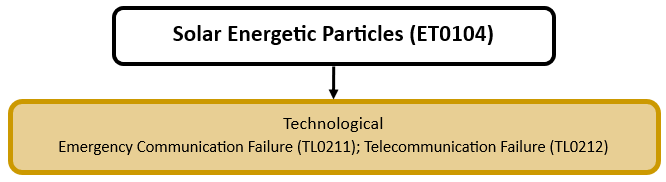
The figure below summarises common interactions between solar energetic particles and other hazards. This information should be used with caution and not be solely relied upon in Disaster Risk Management, particularly as some interactions may not have been included. Note that hazardous events occurring together or locally in space or time may not necessarily cause, amplify, or be otherwise related to each other. Specific examples of multi-hazard context can be found in the ‘Hazard drivers’ and ‘Impacts’ sections above.
Multi-hazard diagram
Risk Management
Space weather monitoring: Space weather services monitor solar activity and provide alerts and forecasts for potential SEP events. These monitoring systems help to detect and assess the risk of SEP events, allowing for appropriate risk management actions.
Particle flux forecasting: Sophisticated models and data analysis techniques are used to forecast the flux and intensity of solar energetic particles during SEP events. This allows operators of satellites and spacecraft to evaluate the potential risks and take necessary precautions to protect the systems and mitigate the impact of the radiation.
Radiation shielding: Astronauts and airline crew members are provided with radiation shielding measures, such as lead or polyethylene shielding materials, to reduce exposure to solar energetic particles during high-risk periods. Spacecraft and satellites are also equipped with shielding measures to protect sensitive components from radiation effects. Spacecraft, satellites, and planetary rovers are designed to take into account the necessary shielding to protect sensitive components from radiation effects, taking into account the foreseen radiation environment where they will operate.
Flight re-routing and altitude restrictions: During periods of heightened solar activity and SEP events, airlines and aviation authorities may consider re-routing flights away from high-polar regions or adjusting flight altitudes to reduce the exposure of crew and passengers to increased particle flux levels. ICAO's SWX advisory system helps airlines mitigate exposure by suggesting flight path alterations.
Monitoring
Space weather services members of the International Space Environment Services (ISES) provide warning systems for specific users in their countries. The Space Weather centres designated by the International Civil Aviation Organization (ICAO) give the airliners advisories about SEPs.
References
Desai M., and Giacalone, J., 2016. “Large gradual solar energetic particle events,” Living Reviews in Solar Physics, vol. 13, no. 3. Large gradual solar energetic particle events | Living Reviews in Solar Physics. Accessed 31 January 2025.
ESA, 2019. Solar Orbiter Top Science Questions: #3 How do solar eruptions produce energetic particle radiation that fills the heliosphere? ESA Science & Technology - Solar Orbiter top science questions: #3 How do solar eruptions produce energetic particle radiation that fills the heliosphere? Accessed 31 January 2025.
ICAO, 2019. New global aviation space weather network launched. International Civil Aviation Organization (ICAO). Accessed 31 January 2025.
International Civil Aviation Organization, 2019. Manual on Space Weather Information in Support of International Air Navigation (Doc 10100); Technical report; ICAO: Montréal, Canada.
NOAA Space Weather Prediction Center, 2023. Solar Radiation Storm. Accessed 31 January 2025.
NOAA, 2011. Solar Radiation Storm scale. Space Weather Prediction Center, National Oceanic and Atmospheric Administration (NOAA). Accessed 31 January 2025.
NOAA, 2019. Solar Radiation Storm. Space Weather Prediction Center, National Oceanic and Atmospheric Administration (NOAA). Accessed 31 January 2025.
Tylka, A. J., 2001. “New insights on solar energetic particles form Wind and ACE,” Journal of Geophysical Research, vol. 106, no. A11. New insights on solar energetic particles from Wind and ACE - Tylka - 2001 - Journal of Geophysical Research: Space Physics - Wiley Online Library. Accessed 31 January 2025.