
Solar Flares
A solar flare is a sudden and large explosion on the Sun characterized by the rapid release of energy, resulting in the emission of electromagnetic radiation across all wavelengths and a rapid increase in brightness on a portion of the Sun's surface. The sudden outburst of electromagnetic energy travels at the speed of light therefore any effect upon the sunlit side of Earth’s exposed outer atmosphere occurs at the same time the event is observed (NOAA Space Weather Prediction Center, 2023).
Primary reference(s)
NOAA Space Weather Prediction Center, 2023. SOLAR FLARES (RADIO BLACKOUTS). Accessed 31 January 2025.
Annotations
Additional scientific description
Solar flares predominantly occur in active regions on the Sun, which are characterized by the presence of intense magnetic fields, often associated with sunspot groups. As these magnetic fields undergo changes and evolve, they can reach a state of instability, resulting in the release of energy in various forms. One of the primary manifestations of this energy release is observed as solar flares, which involve the emission of electromagnetic radiation.
Flares are more likely to occur during periods of high solar activity and are often accompanied by coronal mass ejections (CME).
Flares are classified based on their intensity, primarily determined by the X-ray brightness, and measured in the 1-8 Å band (0.1-0.8 nm). There are five categories of flares, ranging from the weakest to the strongest: A, B, C, M, and X (Hanslmeier, 2007; Schrijver, 2009). Information regarding the intensity of flares is obtained from X-ray and Extreme UV sensors installed on GOES satellites (Thiemann et al., 2019; Machol et al., 2020).
Under favourable observation conditions, when the corresponding active region on the Sun is facing Earth, an intense flare, typically of X-class and occasionally M-class, can lead to significant disturbances in the ionosphere on the sunlit side of Earth. These disturbances can cause signal distortions and radio fadeouts due to increased absorption of radio waves in the lower ionosphere, specifically the D region and lower E region.
Under regular conditions, high-frequency (HF) radio waves support long-distance communication by refracting through the upper layers of the ionosphere. However, during a powerful solar flare, the ionization increases in the lower ionosphere, particularly in its D and lower E regions. This phenomenon can lead to the degradation or complete absorption of HF radio signals, resulting in a radio fadeout that predominantly affects the 3 to 30 MHz frequency band.
Radio bursts are associated with solar flares. The delay in registration of its different radio frequencies at Earth's orbit is due to the outward movement of the source. Large bursts last 10 to 20 minutes on average. Longer radio noise storms of persistent and variable high radiation levels originate in sunspot groups, areas of large, intense magnetic fields. A Solar Radio Burst (SRB) could influence the Global Navigation Satellite System (GNSS) signals through direct radio wave interferences.
Metrics and numeric limits
Solar flare intensities cover a broad range and are classified in terms of peak emission in the 0.1 – 0.8 nm spectral band (soft x-rays) of the NOAA/GOES XRS. Solar flares are classified using a five-level scale introduced by the United States National Oceanic and Atmospheric Administration (NOAA) in 1999. The scale is currently under review and presented below. The X-ray flux levels start with the 'A' level (A ≥ 10⁻⁸ W/m²). The next level, ten times higher, is the 'B' level (≥ 10-7 W/m²), followed by 'C' flares (10-6 W/m²), 'M' flares (10-5 W/m²), and finally 'X' flares (≥10⁻⁴ W/m²) (NOAA, 2023)."
| Scale | Description | Effect | Physical measure | Average Frequency (1 cycle = 11 years) |
|---|---|---|---|---|
| R 5 | Extreme | HF Radio: Complete HF (high frequency) radio blackout on the entire sunlit side of the Earth lasting for a number of hours. This results in no HF radio contact with mariners and en route aviators in this sector. Navigation: Low-frequency navigation signals used by maritime and general aviation systems experience outages on the sunlit side of the Earth for many hours, causing loss in positioning. Increased satellite navigation errors in positioning for several hours on the sunlit side of Earth, which may spread into the night side. | X20 (2 x 10⁻³) | Less than 1 per cycle. |
| R 4 | Severe | HF Radio: HF radio communication blackout on most of the sunlit side of Earth for one to two hours. HF radio contact lost during this time. Navigation: Outages of low-frequency navigation signals cause increased error in positioning for one to two hours. Minor disruptions of satellite navigation possible on the sunlit side of Earth. | X10 (10-3) | 8 per cycle (8 days per cycle). |
| R 3 | Strong | HF Radio: Wide area blackout of HF radio communication, loss of radio contact for about an hour on sunlit side of Earth. Navigation: Low-frequency navigation signals degraded for about an hour. | X1 (10-4) | 175 per cycle (140 days per cycle). |
| R 2 | Moderate | HF Radio: Limited blackout of HF radio communication on sunlit side, loss of radio contact for tens of minutes. Navigation: Degradation of low-frequency navigation signals for tens of minutes. | M5 (5 x 10⁻⁵) | 350 per cycle (300 days per cycle). |
| R 1 | Minor | HF Radio: Weak or minor degradation of HF radio communication on sunlit side, occasional loss of radio contact. Navigation: Low-frequency navigation signals degraded for brief intervals. | M1 (10-5) | 2000 per cycle (950 days per cycle). |
The Space Weather centres designated by the International Civil Aviation Organization (ICAO) are expected to provide airliners with advisories about anomalous conditions in HF communication when the intensity of a solar flare exceeds 10-4W/m2 (MOD) and 10-3W/m2 (SEV) (ICAO, 2019).
Key relevant UN convention / multilateral treaty
Not applicable; however, aviation-related standards fall under ICAO coordination.
Drivers
Solar activity: Solar flares are associated with the active regions and sunspots on the Sun. These are often triggered by magnetic reconnection events in the solar corona. High solar activity periods characterised by increased sunspot numbers are more likely to produce solar flares.
Impacts
Radio communication disruptions: Solar flares emit intense bursts of electromagnetic radiation, including X-rays and extreme ultraviolet (EUV) radiation. These high-energy radiations can cause the increased ionization in the Earth's atmosphere, particularly in the lower ionosphere. This ionization can result in increased absorption and degradation of radio waves across the HF (3-30 MHz) frequency band, affecting long-distance communications vital for aviation, maritime operations, and emergency services., leading to disruptions in radio communication.
GNSS signal interference: Solar flares can generate radio frequency interference that affects the signals transmitted by global navigation satellite systems (GNSS), such as GPS, GLONASS, BEIDOU, and GALILEO. The interference can cause inaccuracies in positioning and timing or complete loss of GNSS signals, leading to potential navigation errors for various applications, including aviation and maritime navigation.
Radio burst interference: Radio bursts from the solar flares may interfere directly with radio communication on Earth. The radio bursts may saturate ground-based mobile phone systems, aviation monitoring radars, and other transmitter/receiver systems in suitable conditions. For example, in 2015, air traffic control centres in Sweden noticed that the radar stations of the Swedish Air Navigation Service Provider were not relaying the correct data. The disruption was attributed to solar flare activity occurring near sunset in Sweden when the angle of the Sun is directed into the radar station. While the cause was rapidly identified and measures taken, the interference resulted in a 90-minute impact to radar across Swedish airspace.
The intense radiation from solar flares can damage satellites' electronic systems, disrupting communications, weather monitoring, and scientific data collection services. Increased radiation levels can also interfere with sensors and instruments aboard space-based observatories.
Solar energetic particles may also pose health risks to astronauts during extravehicular activities (EVAs).
Multi-hazard context
The figure below summarises common interactions between solar flares and other hazards. This information should be used with caution and not be solely relied upon in Disaster Risk Management, particularly as some interactions may not have been included. Note that hazardous events occurring together or locally in space or time may not necessarily cause, amplify, or be otherwise related to each other. Specific examples of multi-hazard context can be found in the ‘Hazard drivers’ and ‘Impacts’ sections above.
Multi-hazard diagram
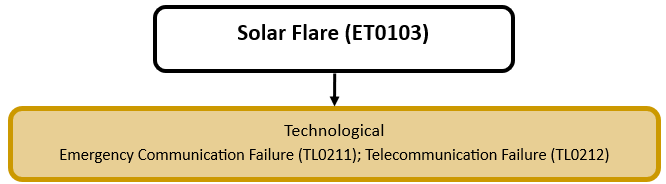
Risk Management
Space weather monitoring: Space weather services monitor solar activity and provide alerts and forecasts for potential solar flares. These monitoring systems help to detect and assess the risk of solar flares, allowing for appropriate risk management actions.
Radio fadeout predictions: The intensity of a solar flare can be measured using X-ray and Ultraviolet sensor data, and this information can be used to predict the potential impact on radio wave propagation. Systems like the D-Region Absorption
Backup communication systems: Organizations and industries can have backup communication systems in place to mitigate the impact of radio communication disruptions. This may involve alternative frequencies, communication modes, or redundant communication networks less affected by the ionospheric changes caused by solar flares.
GNSS integrity monitoring: GNSS users can implement integrity monitoring systems that detect and alert users to potential anomalies or interference in the GNSS signals. This allows for proactive risk management and the implementation of backup navigation methods when necessary.
Monitoring
Space weather services members of the International Space Environment Services (ISES) offer warning systems to specific users in their countries. The Space Weather centres designated by the International Civil Aviation Organization (ICAO) advise airliners about solar flares and radio fadeouts.
References
AMS, 2018. Radio blackout. American Meteorological Society (AMS). Accessed 31 January 2025.
Australian Bureau of Meteorology, no date. Space Weather and the Aviation Sector. Accessed 31 January 2025.
Chakraborty, S., J. Ruohoniemi, J. B. H. Baker and N. Nishitani, “Characterization of short-wave fadeout seen in daytime SuperDARN ground scatter observations,” Radio Science, vol. 53, no. 4, 2018
Hanslmeier, A., 2007. Space Weather-An Overview. Accessed 24 February 2025.
International Civil Aviation Organization, 2019. “Manual on Space Weather Information in Support of International Air Navigation (Doc 10100)”; Technical report; ICAO: Montréal, Canada.
Kataoka, R., 2022. Solar Radio Burst. Chapter 2 – Disturbed space weather. Extreme Space Weather, 31-64. Accessed 31 January 2025.
Machol, J. L., Eparvier, F. G., Viereck, R. A., Woodraska, D. L., Snow, M., Thiemann, E., ... & Reinard, A. A., 2020. “GOES-R series solar X-ray and ultraviolet irradiance”. In The GOES-R Series (pp. 233-242). Elsevier.
NOAA, 2019. Solar flares (Radio blackouts). Space Weather Prediction Center, National Oceanic and Atmospheric Administration (NOAA). Accessed 31 January 2025.
NOAA, no date. NOAA Space Weather Scales. Space Weather Prediction Center, National Oceanic and Atmospheric Administration (NOAA) Solar Flares (Radio Blackouts). Accessed 31 January 2025.
NOAA, no date. NOAA Space Weather Scales. Space Weather Prediction Center, National Oceanic and Atmospheric Administration (NOAA). Accessed 31 January 2025.
NOAA, no date. NOAA Space Weather Scales. Space Weather Prediction Center, National Oceanic and Atmospheric Administration (NOAA) Solar Radio Datasets. Accessed 31 January 2025.
Royal Academy of Engineering, 2013. Extreme Space Weather: Impacts on Engineered systems and Infrastructure. Accessed 31 January 2025.
Schumer, E. A., 2009. “Improved modeling of midlatitude D-region ionospheric absorption of high frequency radio signals during solar x-ray flares”, vol. AFIT/DS/ENP/09/J01, Ohio: United States Air Force, Wright-Patterson Air Force Base.
Thiemann, E. M., Eparvier, F. G., Woodraska, D., Chamberlin, P. C., Machol, J., Eden, T., ... & Woods, T. N., 2019. “The GOES-R EUVS model for EUV irradiance variability”. Journal of Space Weather and Space Climate, 9, A43.
UK CAA, 2020. Impacts of space weather on aviation. UK Civil Aviation Authority (UK CAA). Accessed 31 January 2025.