
Permafrost Loss
Permafrost is defined as ground that remains frozen at or below 0°C for a minimum of two consecutive years. Permafrost loss, also known as permafrost thaw, is the progressive loss of ground ice in permafrost, usually due to input of heat. Thaw can occur over decades to centuries over the entire depth of permafrost ground, with impacts occurring while thaw progresses. During thaw, temperature fluctuations are subdued because energy is transferred by phase change between ice and water. After the transition from permafrost to non-permafrost, ground can be described as thawed (IPCC, 2019).
Primary reference(s)
IPCC. 2019. Annex I: Glossary. N.M. Weyer (ed.). In: IPCC Special Report on the Ocean and Cryosphere in a Changing Climate. H.-O. Pörtner, D.C. Roberts, V. Masson-Delmotte, P. Zhai, M. Tignor, E. Poloczanska, K. Mintenbeck, A. Alegría, M. Nicolai, A. Okem, J. Petzold, B. Rama, N.M. Weyer (eds). Intergovernmental Panel on Climate Change (IPCC). Accessed 21 January 2025.
Annotations
Additional scientific description
Permafrost includes the mineral part of the ground (rocks) as well as any organic matter and ice if it is present (IPCC, 2019). The active layer is the uppermost part of permafrost, which thaws during summer and re-freezes during winter.
Permafrost currently covers around 15 million km², or approximately 15% of the land in the Northern Hemisphere, mostly in the Arctic region, and is very sensitive to climate change (Obu, 2021). An additional 2.5 million km² of permafrost also exists below the seabed in the Arctic continental shelves (Overduin et al., 2019; Obu, 2021).
Gradual permafrost loss or thaw is a steady but slow process, impacting the soil and related to a general increase in the temperature of the ground. Ground temperatures are monitored by the Global Terrestrial Network for Permafrost by examining temperature profiles from multiple borehole sites across the permafrost regions (Biskaborn et al., 2015; 2019). During 2007-2016, continuous-zone permafrost temperatures in the Arctic and Antarctic increased by 0.39 ± 0.15°C and 0.37 ± 0.10°C respectively, and at some locations, the temperature is 2-3°C higher than 30 years ago (Biskaborn et al., 2019).
Abrupt thaw happens mainly in regions with excess ice and occurs when the land surface collapses because of the ice melting away, resulting in, for example, thaw slumps, active layer detachments or thermokarst lakes. This can affect many metres of permafrost soil in the period of a few days to years and will impact the hydrological state of the permafrost (Turetsky et al., 2020). It is estimated that 20-39% of the northern permafrost region is covered by ice-rich thermokarst landscapes (Nitzbon et al., 2024; Olefeldt et al., 2016). Carbon emissions released by abrupt thaw are not currently well represented by models (Turetsky et al., 2020); however, it should be noted that new evidence also indicates that positive feedback on the climate from GHG emissions related to permafrost thaw would not cause enough additional thaw and corresponding GHG emissions to drive a self-perpetuating feedback cycle that would lead to rapid and global-scale permafrost loss once initiated (Nitzbon et al., 2024).
Under future climate change scenarios, the Coupled Model Intercomparison Project Phase 6 (CMIP6) models project a gradual loss of permafrost of between 0.3 and 3.4 million km² per °C increase in global surface air temperature (5th to 95th percentile; Burke et al., 2020). This is equivalent to a reduction of between 10% and 40% per °C in the annual mean frozen volume in the top 2 metres of soil. These estimates are slightly lower than the 4.0 [-1.1; +1.0] million km² per °C equilibrium sensitivity projected by Chadburn et al. (2017), who derived this using an observational-based relationship.
The permafrost region represents a large, climate-sensitive reservoir of organic carbon, with approximately twice as much carbon in the soil as is currently contained in the Earth's atmosphere. The top 3 metres of permafrost soils contain 1,035 ± 150 Pg C (Tarnocai et al., 2009; Hugelius et al., 2014) and could become vulnerable to decomposition due to climate warming. Schuur et al. (2015) suggested that between 5% and 15% of this permafrost carbon pool may be decayed and released as either carbon dioxide or methane during the 21st century, contributing to further global warming. Some researchers postulate that this feedback could cause an additional warming of between 0.2% and 12% of the change in global temperature by 2100 (Burke et al., 2017), given that about half of below-ground carbon is stored in thermokarst landscapes that are vulnerable to abrupt thaw (Olefeldt et al., 2016) and the release of this additional carbon has not been considered in these estimates. Therefore, these estimates may be a substantial underestimation of carbon emissions from thawing permafrost (Turetsky et al., 2020). On the other hand, other researchers indicate that there is no proof that permafrost thaw is self-amplifying; rather, that the effect is local, or possibly regional, and that thawing will continue in step with climate warming (Nitzbon et al., 2024).
Metrics and numeric limits
The Global Terrestrial Network for Permafrost (GTN-P; Streletskiy et al., 2017) coordinates long-term monitoring of the thermal state of permafrost via an extensive borehole network used to measure ground temperatures at depths from the surface to up to 100 m. It also coordinates monitoring of the maximum active layer thickness via the Circumpolar Active Layer Monitoring (CALM) programme (no date). Typically, this is done at the end of summer on a grid arrangement via mechanical probing of the soil. Currently, it is not possible to use Earth observation data for routine permafrost monitoring; however, the Arctic Landscape EXplorer (ALEX), attempts to monitor relevant proxies like lake formation and coastal erosion (Lübker et al., 2024).
Key relevant UN convention / multilateral treaty
The UN Climate Change Paris Agreement (2015) builds upon the United Nations Framework Convention on Climate Change and, for the first time, brings all nations into a common cause to undertake ambitious efforts to combat climate change and adapt to its effects, with enhanced support to assist low- and middle-income countries to do so. As such, it charts a new course in the global climate effort.
Drivers
Permafrost thaw is one of the leading factors increasing climate-related vulnerability (Murray et al., 2012). Changes in temperature and precipitation typically act as gradual (i.e. continuous) disturbances that directly affect permafrost by modifying the ground thermal regime. Climate warming can also modify the occurrence and magnitude of abrupt physical disturbances such as fire (Wotton et al., 2017), and soil subsidence and erosion resulting from ice-rich permafrost thaw (Lewkowicz and Way, 2019). These 'pulse' (i.e. discrete) disturbances are often part of the ongoing disturbance and successional cycle in Arctic and boreal ecosystems (Grosse et al., 2011), but changing rates of occurrence have recently been observed, altering the landscape distribution of successional ecosystem states (Farquharson et al., 2019).
Recent climate warming has been linked to increased wildfire activity in boreal forest regions in Alaska and western Canada (Gillett et al., 2004; Veraverbeke et al., 2017). Based on satellite imagery, an estimated 80,000 km2 of boreal area was burned globally per year from 1997 to 2011 (Giglio et al., 2013). During the summers of 2019 and 2020, the Arctic saw record wildfires, mainly in Siberia in areas underlain by permafrost peatland. There is high confidence that fire will accelerate change in permafrost relative to climate effects alone, if the rates of these disturbances increase. The observed trend of increasing fire is projected to continue for the rest of the 21st century across most of the tundra and boreal region under many climate scenarios (Meredith et al., 2019).
Impacts
Permafrost thaw can lead to ground subsidence—a process where the ground surface collapses due to the loss of underlying support. This can cause serious damage to infrastructure (e.g. roads, runways, buildings), with variable effects across infrastructure types. Disrupted transportation networks and threatened communities are among the potential consequences (Bastedo, 2007; GRID-Arendal, 2023). Impacts on infrastructure affect the health, economic livelihood and safety of communities. For example, in northern Canada, adapting or repairing infrastructure may cost several million to many billions of dollars, depending on damage extent and infrastructure type. The Tibbitt to Contwoyto winter road (Northwest Territories, Canada) experienced climate-related closures in 2006, remaining open for only 42 days compared to 76 in 2005 (Bastedo, 2007). Residents and businesses had to airlift supplies, costing millions of dollars.
In the Northwest Territories, 10% of public access buildings have been retrofitted since 2004 due to critical structural malfunctions. In Inuvik, a local school experienced a complete roof collapse under heavy snowfall. As permafrost continues to thaw and structural integrity declines, snow loads may increasingly cause collapses (Bastedo, 2007; Murray et al., 2012). These rapid changes challenge planners, decision-makers and engineers, threatening infrastructure stability and functionality (Meredith et al., 2019). Climate and permafrost projections suggest a wide range of infrastructure is at risk (Melvin et al., 2017; Schneider von Deimling et al., 2020). A circumpolar study found that around 70% of infrastructure—including over 1,200 settlements (about 40 with populations over 5,000)—is located in areas where permafrost is projected to thaw by 2050 under RCP4.5 (Hjort et al., 2018).
The geopolitical landscape of the Arctic is also affected. As permafrost thaws, previously inaccessible resources (e.g. minerals, oil and gas) become more accessible, potentially escalating competition and geopolitical tensions (Kalhoro, 2022; Marten, 2023).
Freshwater quality and availability are also at risk. Thaw alters drainage patterns and contaminates water with carbon compounds, pathogens and pollutants such as mercury and lead (Schuster et al., 2018; Charlier et al., 2020; Christie, 2021; Rudnicka-Kępa & Zaborska, 2021). Disruption of meltwater-dependent ecosystems may also lead to biodiversity loss (Rani et al., 2021).
Permafrost loss also alters ecosystems. For example, the ecology of thaw-impacted lakes and streams is likely to change, with microbiological communities adapting to changes in sediment, dissolved organic matter and nutrient levels (Vonk et al., 2015).
Another primary concern associated with permafrost loss is the release of greenhouse gases. Permafrost acts as a large natural carbon sink, storing immense quantities of methane and carbon dioxide. As permafrost thaws, these potent greenhouse gases may be released into the atmosphere, accelerating climate change and further warming the planet. This may create a dangerous feedback loop, where rising temperatures drive permafrost thaw, which in turn releases more greenhouse gases, perpetuating the cycle (Turetsky et al., 2020). However, some researchers argue that this may not occur (Nitzbon et al., 2024).
Multi-hazard context
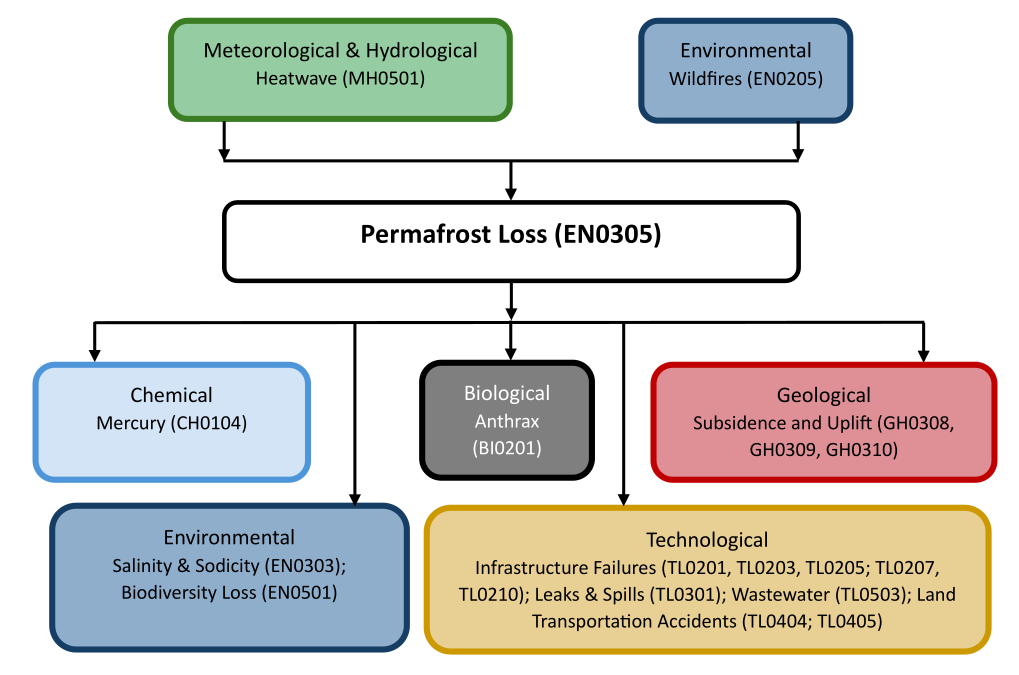
The figure below summarises common interactions between wetland loss or degradation and other hazards. This information should be used with caution and not be solely relied upon in disaster risk management, particularly as some interactions may not have been included. Note that hazardous events occurring together or locally in space or time may not necessarily cause, amplify, or be otherwise related to each other. Specific examples of multi-hazard context can be found in the ‘Hazard drivers’ and ‘Impacts’ sections above.
Multi-hazard diagram
Risk Management
Reducing and avoiding infrastructure impacts from climate change requires attention to engineering, land use planning, maintenance, culture, and budgeting. In some cases, relocating human settlements may be necessary (Meredith et al., 2019). Subsidence due to thawing permafrost and river and delta erosion makes coastal and rural communities in Alaska and Russia particularly vulnerable, potentially requiring relocation in the future (Romero Manrique et al., 2018).
Monitoring
The section and the table below provide an overview of monitoring for permafrost loss. This information can be used for forecasting within a national early warning system (EWS). Since EWS capacities and processes differ across countries, the most current and specific information regarding EWS should be obtained from the appropriate national or regional agency or authority responsible for disaster management.
| Which institution(s) produce(s) disaster risk data/information? | No information available |
| How is the hazard observed/monitored/forecast? | Ground-based measurements, such as temperature sensors at various permafrost depths, provide direct indicators of thermal regime changes. Surface deformation, monitored through techniques such as LiDAR and Interferometric Synthetic Aperture Radar (InSAR), can provide high-resolution topographic data and detect subtle ground movements associated with permafrost thaw and subsidence (Zhang et al., 2022). Remote sensing, using satellite imagery, offers a synoptic perspective on permafrost conditions, enabling the tracking of vegetation changes, hydrological alterations and landscape evolution (Lübker et al., 2024). Borehole measurements of active layer thickness also offer valuable ground-truth data (Biskaborn et al., 2019). Additionally, Global Positioning System (GPS) monitoring of infrastructure can detect early signs of ground instability due to permafrost degradation (Zhang et al., 2020). |
References
Bastedo, J., 2007. On the Frontlines of Climate Change: What’s really happening in the northwest Territories. Yellowknife, Canada: Government of the Northwest Territories. 2007.
Biskaborn, B.K., S.L. Smith, J. Noetzli, H. Matthes, G. Vieira, D.A. Streletskiy, P. Schoeneich and 41 others, 2019. Permafrost is warming at a global scale. Nature communications, 10:264. Accessed 21 January 2025.
Burke, E.J., Ye Huang, A.E., Chadburn, S.E., Huntingford, C., Ciais, P., Friedlingstein, P., Peng, S., Krinner, G., 2017. Quantifying uncertainties of permafrost carbon–climate feedbacks. Biogeosciences, 14:3051-3066. Accessed 21 January 2025.
Burke, E.J., Zhang, Y., Krinner, G., 2020. Evaluating permafrost physics in the Coupled Model Intercomparison Project 6 (CMIP6) models and their sensitivity to climate change. The Cryosphere, 14:3155-3174. Accessed 21 January 2025.
CALM, no date. Circumpolar Active Layer Monitoring Network-CALM: Long-Term Observations of the Climate-Active Layer-Permafrost System. Accessed 21 January 2025.
Chadburn, S.E., E.J. Burke, P.M. Cox, P. Friedlingstein, G. Hugelinus and S. Westermann, 2017. An observation-based constraint on permafrost loss as a function of global warming. Nature Climate Change, 7:340-344. Accessed 21 January 2025.
Charlier, P., Héry-Arnaud, G., Coppens, Y., Malaurie, J., Hoang-Oppermann, V., Deps, P., et al., 2020. Global warming and planetary health: An open letter to the WHO from scientific and indigenous people urging for paleo-microbiology studies. Infection, Genetics and Evolution 82, 104284. Accessed 21 January 2025.
Christie, A., 2021. Blast from the past: Thawing permafrost could lead to future pandemics. Cambridge Journal of Science & Policy 2(2), 8. DOI: 10.17863/CAM.74501. Accessed 21 January 2025.
Farquharson, L.M., Romanovsky, V.E., Cable, W.L., Walker, D.A., Kokel, S.V., Nicolsky, D., 2019. Climate change drives widespread and rapid thermokarst development in very cold permafrost in the Canadian High Arctic. Geophysical Research Letters, 46:6681-6689. DOI: 10.1029/2019GL082187. Accessed 21 January 2025.
Giglio, L., Randerson, J.T., van der Werf, G.R., 2013. Analysis of daily, monthly, and annual burned area using the fourth- generation global fire emissions database (GFED4). Journal of Geophysical Research: Biogeosciences, 118:317-328. DOI: 10.1002/jgrg.20042. Accessed 21 January 2025.
Gillett, N.P., Weaver, A.J., Zwiers, F.W., Flannigan, M.D., 2004. Detecting the effect of climate change on Canadian forest fires. Geophysical Research Letters, 31. DOI: 10.1029/2004GL020876. Accessed 21 January 2025.
GRID Arendal, 2023. Permafrost Atlas. 2023 Accessed 21 January 2025.
Grosse, G., Harden, J., Turetsky, M., McGuire, A.D., Camill, P., Tarnocai, C., Frolking, S., Schuur, E.A.G., Jorgenson, T., Marchenko, S., Romanovsky, V., Wickland, K.P., French, N., Waldrop, M., Bourgeau-Chavez, L., Striegl, R.G., 2011. Vulnerability of high-latitude soil organic carbon in North America to disturbance. Journal of Geophysical Research: Biogeosciences, 116:G00K06, doi:10.1029/2010jg001507.
Hjort, J., Karjalainen, O., Aalto, J., Westermann, S., Romanovsky, V.E., Nelson, F.E., Etzelmuller, B., Luoto, M., 2018. Degrading permafrost puts Arctic infrastructure at risk by mid-century. Nature Communications, 9:5147. doi:10.1038/s41467-018-07557-4
Hugelius, G., Strauss J., Zubrzycki, S., Harden, J.W., Schuur, E.A.G., Ping, C.-L., Schirrmeister, L., Grosse, G., Michaelson, G.J., Koven, C.D., O’Donnell, J.A., Elberling, B., Mishra, U., Camill, P., Yu, Z., Palmtag, J., Kuhry, P., 2014. Estimated stocks of circumpolar permafrost carbon with quantified uncertainty ranges and identified data gaps. Biogeosciences, 11:6573-6593. Accessed 21 January 2025.
IPCC, 2019. Annex I: Glossary [Weyer, N.M. (ed.)]. In: IPCC Special Report on the Ocean and Cryosphere in a Changing Climate [H.-O. Pörtner, D.C. Roberts, V. Masson-Delmotte, P. Zhai, M. Tignor, E. Poloczanska, K. Mintenbeck, A. Alegría, M. Nicolai, A. Okem, J. Petzold, B. Rama, N.M. Weyer (eds.)]. Intergovernmental Panel on Climate Change (IPCC). Accessed 21 January 2025.
Kalhoro, A., 2022. Changing Geopolitics: Reinforcing Competitive Proclivities in the Arctic Region. Journal of Politics and International Studies, 8(02), 93-105. Accessed 21 January 2025.
Lewkowicz, A.G., W.G. Way, 2019. Extremes of summer climate trigger thousands of thermokarst landslides in a High Arctic environment. Nature Communications, 10:1329. Accessed 21 January 2025.
Lübker T., Nitze I., Laboor S., Irrgang A., Lantuit H., Grosse G., 2024. Visualizing data on permafrost degradation in a pan-arctic pilot service aiming at a non-scientific audience. 13. Deutsche Klimatagung, Potsdam, Germany, 12–15 Mar 2024, DKT-13-19. DOI: . PDF:
Marten, K.,2023. Geopolitics and security in the changing Arctic. In Climate Change, Conflict and (In) Security (pp. 55-76). Routledge.
Melvin, A.M., Larsen, P., Boehlert, B., Neumann, J.E., Chinowsky, P., Espinet, X., Martinich, J., Baumann, M.S., Rennels, L., Bothner, A., Nicolsky, D.J., Marchenko, S.S., 2017. Climate change damages to Alaska public infrastructure and the economics of proactive adaptation. Proceedings of the National Academy of Sciences of the United States of America, 114:E122–E131. Accessed 21 January 2025.
Meredith, M., Sommerkorn, M., Cassotta, S., Derksen, C., Ekaykin, A., Hollowed, A., Kofinas, G., Mackintosh, A., Melbourne-Thomas, J., Muelbert, M.M.C., Ottersen, G., Pritchard, H., Schuur, E.A.G., 2019. Polar regions. In: IPCC Special Report on the Ocean and Cryosphere in a Changing Climate [H.-O. Pörtner, D.C. Roberts, V. Masson-Delmotte, P. Zhai, M. Tignor, E. Poloczanska, K. Mintenbeck, A. Alegría, M. Nicolai, A. Okem, J. Petzold, B. Rama, N.M. Weyer (eds.)]. Accessed 21 January 2025.
Murray, V., McBean, G., Bhatt, M., Borsch, S., Cheong, T.S., Erian, W.F., Llosa, S., Nadim, F., Nunez, M., Oyun, R., Suarez, A.G., 2012. Case studies. In: Managing the Risks of Extreme Events and Disasters to Advance Climate Change Adaptation [Field, C.B., V. Barros, T.F. Stocker, D. Qin, D.J. Dokken, K.L. Ebi, M.D. Mastrandrea, K.J. Mach, G.-K. Plattner, S.K. Allen, M. Tignor, and P.M. Midgley (eds.)]. A Special Report of Working Groups I and II of the Intergovernmental Panel on Climate Change (IPCC). Cam- bridge University Press, pp. 487-542. Accessed 21 January 2025.
Nitzbon, J., Schneider von Deimling, T., Aliyeva, M., et al., 2024. No respite from permafrost-thaw impacts in the absence of a global tipping point. Nat. Clim. Chang. 14, 573–585. DOI: 10.1038/s41558-024-02011-4. Accessed 21 January 2025.
Obu, J., 2021. How much of the Earth’s surface is underlain by permafrost? Journal of Geophysical Research: Earth Surface, 126 (5), e2021JF006123. DOI: 10.1029/2021JF006123. Accessed 21 January 2025.
Olefeldt, D., Goswami, S., Grosse, G., Hayes, D., Hugelius, G., Kuhry, P., McGuire, A.D., Romanovsky, V.E., Sannel, A.B.K., Schuur, E.A.G., Turetsky, M.R., 2016. Circumpolar distribution and carbon storage of thermokarst landscapes. Nature Communications, 7:13043. Accessed 21 January 2025.
Overduin, P.P., von Deimling, T.S., Miesner, F., Grigoriev, M.N., Ruppel, C., Vasiliev, A., et al., 2019. Submarine permafrost map in the Arctic modeled using 1-D transient heat flux (SuPerMAP). Journal of Geophysical Research: Oceans 124(6), 3490–3507. DOI: 10.1029/2018JC014675. Accessed 21 January 2025.
Rani, A., Gupta, K., Saini, K. C., Narwal, S., Bast, F., 2021. Arctic biodiversity amidst looming climate apocalypse: current status and way forward. Understanding Present and Past Arctic Environments, 213-255. DOI: 10.1016/B978-0-12-822869-2.00003-7 Accessed 21 January 2025.
Romero Manrique, D., Corral, S., Guimarães Pereira, Â., 2018. Climate-related displacements of coastal communities in the Arctic: Engaging traditional knowledge in adaptation strategies and policies. Environmental Science & Policy, 85:90-100. Accessed 21 January 2025.
Rudnicka-Kępa, P., Zaborska, A., 2021. Sources, fate and distribution of inorganic contaminants in the Svalbard area, representative of a typical Arctic critical environment – A review. Environmental Monitoring and Assessment 193, 724. Accessed 21 January 2025.
Schneider von Deimling, T., Lee, H., Ingeman-Nielsen, T., Westermann, S., Romanovsky, V., Lamoureux, S., Walker, D.A., Chadburn, S., Cai, L., Trochim, E., Nitzbon, J., Jacobi, S., Langer, M., 2020. Consequences of permafrost degradation for Arctic infrastructure – bridging the model gap between regional and engineering scales. The Cryosphere Discussions, [preprint] DOI: 10.5194/tc-2020-192, in review. Accessed 21 January 2025.
Schuster, P.F., Schaefer, K.M., Aiken, G.R., Antweiler, R.C., Dewild, J.F., Gryziec, J.D. et al., 2018. Permafrost stores a globally significant amount of mercury. Geophysical Research Letters 45(3), 1463–1471. DOI: 10.1002/2017GL075571. Accessed 21 January 2025.
Schuur, E.A.G., McGuire, A.D., Schadel, C., Grosse, G., Harden, J.W., Hayes, D.J., Hugelius, G., Koven, C.D., Kuhry, P., Lawrence, D.M., Natali, S.M., Olefeldt, D., Romanovsky, V.E., Schaefer, K., Turetsky, M.R., Treat, C.C., Vonk, J.E., 2015. Climate change and the permafrost carbon feedback. Nature, 520:171-179. Accessed 21 January 2025.
Streletskiy, D., Biskaborn, B., Smith, S.L., Noetzli, J., Viera, G., Schoeneich, P., 2017. GTN-P - Strategy and Implementation Plan 2016-2020. Technical Report. Global Terrestrial Network for Permafrost. Accessed 21 January 2025.
Tarnocai, C., Canadell, J.G., Schuur, E.A.G., Kuhry, P., Mazhitova, G., Zimov, S., 2009. Soil organic carbon pools in the northern circumpolar permafrost region. Global Biogeochemical Cycles, 23:GB2023, doi:10.1029/2008gb003327. Accessed 21 January 2025.
Turetsky, M.R., Abbott, B.W., Jones, M.C., et al., 2020. Carbon release through abrupt permafrost thaw. Nat. Geosci. 13, 138–143. DOI: 10.1038/s41561-019-0526-0. Accessed 21 January 2025.
United Nations Climate Change, 2015. Paris Agreement. United Nations Framework Convention on Climate Change. Accessed 21 January 2025.
van Everdingen, R.O., 2005. Multi-language glossary of permafrost and related ground-ice terms. The Arctic Institute of North America, The University of Calgary. 90 pp.
Veraverbeke, S., Rogers, B.M., Gouldern, M.L., Jandt, R.R., Miller, C.E., Wiggins, E.B., Randerson, J.T., 2017. Lightning as a major driver of recent large fire years in North American boreal forests. Nature Climate Change, 7:529-534. Accessed 21 January 2025.
Vonk J.E., Tank, S.E., W.B. Bowden, W.B., Laurion, I., Vincent, W.F., Alekseychik, P., Amyot, M., Billet, M.F., Canário, J., Cory, R.M., Deshpande, B.N., Helbig, M., Jammet, M., Karlsson, J., Larouche, J., MacMillan, G., Rautio, M., Walter Anthony, K.M., Wickland, K.P., 2015. Reviews and syntheses: Effects of permafrost thaw on Arctic aquatic ecosystems. Biogeosciences, 12:7129-7167. Accessed 21 January 2025.
Wotton, B., Flannigan, M., Marshall, G., 2017. Potential climate change impacts on fire intensity and key wildfire suppression thresholds in Canada. Environmental Research Letters, 12:095003. Accessed 21 January 2025.
Zhang, J., Liu, L., Hu, Y., 2020. Global Positioning System interferometric reflectometry (GPS-IR) measurements of ground surface elevation changes in permafrost areas in northern Canada. The cryosphere, 14(6), 1875-1888.
Zhang, Z., Lin, H., Wang, M., Liu, X., Chen, Q., Wang, C., Zhang, H., 2022. A review of satellite synthetic aperture radar interferometry applications in permafrost regions: Current status, challenges, and trends. IEEE Geoscience and Remote Sensing Magazine, 10(3), 93-114. DOI: 10.1109/MGRS.2022.3170350. Accessed 21 January 2025.