
Saltwater Intrusion
Seawater intrusion is the process by which saltwater infiltrates a coastal aquifer, leading to contamination of fresh groundwater (Prince Edward Island Department of Environment, Labour and Justice, 2011).
Primary reference(s)
European Environment Agency, no date. Helpcenter definition: intrusion of saltwater. Intrusion of saltwater — European Environment Agency (Accessed 13 May 2025).
Annotations
Additional scientific description
Saltwater intrusion (SWI) refers to the process by which seawater infiltrates coastal groundwater systems, thus mixing with the local freshwater supply. Groundwater is stored in the pores and fractures of rock beneath the surface, and the rock formations containing groundwater are referred to as aquifers (Prince Edward Island Department of Environment, Labour and Justice, 2011).
The occurrence of SWI has been shown to take a variety of distinct forms. Two major categories are proposed to classify seawater intrusion: 'passive SWI', referring to inland movements of seawater in areas where fresh groundwater flows towards the coastline, and 'active SWI', whereby seawater moves in the same direction as fresh groundwater flow (Werner, 2017).
Seawater intrusion (SWI) is a natural process encountered in almost all coastal aquifers around the globe, however with different intrusion degrees based on multiple geological, hydrological, and environmental factors. The problem is exacerbated through anthropogenic activities, particularly the excessive extraction of groundwater (Geosciences Australia, 2014; Kassem et al., 2024).
Aquifers are naturally replenished (or recharged) by way of precipitation (rain, snowmelt) that seeps into the ground and eventually reaches the water table. Because saltwater is denser than freshwater, this saline groundwater may 'intrude' beneath freshwater, creating a saltwater 'wedge' at the coastline. In addition to the local hydraulic and density gradients, the nature of this saltwater-freshwater interaction is controlled by many factors, including the characteristics of the aquifer (such as permeability and thickness) and the characteristics of any layers of rock underlying or overlying the aquifer (confining layers) (Prince Edward Island Department of Environment, Labour and Justice, 2011; Government of Australia, 2015; Chun et al., 2018).
Metrics and numeric limits
Surface water salinity is described by units of electrical conductivity (EC). Groundwater salinity is described by units of parts per million (ppm). Scientific reports use decisiemens per metre (dS/m) as the main unit of measure (USGS, 2019).
Salinity is the measure of the concentration of dissolved (soluble) salts in water from all sources. The concentration is the amount (by weight) of salt in seawater, as expressed in parts per million (ppm) (USGS, 2019).
Key relevant UN convention / multilateral treaty
Not identified.
Drivers
Many factors contribute to the severity of the seawater inclusion, among others, pumping and recharge events, aquifer geometry (specifically, depth at the seaside), geological and hydrological parameters, boundary conditions, natural freshwater flux from the land side, and land use (Werner et al., 2013).
With rising sea levels, saline water intrusion into coastal aquifers, surface waters and soils are expected to become more frequent and advance further inland. Salinisation of groundwater, surface water and soil resources also increase with land-based drought events and decreasing river discharge in combination with water extraction and sea-level rise (Oppenheimer et al., 2019).
A major factor of seawater inclusion is groundwater abstraction. Further natural and anthropogenic drivers of seawater intrusion are discussed by White and Kaplan (2017).
Impacts
Seawater intrusion can render freshwater drinking water supplies unusable, especially dangerous for people with hypertension who need to reduce their salt intake (Government of British Columbia, no date).
In low-lying atoll islands, sea-level rise will make seawater intrusion in shallow aquifers more frequent, in fact too frequent for the aquifers to recover between intrusions, resulting in atolls becoming uninhabitable (Storlazzi et al., 2018).
Seawater intrusion is also a threat to agriculture, both in coastal areas (U.S. Department of Agriculture Northeast Climate Hub, no date) and in regions where water supply and availability are limited, like Saudi Arabia (Benaafi et al., 2023). Saltwater is unsuitable for irrigation because of its elevated salinity, sodium and magnesium, resulting in salinity and alkalinity hazards that decrease with distance from the sea (Benaafi et al., 2023).
In addition to the elements cited above, seawater intrusion may also contaminate the aquifer with B, Se, F and Zn which were present above the permissible WHO standards. Other heavy metals were measured but at an acceptable level (Alshehri et al., 2021).
Saltwater can also impact water quality by 'unlocking' nutrients from fertilisers in farm fields. This is due to the unique chemistry of saltwater and how it interacts with soil. Once these nutrients become mobile, they can travel through networks of agricultural ditches into larger coastal water bodies such as tidal creeks and marshes. There, the excess nutrients can cause excess algae growth. When the algae die, they are broken down by bacteria. This process can use up all the oxygen in the water. Depleted oxygen levels can result in fish kills, loss of animal habitat, and other harmful effects on coastal ecosystems and wildlife (U.S. Department of Agriculture Northeast Climate Hub, no date). This is a threat to agriculture and environmental water uses.
In an urban context, seawater inclusion, making water saltier and more corrosive, damages pipes and other elements of the water supply and water drainage and sewer system. Other infrastructure like roads, bridges and buildings may also be damaged (Coastal City Resilience and Extreme Heat Action Project (CoCHAP), no date). During Hurricane Katrina in New Orleans in 2005, 90% of City Park was submerged in saltwater, leading to damages estimated at over $43 million (Williams, 2010).
Multi-hazard context
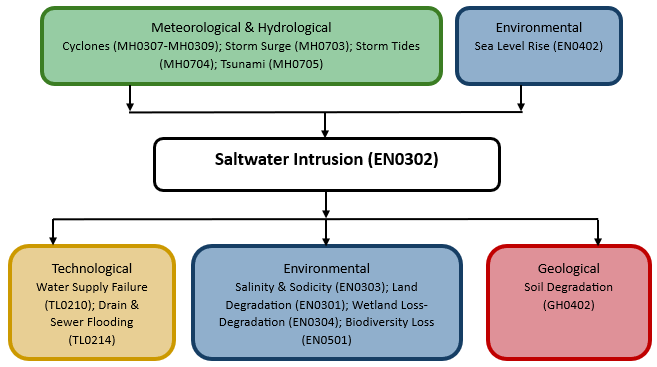
The figure below summarises common interactions between seawater intrusion and other hazards. This information should be used with caution and not be solely relied upon in Disaster Risk Management, particularly as some interactions may not have been included. Note that hazardous events occurring together or locally in space or time may not necessarily cause, amplify, or be otherwise related to each other. Specific examples of multi-hazard contexts can be found in the ‘Hazard drivers’ and ‘Impacts’ sections above.
Multi-hazard diagram
Risk Management
Proper management of seawater intrusion issues requires good knowledge of aquifer systems and the ability to predict their future behaviour under different scenarios of naturally forcing and anthropogenic interactions. In this respect, numerical simulation is widely used to examine seawater intrusion in coastal aquifers and to evaluate alternative groundwater-resource-management scenarios (Jeen et al., 2021).
Management techniques are generally divided into two main types: managing the pumping of water from the groundwater aquifers and putting in place physical barriers to prevent saltwater from intruding into the aquifers (Wu et al., 2020). The table below provides a summary of strategies, approaches, and tools to mitigate the impacts of saltwater intrusion (Montanari, 2017; White and Kaplan, 2017).
As part of the Regional Adaptation Collaborative (RAC) of Natural Resources Canada, case studies have been developed in each of the Atlantic Canadian provinces in order to better understand saltwater intrusion, as well as the challenges and needs it presents. Case studies are being conducted to investigate existing conditions and the potential impacts of climate change on groundwater resources (Prince Edward Island Department of Environment, Labour and Justice, 2011).
Monitoring
The section and the table below offer an overview of monitoring for seawater intrusion. This information can be used for forecasting within a national early warning system (EWS). Since EWS capacities and processes differ across countries, the most current and specific information regarding EWS should be obtained from the appropriate national or regional agency/authority responsible for disaster management.
| Which institution(s) produce(s) disaster risk data/Information? | Water agencies, agriculture agencies, health agencies. |
| How is the hazard observed/monitored/forecast? | Measurement and monitoring of water levels in groundwater wells (Jasechko et al., 2020); hydrograph analysis; water quality sampling; and geophysical logging (California Water Science Center, no date). |
References
Alshehri, F., Almadani, S., El-Sorogy, A.S., Alwaqdani, E., Alfaifi, H.J., Alharbi, T., 2021. Influence of seawater intrusion and heavy metals contamination on groundwater quality, Red Sea coast, Saudi Arabia. MarinePollutionBulletin165, 112094. Accessed 12 February 2025.
Benaafi M., Abba, S.I., Aljundi, I.H., 2023. Effects of Seawater Intrusion on the Groundwater Quality of Multi-Layered Aquifers in Eastern Saudi Arabia. Molecules, 28(7):3173. doi: 10.3390/molecules28073173. Accessed 12 February 2025.
California Water Science Center, no date. Sustainable Groundwater. Accessed 12 February 2025.
Chun, J.A., Lim, C., Kim, D., Kim, J.S., 2018. Assessing impacts of climate change and sea-level rise on seawater intrusion in a coastal aquifer. Water, 10:357. Accessed 12 February 2025.
Coastal City Resilience and Extreme Heat Action Project (CoCHAP), no date. Coastal hazards Fact Sheets #4: Saltwater Intrusion in Cities. Accessed 12 February 2025.
Geosciences Australia, 2014. Seawater Inclusion. Accessed 12 February 2025.
Government of British Columbia, No Date. Best Practices for Prevention of Saltwater Intrusion. Accessed 12 February 2025. 14 April 2021.
Government of South Australia, 2015. Measuring salinity. Accessed 12 February 2025.
Jasechko, S., Perrone, D., Seybold, H.et al., 2020. Groundwater level observations in 250,000 coastal US wells reveal scope of potential seawater intrusion. Nat Commun 11, 3229 (2020). DOI: 10.1038/s41467-020-17038-2. Accessed 12 February 2025.
Jeen, S.-W., Kang, J., Jung, H.; Lee, J., 2021. Review of Seawater Intrusion in Western Coastal Regions of South Korea. Water, 13, 761. DOI: 10.3390/w13060761. Accessed 12 February 2025.
Kassem, A., Sefelnasr, A., Ebraheem, A.A., Sherif, M., 2024. Seawater intrusion physical models: A bibliometric analysis and review of mitigation strategies, Journal of Hydrology, 634, 131135. DOI: 10.1016/j.jhydrol.2024.131135. Accessed 12 February 2025.
Montanari, A., 2017. Lecture: Seawater intrusion. Accessed 12 February 2025.
Oppenheimer, M., Glavovic, B.C., Hinkel, J., van de Wal, R., Magnan, A.K., Abd-Elgawad, A., Cai, R., Cifuentes-Jara, M., DeConto, R.M., Ghosh, T., Hay, J., Isla, F., Marzeion, B., Meyssignac, B., Sebesvari, Z., 2019. Sea Level Rise and Implications for Low-Lying Islands, Coasts and Communities. In: IPCC Special Report on the Ocean and Cryosphere in a Changing Climate [H.-O. Pörtner, D.C. Roberts, V. Masson-Delmotte, P. Zhai, M. Tignor, E. Poloczanska, K. Mintenbeck, A. Alegría, M. Nicolai, A. Okem, J. Petzold, B. Rama, N.M. Weyer (eds.)]. Accessed 12 February 2025.
Prince Edward Island Department of Environment, Labour and Justice, 2011. Saltwater Intrusion and Climate Change. Accessed 12 February 2025.
Storlazzi, C.D., Gingerich, S.B., van Dongere, N. A., Cheriton, O.M., Swarzenski, P.W., Quataert, E., Voss, C.I., Field, D.W., Annamalai, H., Piniak, G.A., McCall, R., 2018. Most atolls will be uninhabitable by the mid-21st century because of sea-level rise exacerbating wave-driven flooding. Science Advances, 4:eaap9741. Accessed 12 February 2025.
U.S. Department of Agriculture Northeast Climate Hub, no date. Saltwater Intrusion: A Growing Threat to Coastal Agriculture. Accessed 12 February 2025.
USGS, 2019. Saline Water and Salinity. United States Geological Survey (USGS). Accessed 12 February 2025.
Werner, A.D., 2017. On the classification of seawater intrusion. Journal of Hydrology, 551, 619-631. Accessed 12 February 2025.
Werner, A.D., Bakker, M., Post, V.E.A., Vandenbohede, A., Lu, C., Ataie-Ashtiani, B., Simmons, C. T., Barry, D.A., 2013. Seawater intrusion processes, investigation and management: recent advances and future challenges. Adv. Water Resour., 51, 3-26, DOI: 10.1016/j.advwatres.2012.03.004. Accessed 12 February 2025.
White, E. Kaplan, D., 2017. Restore or retreat? Saltwater intrusion and water management in coastal wetlands. Ecosystem Health and Sustainability, 3:e01258. Accessed 12 February 2025.
Williams, V.J., 2010. Identifying the Economic Effects of Salt Water Intrusion after Hurricane Katrina. Journal of Sustainable Development, 3(1):29-29, DOI:10.5539/jsd.v3n1p29. Accessed 12 February 2025.
Wu, H., Lu, C., Kong, J., Werner, A.D., 2020. Preventing Seawater Intrusion and Enhancing Safe Extraction Using Finite-Length, Impermeable Subsurface Barriers: 3D Analysis. Water Resources Research, 56 (11), DOI: 10.1029/2020WR027792. Accessed 12 February 2025.