
Black Carbon
Black carbon refers to the substance formed through the incomplete combustion of fossil fuels, biofuels and biomass, which is emitted in both anthropogenic and naturally occurring soot. It consists of pure carbon in several linked forms. Black carbon warms the Earth by absorbing heat in the atmosphere and by reducing albedo – the ability to reflect sunlight – when deposited on snow and ice. It is operationally defined as an aerosol species based on measurement of light absorption and chemical reactivity and/or thermal stability (UNEP, 2019).
Primary reference(s)
UNEP, 2019. Air Pollution in Asia and the Pacific: Science-based Solutions. Accessed 14 March 2025.
Annotations
Additional scientific description
Black carbon is a major component of PM₂.₅. It is sometimes referred to as soot, and its main sources are the incomplete combustion of fossil fuels, biofuels and biomass. It can be emitted from both anthropogenic sources (e.g. diesel vehicles, biomass cookstoves) and natural sources (e.g. wildfires). It is also a potent warming agent in the atmosphere, contributing to regional environmental disruption and accelerating glacier melt. Short- and long-term exposure to black carbon has been associated with cardiovascular health effects and premature mortality (WHO, no date).
Black carbon is the sooty black material emitted from all forms of incomplete combustion of carbon-containing materials, including gas and diesel engines, coal-fired power plants and other fossil fuel-burning sources. It comprises a significant proportion of atmospheric particulate matter (PM), which is an air pollutant (US EPA, 2019).
Elevated black carbon concentrations in areas with high solar radiation are a major contributor to the so-called 'brown clouds' covering large regions, for instance in Asia. Black carbon plays a unique and important role in Earth's climate system (Bond et al., 2013), leading to dimming of the Earth's surface, warming of the atmosphere and perturbation of the hydrological cycle, possibly affecting the monsoon (WMO, 2009), and enhancing snowmelt in the cryosphere (Kang et al., 2020; Szopa et al., 2021).
Black carbon (BC), the second-largest contributor to global warming, has detrimental effects on human health and the environment. However, accurate quantification of BC remains a challenge, impeding comprehensive assessment of its impacts. Three quantitative methods are commonly used for measuring BC: thermal optical analysis (TOA), the optical method and laser-induced incandescence (LII) (Zhang et al., 2023).
Indoor black carbon is largely due to cooking, heating and lighting, with biofuels such as wood, dung and crop residue. Outdoor sources include fossil fuel combustion (diesel and coal), open biomass burning (linked to deforestation, crop residue burning and wildfires), waste burning and cooking with biofuels (Szopa et al., 2021).
Despite intensive efforts in recent decades, no widely accepted standard measurement method exists for determining black carbon or light-absorbing carbon. Real-time measurements can be performed using optical methods, which measure the absorption of light through a filter collecting airborne particles (Ahmed et al., 2010).
Metrics and numeric limits
Not identified
Key relevant UN convention / multilateral treaty
UNECE Convention on Long-range Transboundary Air Pollution (CLRTAP): Since 1979 the Convention on Long-range Transboundary Air Pollution has addressed some of the major environmental problems of the United Nations Economic Commission for Europe (UNECE) region through scientific collaboration and policy negotiation (UNECE, 1979). The Convention has been extended by eight protocols that identify specific measures to be taken by Parties to cut their emissions of air pollutants. The Convention, which now has 51 Parties, identifies the Executive Secretary of UNECE as its secretariat. In addition to
Arctic Council Fairbanks Declaration, 2017.(https://www.ccacoalition.org/resources/arctic-council-fairbanks-declara…)
Drivers
Black carbon is formed by the incomplete combustion of fossil fuels, biomass and biofuels. Sources include: mobile sources, particularly diesel driven road vehicles, nonroad mobile machinery and ships; residential heating in combustion facilities, particularly burning of biomass such as fossil fuel coal and wood; and open biomass burning, forest fires and agricultural waste burning (EEA, 2013). Household waste burning is also a source of black carbon (Ramadan et al., 2023).
Impacts
Black carbon is a major component of PM₂.₅ pollution, often making up 10–30% of measured PM₂.₅ concentrations. As a harmful air pollutant, black carbon significantly contributes to the 4 million premature deaths from outdoor air pollution, the 3 million deaths from household air pollution and the trillions of dollars of economic cost (6% of global GDP) each year. There is growing evidence on the health impacts of exposure to black carbon specifically, which builds on a plethora of evidence on PM₂.₅ more broadly. Assuming all components of PM₂.₅ are equally toxic, outdoor/ambient black carbon exposure is estimated to be responsible for 150,000 excess deaths annually worldwide. Black carbon can also worsen extreme heat conditions and increase the risk of heatwave-related mortality. Black carbon has been linked to the increased temperature of heatwaves. Also, exposure to elevated levels of air pollution and black carbon has been shown to increase the risk of mortality from heatwaves. It is estimated that when particulate matter concentrations were high, heatwaves caused 36% and 106% more deaths in the 75–84 and 85+ age groups, respectively (Muduchuru et al., 2024). Full implementation of the reduction of black carbon emission in all Arctic Council member and observer states could reduce the annual global number of premature deaths by 329,000 by the year 2030, which amounts to 9% of the total global premature deaths due to particulate matter (Kühn et al., 2020).
Black carbon is a major contributor to the fine particulate (PM₂.₅) burden in the air. It is small enough to be easily inhaled into the lungs and has been associated with adverse health effects. The Near-Road Exposures to Urban Air Pollutants Study (NEXUS) evaluated that peat-burning wildfires release enormous amounts of particulate matter, including black carbon, which has been linked to increased risk of heart failure and respiratory hospital visits (US EPA, 2019).
Black carbon emissions affect global warming, snow and ice melt, monsoon and weather patterns, flood risk, heat stress and public health. The potential benefits of reducing the emissions are felt most strongly close to the source. The dual nature of black carbon as a climate and air pollutant has resulted in neither of these fields taking full ownership. Therefore, black carbon remains largely absent from mainstream climate and health agendas (Muduchuru et al., 2024). More specifically, black carbon affects atmospheric radiative forcing through three distinct mechanisms: aerosol–radiation interactions, aerosol–cloud interactions, and snow darkening. Black carbon significantly influences regional surface temperatures, particularly in the Arctic, and has a substantial warming effect on the cryosphere, estimated to be approximately three times more potent than that of CO₂. Black carbon is also a significant contributor to regional precipitation changes and has been shown to drive the slowdown of the hydrological cycle, leading to drier conditions.
The darkening of snow through the deposition of black carbon and other light‑absorbing particles enhances snowmelt. Sectors that emit large amounts of methane (agriculture and waste management) and black carbon (residential biofuel) are important contributors to warming over short time horizons of up to 20 years (Szopa et al., 2021).
Multi-hazard context
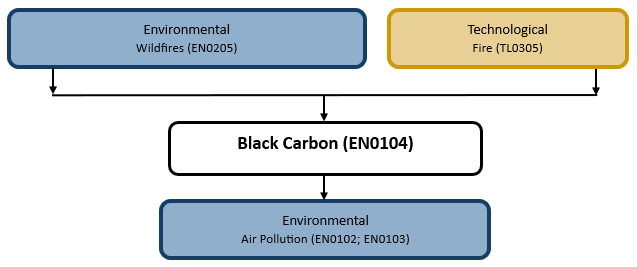
The figure below summarises common interactions between black carbon and other hazards. This information should be used with caution and not be solely relied upon in disaster risk management, particularly as some interactions may not have been included. Note that hazardous events occurring together or locally in space or time may not necessarily cause, amplify or be otherwise related to each other. Specific examples of multi-hazard context can be found in the ‘Hazard drivers’ and ‘Impacts’ sections above.
Multi-hazard diagram
Risk Management
Control measures: recommended measures include requiring regular vehicle emissions tests, retirement, or retrofitting; banning or regulating slash-and-burn clearing of forests and burning of agricultural waste; requiring shore-based electrification/power of ships, regulating idling at terminals, and mandating fuel standards for ships seeking to dock; banning or regulating the sale of certain fuels and/or requiring the use of cleaner fuels; requiring permits to operate industrial, power-generating and oil-refining facilities, and periodic permit renewal and/or modification of equipment; and requiring filtering technology and high-temperature combustion for existing power generation plants (EEA, 2013).
The Climate and Clean Air Coalition (CCAC) is a voluntary partnership of over 190 governments, intergovernmental organizations, and non-governmental organizations founded in 2012, and convened within UNEP. Collectively and individually, partners who join the Climate and Clean Air Coalition are working to reduce powerful but short-lived climate pollutants (SLCPs) – methane, black carbon, hydrofluorocarbons (HFCs), and tropospheric ozone – that drive both climate change and air pollution. (https://www.ccacoalition.org/content/climate-and-clean-air-coalition).
The Clean Cooking Alliance (CCA) works with a global network of partners to build an inclusive industry that can make clean cooking accessible to all. Established in 2010, CCA is driving consumer demand, mobilising investment, and supporting policies that allow the clean cooking sector to thrive. (https://cleancooking.org/).
Monitoring
Air quality monitoring networks: the status of black carbon monitoring in Europe has been reported by the European Environment Agency (EEA, 2013).
References
Ahmed, T., Dutkiewicz, V., Shareef, A., Tuncel, G., Tuncel, S., and Husain, L., 2010. Measurement of black carbon (BC) by an optical method and a thermal-optical method: Intercomparison for four sites. Atmospheric Environment, 44:6305-6311.
Bond, T.C., Doherty, S.J., Fahey, D.W., Forster, P.M., Berntsen, T., DeAngelo, B.J., Flanner, M.G., Ghan, S., Kärcher. B., Koch, D., Kinne, S., Kondo, Y., Quinn, P.K., Sarofim, M.C., Schultz, M.G., Schulz, M., Venkataraman, C., Zhang, H., Zhang, S., Bellouin, N., Guttikunda, S.K., Hopke, P.K., Jacobson, M.Z., Kaiser, J.W., Klimont, Z., Lohmann, U., Schwarz, J. P., Shindell D., Storelvmo, T., Warren, S.G., and Zender, C.S., 2013. Bounding the role of black carbon in the climate system: A scientific assessment. JGR Atmosphere 118 (11), 5380-5552. DOI: 10.1002/jgrd.50171. Accessed 14 March 2025.
EEA, 2013. Status of Black Carbon Monitoring in Ambient Air in Europe. EEA Technical Report, No. 18/2013. European Environment Agency (EEA). Accessed 14 March 2025.
Kang, S., Zhang, Y., Qian, Y., and Wang, H., 2020. A review of black carbon in snow and ice and its impact on the cryosphere. Earth-Science Reviews, 210, 103346. DOI: 10.1016/j.earscirev.2020.103346. Accessed 14 March 2025.
Kühn, T., Kupiainen, K., Miinalainen, T., Kokkola, H., - Paunu, V.-V., Laakso, A., Tonttila, J., Van Dingenen, R., Kulovesi, K., Karvosenoja, N., Lehtinen, K.E.J., 2020. Effects of black carbon mitigation on Arctic climate. Atmospheric Chemistry and physics 20, 5527-5546. Accessed 14 March 2025.
Muduchuru, K.R., Lakshmisha, C., Srivastava, A., Tewari, A., Murthy, I. K., Subramanian, R., Johnson, M., Kleiman, G., McDougall, D., Roy, A., Sweeney, O., Grylls, T., 2024. The Case for Acton on Black Carbon. Accessed 14 March 2025.
Ramadan, B.S., Rosmalina, R.T., Syafrudin, Munawir, Khair, H., Rachman, I., and Matsumoto, T., 2023. Potential Risks of Open Waste Burning at the Household Level: A Case Study of Semarang, Indonesia. Aerosol Air Qual. Res. 23, 220412. Potential Risks of Open Waste Burning at the Household Level: A Case Study of Semarang, Indonesia - Aerosol and Air Quality Research Accessed 14 March 2025.
Szopa, S., Naik, V., Adhikary, B., Artaxo, P., Berntsen, T., Collins, W. D., Fuzzi, S., Gallardo, L., Kiendler-Scharr, A., Klimont, Z., Liao, H., Unger, N., and Zanis, P., 2021. Short-Lived Climate Forcers. In Climate Change 2021: The Physical Science Basis. Contribution of Working Group I to the Sixth Assessment Report of the Intergovernmental Panel on Climate Change [Masson-Delmotte, V., P. Zhai, A. Pirani, S.L. Connors, C. Péan, S. Berger, N. Caud, Y. Chen, L. Goldfarb, M.I. Gomis, M. Huang, K. Leitzell, E. Lonnoy, J.B.R. Matthews, T.K. Maycock, T. Waterfield, O. Yelekçi, R. Yu, and B. Zhou (eds.)]. Cambridge University Press, Cambridge, United Kingdom and New York, NY, USA, pp. 817–922. DOI: 10.1017/9781009157896.008. Accessed 14 March 2025.
UNECE, 1979. Convention on Long-range Transboundary Air Pollution (CLRTAP). United Nations Economic Commission for Europe (UNECE). Accessed 14 March 2025.
United Nations, no date. Partnership for Clean Indoor Air (PCIA). The Partnership For Clean Indoor Air. Accessed 14 March 2025.
US EPA, 2019. Black Carbon Research. United States Environmental Protection Agency (US EPA). Accessed 14 March 2025.
WHO, No Date. Air Quality, Energy and Health. Accessed 14 March 2025.
WMO, 2009. The Carbonaceous Aerosol: A Remaining Challenge. WMO Bulletin, 58 (1). World Meteorological Organization (WMO). The Carbonaceous Aerosol—a Remaining Challenge. Accessed 14 March 2025.
Zhang, Z., Cheng, Y., Liang, L., and Liu, J., 2023. The Measurement of Atmospheric Black Carbon: A Review. Toxics, 11 (12), 975. DOI: 10.3390/toxics11120975 Accessed 14 March 2025.