
Wetland Loss/Degradation
Wetland loss/degradation is a negative trend in wetland condition, caused by physical or direct/indirect human-induced processes, expressed as a long-term reduction or loss of at least one of the following: biological productivity, ecological role or value to humans (Olsson et al., 2019). Wetlands are defined as areas of marsh, fen, peatland or water, whether natural or artificial, permanent or temporary, with water that is static or flowing, fresh, brackish or salt, including areas of marine water the depth of which at low tide does not exceed six metres (Convention on Wetlands, 1971: Article 1.1). Wetlands may incorporate riparian and coastal zones adjacent to the wetlands, and islands or bodies of marine water deeper than six metres at low tide lying within the wetlands (Convention on Wetlands, 1971: Article 2.1).
Primary reference(s)
Olsson, L., H. Barbosa, S. Bhadwal, A. Cowie, K. Delusca, D. Flores-Renteria, K. Hermans, E.
Jobbagy, W. Kurz, D. Li, D.J. Sonwa, L. Stringer, 2019. Land degradation. In: Climate Change and Land: an IPCC Special Report on Climate Change, Desertification, Land Degradation, Sustainable Land Management, Food Security, and Greenhouse Gas Fluxes in Terrestrial Ecosystems. Accessed 21 January 2025.
Convention on Wetlands of International Importance Especially as Waterfowl Habitat, 2 February 1971 (amended 1982 & 1987). Accessed 21 January 2025.
Annotations
Additional scientific description
The Convention classification of wetland types includes 42 types of wetlands grouped into three categories: marine and coastal wetlands, inland wetlands, and human-made wetlands. The five major wetland types are generally recognised as: marine (coastal wetlands including coastal lagoons, rocky shores, and coral reefs); estuarine (including deltas, tidal marshes, and mangrove swamps); lacustrine (wetlands associated with lakes); riverine (wetlands along rivers and streams); and palustrine (meaning 'marshy' - marshes, swamps and bogs). In addition, there are human-made wetlands such as fish and shrimp ponds, farm ponds, irrigated agricultural land, salt pans, reservoirs, gravel pits, sewage farms and canals (Convention on Wetlands 1971; Recommendation 4.7; Resolution VI.5 and Resolution VII.11).
Conversion of freshwater wetlands to agricultural land has historically been a common way of increasing the area of arable land (Olsson et al., 2019; Fluet-Chouinard et al., 2023). However, wetlands with organic and wet soils are crucial in maintaining the Earth's carbon balance as they contain soils with high organic carbon content. Human activities on wetlands (e.g. drainage, agriculture, forestry, peat extraction, aquaculture) and their effects (e.g. oxidation of soil organic matter) may significantly affect the carbon and nitrogen balance and, thus, the greenhouse gas emissions from these lands. The degradation of peatland ecosystems, for example, is particularly relevant in the context of climate change given their very high carbon storage and their sensitivity to changes in soils, hydrology and/or vegetation. Human activity, either draining or mining, takes up approximately 10% of global peatlands, releasing 80.8 Gt carbon and 2.3 Gt nitrogen. This corresponds to an annual greenhouse gas emission of 1.91 (0.31-3.38) Gt CO₂-equivalent that could be saved with peatland restoration. Drainage induces peatland degradation and alters peatlands, globally, from a net sink to a net source of greenhouse gases in the land-use sector (Joosten, 2009; IPCC, 2014; Leifeld and Menichetti, 2018; Olsson et al., 2019; Loisel et al., 2022; Strack et al., 2022; UNEP, 2022).
Wetlands constitute a resource of great economic, cultural, scientific and recreational value to human life by providing provisioning, regulating and supporting ecosystem services (Reed et al., 2019). Wetlands and people are ultimately interdependent. Furthermore, wetlands are an essential component of the global water cycle and play a key role in climate regulation. As such, the progressive encroachment on and loss of wetlands needs to be stopped, and measures must be taken to conserve and make wise use of wetland resources. Achieving this at a global level requires cooperative, intergovernmental action. The Convention on Wetlands provides the framework for such international, national and local action (Convention on Wetlands, 2016).
Metrics and numeric limits
Approximately 1% of the Earth's surface is freshwater wetlands. They provide a large number of ecosystem services such as groundwater replenishment, flood protection and nutrient retention, and are biodiversity hotspots. Over two-thirds of the world's fish harvest is linked to the health of coastal and inland wetland areas. Agriculture is also impacted by wetlands through the maintenance of water tables and nutrient retention in floodplains. In addition, rice, a common wetland plant, is the staple diet of more than half of the global population. The global loss of wetlands has recently been estimated at 21% since the 1700s; however, there are significant regional differences (Fluet-Chouinard et al., 2023).
Coastal wetlands around the world are sensitive to sea level rise. Studies and projections of the impacts on global coastlines are inconclusive, with suggestions that between 0% and 90% (depending on sea level rise scenario) of present-day wetlands will disappear during the 21st century (Olsson et al., 2019).
Despite their importance, coastal wetlands are listed among the most heavily damaged natural ecosystems worldwide; this includes damage to mangrove ecosystems (Bunting et al., 2022). However, coastal wetland restoration and preservation is a highly cost-effective strategy for society. For example, the preservation of coastal wetlands in the USA provides storm protection services worth USD 23.2 billion per year. Coastal wetlands function as valuable, self-maintaining 'horizontal levees' for storm protection (Costanza et al., 2008; Olsson et al., 2019).
Globally, approximately 1.1 Gha of land is affected by salt, with 14% of this categorised as forest, wetland or some other form of protected area (Olsson et al., 2019).
Key relevant UN convention / multilateral treaty
The Convention on Wetlands is an intergovernmental treaty whose mission is the conservation and wise use of all wetlands through local and national actions and international cooperation, as a contribution towards achieving sustainable development throughout the world (Convention on Wetlands, 2016). As of August 2023, 172 nations had joined the Convention as Contracting Parties, and more than 2,400 wetlands of international importance, covering over 2.5 million km2, have been designated for inclusion in the List of Wetlands of International Importance.
The United Nations Educational, Scientific and Cultural Organization (UNESCO) serves as the depositary for the Convention. However, the Convention on Wetlands is not part of the United Nations or UNESCO system of environmental conventions and agreements. The Convention is responsible only to its Conference of the Contracting Parties (COP), and its day-to-day administration has been entrusted to a secretariat under the authority of a standing committee elected by the COP. The Secretariat to the Convention on Wetlands is hosted under contract by the International Union for Conservation of Nature
Drivers
Overexploitation of freshwater resources jeopardises human wellbeing and the environment. Wetlands, critical ecosystems for biodiversity, water purification and flood control, are increasingly under threat from a complex interplay of socio-economic and environmental hazards. The multi-hazard context of wetland loss and degradation involves a combination of natural and anthropogenic factors that exacerbate their vulnerability.
Human activities are a primary driver of wetland loss, in particular land use change and agriculture. Agricultural expansion results in direct habitat loss and fragmentation. Agricultural practices represent a significant driver of wetland loss, primarily through conversion for agricultural land, water extraction and pollution. The expansion of agricultural land often necessitates the drainage and infilling of wetlands, disrupting their natural hydrology and ecological functions. Furthermore, agricultural activities can lead to increased nutrient pollution, sedimentation and habitat fragmentation, further degrading wetland ecosystems. These impacts can have severe consequences for biodiversity, water quality and the provision of ecosystem services (Convention on Wetlands, 2022).
Climate change also contributes to wetland loss, manifesting through rising temperatures, altered precipitation patterns and increased frequency of extreme weather events such as storms and droughts. These climatic shifts disrupt hydrological regimes, leading to either prolonged inundation or excessive drying, both detrimental to wetland health. For instance, intensified storms can cause physical damage and increase sedimentation rates, while droughts can reduce water availability, impacting the flora and fauna dependent on wetland habitats (Humpenöder et al., 2020; Gitay et al., 2011).
Moreover, socio-economic factors such as poverty and inadequate environmental governance can exacerbate wetland degradation. In many regions, wetlands are exploited for their resources-such as timber, fish and water-without sustainable management practices, leading to over-extraction and habitat destruction (Ghosh et al., 2023).
Impacts
Access to safe water, human health, food production, economic development and geopolitical stability are made less secure by the degradation of wetlands driven by the rapidly widening gap between water demand and supply. Even with current attempts to maintain minimum water flows for ecosystems, the capacity of wetlands to continue to deliver benefits to people and biodiversity—including clean and reliable water supplies—is declining. Efforts to support water allocation to ecosystems, such as environmental flow requirements, placing upper limits on water allocations and new water management legislation, must be strengthened (Convention on Wetlands, 2016).
Wetland loss/degradation results in associated reductions in ecosystem services delivered by wetlands, such as: provisioning services including food and freshwater; regulating services such as flood control, storm protection, drought buffering, groundwater recharge and discharge, and carbon sequestration; cultural services such as recreation; and supporting services such as purification of water supplies, shoreline stabilisation and erosion control, retention of nutrients, sediments and pollutants, and stabilisation of local climate conditions—particularly rainfall and temperature. The ecosystem services related to human health primarily cover the supply of water, food, nutrition and medicine; purification of waste products; and buffering against adverse flooding and climate effects (Convention on Wetlands, 2005; 2016).
The cumulative effects of these hazards create a feedback loop, where the degradation of wetlands reduces their resilience to future threats, thereby increasing their susceptibility to ongoing environmental changes. Addressing this multi-hazard context requires integrated management approaches that consider the interconnections between climatic, environmental and socio-economic factors to protect and restore these vital ecosystems (Convention on Wetlands, 2012; Docherty et al., 2020).
Multi-hazard context
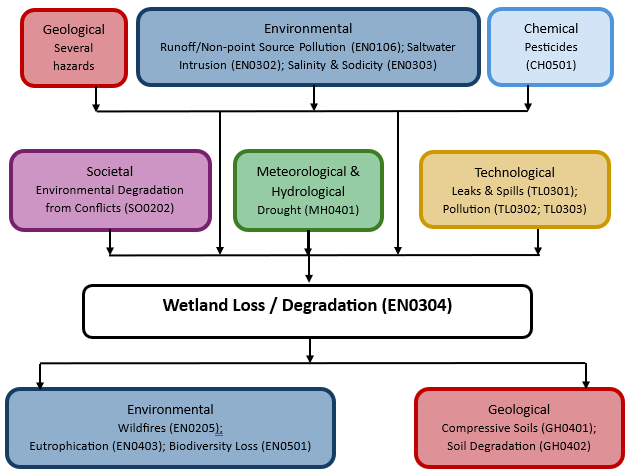
The figure below summarises common interactions between wetland loss or degradation and other hazards. This information should be used with caution and not be solely relied upon in disaster risk management, particularly as some interactions may not have been included. Note that hazardous events occurring together or locally in space or time may not necessarily cause, amplify, or be otherwise related to each other. Specific examples of multi-hazard context can be found in the ‘Hazard drivers’ and ‘Impacts’ sections above.
Multi-hazard diagram
Risk Management
Preserving wetlands requires an integrated approach, which not only addresses wetland conservation and restoration but also the implementation of effective climate change solutions and the achievement of the Sustainable Development Goals. This is particularly important given that water-related hazards constitute around 74% of all natural hazards (Chen, 2022; UNESCO 2020; Priscoli et al., 2015). Many Contracting Parties to the Convention on Wetlands, recognising the importance of the conservation and wise use of wetlands, have adopted some form of an avoid-mitigate-compensate approach to wetland loss and degradation. In this context, national, regional, and local laws and policies emphasise that negative wetland impacts should be avoided if at all possible. If such negative impacts cannot be avoided or prevented, actions should be taken to mitigate (minimise or reduce) this wetland loss or degradation. Finally, if wetland loss or degradation remains after such mitigation, actions should be taken to compensate for (i.e., offset) these residual impacts (Gardner et al., 2012).
Wetlands themselves can act as early warning systems for broader catchment changes. Alterations in wetland hydrology, such as changes in water levels or flow regimes, can signal broader hydrological shifts that may impact water resources and downstream ecosystems (Grenfell et al., 2005).
Monitoring
The section and the table below provide an overview of monitoring for wetland loss or degradation. This information can be used for forecasting within a national early warning system (EWS). Since EWS capacities and processes differ across countries, the most current and specific information regarding EWS should be obtained from the appropriate national or regional agency or authority responsible for disaster management.
| Which institution(s) produce(s) disaster risk data/information? | Environmental agencies; water agencies |
| How is the hazard observed/monitored/forecast? | Traditional monitoring methods include water quality assessments and biodiversity surveys. Satellite imagery is crucial for large-scale monitoring of wetland extent, vegetation cover and hydrological patterns (Rebelo et al., 2018). Changes in these parameters can serve as early indicators of wetland degradation. For instance, a decline in vegetation cover or alterations in water bodies might signal hydrological changes impacting wetland health (Demarquet et al., 2023; Rebelo et al., 2018; Lowry, 2006; van Dam et al., 1998). Biogeochemical indicators—such as nutrient levels, organic matter content and sediment accumulation—can also offer valuable insights into wetland condition. These parameters can be monitored through regular water quality assessments and sediment core analysis (Reddy et al., 2022). |
References
Bunting, P.; Rosenqvist, A.; Hilarides, L.; Lucas, R.M.; Thomas, N.; Tadono, T.; Worthington, T.A.; Spalding, M.; Murray, N.J.; Rebelo, L.-M., 2022. Global Mangrove Extent Change 1996–2020: Global Mangrove Watch Version 3.0. Remote Sens. 14, 3657. DOI: 0.3390/rs14153657. Accessed 21 January 2025.
Chen, W.-B., 2022. Mitigation Techniques for Water-Induced Natural Disasters: The State of the Art. Water, 14, 1247. DOI: 10.3390/w14081247. Accessed 21 January 2025.
Convention on Wetlands of International Importance Especially as Waterfowl Habitat. Ramsar, 2 February 1971 (amended 1982 & 1987). Accessed 21 January 2025.
Convention on Wetlands, 2005. Information Paper: Rationale for proposals for A Conceptual Framework for the wise use of wetlands and the updating of wise use and ecological character definitions (COP9 DR1 Annex A). 9th Meeting of the Conference of the Parties to the Convention on Wetlands (Ramsar, Iran, 1971) “Wetlands and water: supporting life, sustaining livelihoods” Kampala, Uganda, 8-15 November 2005. Accessed 21 January 2025.
Convention on Wetlands, 2012. Integrated Framework and guidelines for avoiding, mitigating and compensating for wetland losses (Resolution XI.9, 2012). Accessed 21 January 2025.
Convention on Wetlands, 2016. An Introduction to the Ramsar Convention on Wetlands, 7th ed. (previously The Ramsar Convention Manual). Accessed 21 January 2025.
Convention on Wetlands, 2022. Briefing Note No. 13: Wetlands and agriculture: impacts of farming practices and pathways to sustainability. Gland, Switzerland: Secretariat of the Convention on Wetlands.
Costanza, R., Pérez-Maqueo, O., Martinez, M.L., Sutton, P., Anderson, S.J., Mulder, K., 2008. The value of coastal wetlands for hurricane protection. Ambio. 37(4):241-248. DOI: 10.1579/0044-7447(2008)37. Accessed 21 January 2025.
Demarquet, Q., Rapinel, S., Dufour, S., Hubert-Moy, L., 2023. Long-Term Wetland Monitoring Using the Landsat Archive: A Review. Remote Sens. 15, 820. DOI: 10.3390/rs15030820. Accessed 21 January 2025.
Docherty, J M., Mao, F., Buytaert, W., Clark, J.R., Hannah, D.M., 2020. A framework for understanding water-related multi-hazards in a sustainable development context. Progress in Physical Geography: Earth and Environment, 44(2), 267-284. DOI: 10.1177/0309133319900926. Accessed 21 January 2025.
Fluet-Chouinard, E., Stocker, B.D., Zhang, Z. et al., 2023. Extensive global wetland loss over the past three centuries. Nature 614, 281–286. DOI: 10.1038/s41586-022-05572-6. Accessed 21 January 2025.
Gardner, C., Bonells, M., Okuno, E., Zarama, J.M., 2012. Avoiding, mitigating, and compensating for loss and degradation of wetlands in national laws and policies. Ramsar Scientific and Technical Briefing Note no. 3. Accessed 21 January 2025.
Ghosh, S., Swades P., 2023. Economic and socioecological perspectives of urban wetland loss and processes: a study from literatures. Environ Sci Pollut Res 30, 66514–66537. DOI: https://doi.org/10.1007/s11356-023-27123-w. Accessed 21 January 2025.
Gitay, H., Finlayson, C.M., Davidson, N.C., 2011. A Framework for assessing the vulnerability of wetlands to climate change. Ramsar Technical Report No. 5/CBD Technical Series No. 57. Ramsar Convention Secretariat, Gland, Switzerland & Secretariat of the Convention on Biological Diversity, Montreal, Canada. Accessed 21 January 2025.
Grenfell, M.C., Ellery, W.N., Preston-Whyte, R.A., 2005. Wetlands as early warning (eco) systems for water resource management. Water SA 31.4: 465-472, DOI: 10.4314/wsa.v31i4.5137. Accessed 21 January 2025.
Humpenöder, F., Karstens, K., Lotze-Campen, H., Leifeld, J., Menichetti, L., Barthelmes, A., Popp, A., 2020. Peatland protection and restoration are key for climate change mitigation. Environmental Research Letters, 15(10), 104093, DOI: 10.1088/1748-9326/abae2a. Accessed 21 January 2025.
IPCC, 2014. 2013. Supplement to the 2006 IPCC Guidelines for National Greenhouse Gas Inventories: Wetlands. Methodological Guidance on Lands with Wet and Drained solid and Constructed Wetlands for Wastewater Treatment. Hiraishi, T., T. Krug, K. Tanabe, N. Srivastava, J. Baasansuren, M. Fukuda and T.G. Troxler (eds). Intergovernmental Panel on Climate Change (IPCC). Accessed 21 January 2025
Joosten, H., 2009. The Global Peatland CO2 Picture: Peatland Status and Drainage Related Emissions in all Countries of the World. Wetland International. Accessed 21 January 2025
Leifeld, J., Menichetti, L., 2018. The underappreciated potential of peatlands in global climate change mitigation strategies. Nature Communications, 9:1071. doi: 10.1038/s41467-018-03406-6. Accessed 21 January 2025.
Loisel, J., Gallego-Sala, A., 2002. Ecological resilience of restored peatlands to climate change. Commun Earth Environ 3, 208. DOI: 10.1038/s43247-022-00547-x. Accessed 21 January 2025
Lowry, J. 2006. Low-cost GIS software and data for wetland inventory, assessment and monitoring. Ramsar Technical Report No. 2. Ramsar Convention Secretariat, Gland, Switzerland. ISBN 2-940073-30-9. Accessed 21 January 2025.
Olsson, L., Barbosa, H., Bhadwal, S., Cowie, A., Delusca, K., Flores-Renteria, D., Hermans, K., Jobbagy, E., Kurz, W., Li, D., Sonwa, D.J., Stringer, L., 2019. Land degradation. In: Climate Change and Land: an IPCC Special Report on Climate Change, Desertification, Land Degradation, Sustainable Land Management, Food Security, and Greenhouse Gas Fluxes in Terrestrial Ecosystems. Accessed 21 January 2025.
Priscoli, J.D., Hiroki, K., 2015. Water and Disasters: Cases from the High Level Experts and Leaders Panel on Water and Disasters. Water Policy 17 (S1): 1–5. DOI:10.2166/wp.2015.000.
Rebelo, L.-M., Finlayson, C.M., Strauch, A., Rosenqvist, A., Perennou, C., Tøttrup, C., Hilarides, L., Paganini, M., Wielaard, N., Siegert, F., Ballhorn, U., Navratil, P., Franke, J. Davidson, N., 2018. The use of Earth Observation for wetland inventory, assessment and monitoring: An information source for the Ramsar Convention on Wetlands. Ramsar Technical Report No.10. Gland, Switzerland: Convention on Wetlands Secretariat. Accessed 21 January 2025.
Reddy, K.R., DeLaune, R.D., Inglett, P.W., 2022. Biogeochemistry of Wetlands: Science and Applications (2nd ed.). CRC Press. DOI: 10.1201/9780429155833. Accessed 21 January 2025.
Reed, M.H., Jenkins, T., Kenyon, L., 2019. Why wetlands matter. The Science Teacher, 87(4), pp.34-42.
Strack, M., Davidson, S.J., Hirano, T., et al., 2022. The Potential of Peatlands as Nature-Based Climate Solutions. Curr Clim Change Rep 8, 71–82. Accessed 21 January 2025.
UNEP, 2022. Global Peatlands Assessment – The State of the World’s Peatlands: Evidence for action toward the conservation, restoration, and sustainable management of peatlands. Main Report. Global Peatlands Initiative. United Nations Environment Programme, Nairobi. Accessed 21 January 2025.
UNESCO, UN-Water, 2020. United Nations World Water Development Report 2020: Water and Climate Change, Paris, UNESCO
van Dam, R.A., Camilleri, C., Finlayson, C.M., 1998. The potential of rapid assessment techniques as early warning indicators of wetland degradation: A review. Environ. Toxicol. Water Qual., 13: 297-312. DOI: 10.1002/(SICI)1098-2256(1998)13:4<297::AID-TOX3>3.0.CO;2-2. Accessed 21 January 2025.