
Household Air Pollution
Household air pollution is pollution primarily resulting from the incomplete combustion of solid fuels (e.g. wood, dung, charcoal, coal, kerosene), resulting in the emission of potentially toxic pollutants, including particles of varying sizes, carbon monoxide (CO), nitrogen dioxide, volatile and semi-volatile organic compounds (e.g. formaldehyde and benzo[a]pyrene), methylene chloride and dioxins. It is one of the leading environmental risk factors for disease and premature death and is generated by the use of inefficient and polluting fuels and technologies in and around homes.
Primary reference(s)
WHO, 2018. Household air pollution and health. World Health Organization (WHO). Accessed 21 January 2025.
Naeher, L.P., Brauer, M., Lipsett, M., Zelikoff, J.T., Simpson, C.D., Koenig, J.Q., & Smith, K.R., 2007. Woodsmoke health effects: a review. Inhalation toxicology, 19(1), 67-106. DOI: 10.1080/08958370600985875. Accessed 21 January 2025.
Annotations
Additional scientific description
Around 2.4 billion people still cook using solid fuels (such as wood, crop wastes, charcoal, coal and dung) and kerosene in open fires and inefficient stoves (IEA, 2023). Most of these people are poor and live in low- and middle-income countries. These cooking practices are inefficient and utilise polluting fuels and technologies that produce high levels of household air pollution, containing a range of health-damaging pollutants, including small soot particles that penetrate deep into the lungs. In poorly ventilated dwellings, indoor smoke can be 100 times higher than acceptable levels for fine particles. Exposure is particularly high among women and young children, who spend the most time near the domestic hearth (WHO, 2018a).
Exposure to smoke from cooking fires caused 3.3 million premature deaths per year in 2019 from illnesses attributable to household air pollution due to the use of inefficient and polluting fuels and technologies for cooking. Among these 3.3 million deaths: 23% were due to pneumonia; 22% from stroke; 31% from ischaemic heart disease; 18% from chronic obstructive pulmonary disease (COPD); and 6% from lung cancer (WHO, 2024).
The WHO provides definitions of clean, transitional and polluting fuels and technologies used for cooking, heating and lighting. For cooking, clean fuels and technologies are those that attain the fine particulate matter (PM2.5) and carbon monoxide (CO) levels recommended in the WHO global air quality guidelines (2021). The WHO Guidelines for indoor air quality: household fuel combustion (2014) provide PM2.5 and CO emission rate targets for devices, which are linked to the levels from the Air Quality Guidelines.
Metrics and numeric limits
The WHO Air Quality Guidelines (WHO, 2021) offer recommended exposure levels for particulate matter (PM10 and PM2.5), ozone, nitrogen dioxide, sulphur dioxide and carbon monoxide, as well as a set of interim targets to encourage a progressive improvement in air quality, as outlined in Table 1 (WHO, 2021).
| Pollutant | Averaging time | Interim target | AQG level | |||
|---|---|---|---|---|---|---|
| 1 | 2 | 3 | 4 | |||
| PM2.5, µg/m³ | Annual | 35 | 25 | 15 | 10 | 5 |
| 24-houra | 75 | 50 | 37.5 | 25 | 15 | |
| PM10, µg/m³ | Annual | 70 | 50 | 30 | 20 | 15 |
| 24-houra | 150 | 100 | 75 | 50 | 45 | |
| O3, µg/m³ | Peak seasonb | 100 | 70 | – | – | 60 |
| 8-houra | 160 | 120 | – | – | 100 | |
| NO2, µg/m³ | Annual | 40 | 30 | 20 | – | 10 |
| 24-houra | 120 | 50 | – | – | 25 | |
| SO2, µg/m³ | 24-houra | 125 | 50 | – | – | 40 |
| CO, mg/m³ | 24-houra | 7 | – | – | – | 4 |
a 99th percentile (i.e. 3–4 exceedance days per year).
b Average of daily maximum 8-hour mean O3 concentration in the six consecutive months with the highest six-month running-average O3 concentration.
Key relevant UN convention / multilateral treaty
Sendai Framework for Disaster Risk Reduction 2015-2030.
Drivers
Multiple factors contribute to household air quality degradation. Combustion processes, including residential heating, cooking and tobacco smoking, release a range of pollutants, such as carbon monoxide, nitrogen oxides and particulate matter, into indoor environments (Naeher et al., 2007). Building materials and furnishings emit volatile organic compounds (VOCs) and formaldehyde, further compromising indoor air quality (Harčárová et al., 2020). Biological contaminants, including mould, bacteria and allergens, can also proliferate within indoor spaces, particularly in environments with inadequate ventilation (Kumar et al., 2021).
The reliance on biomass fuels, which are the primary source of household air pollution in many countries, contributes to outdoor air pollution (Zuazua-Ros et al., 2023) and climate change. In some regions, fuel gathering for inefficient stoves contributes to environmental degradation, including deforestation and desertification (Martin et al., 2013). Moreover, household air pollution is often linked with energy poverty, where households lack access to clean energy sources. This limits economic opportunities and educational attainment, as children and adults are forced to allocate time to fuel collection instead of engaging in productive activities (Wang et al., 2022).
Impacts
Exposure to household air pollution has been linked to a variety of adverse health effects. Respiratory illnesses, including asthma and allergies, are commonly associated with poor indoor air quality. More severe health consequences, such as cardiovascular disease and cancer, have also been linked to long-term exposure (Lee et al., 2020). Additionally, household air pollution has been associated with reduced cognitive function, particularly in children (Wang et al., 2021).
Multi-hazard context
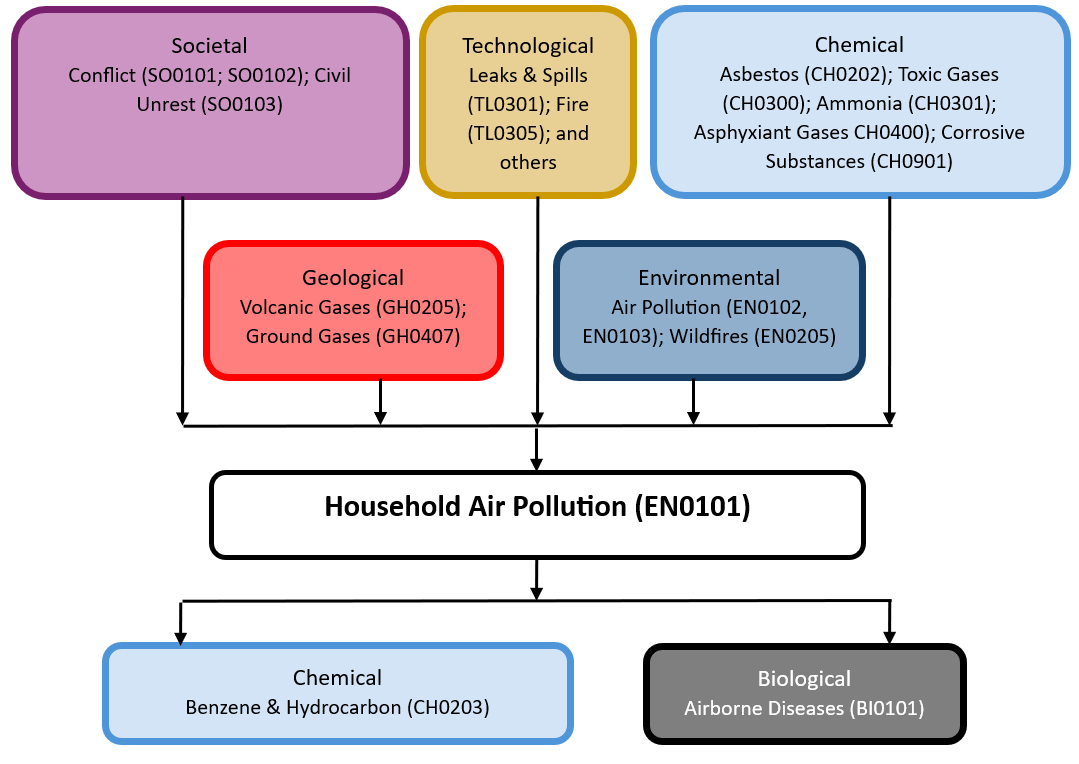
The figure below summarises common interactions between household air pollution and other hazards. This information should be used with caution and not be solely relied upon in disaster risk management, particularly as some interactions may not have been included. Note that hazardous events occurring together or locally in space or time may not necessarily cause, amplify or be otherwise related to each other. Specific examples of multi-hazard context can be found in the ‘Hazard drivers’ and ‘Impacts’ sections above.
Multi-hazard diagram
Risk Management
Mitigating the risks associated with household air pollution can be done through the use of effective ventilation and air filtration systems for diluting and removing pollutants from indoor spaces (Chojer et al., 2024). Source control measures, such as selecting low-emission building materials and furnishings, can significantly reduce indoor pollutant levels. Public awareness campaigns can empower individuals to adopt healthy indoor practices and reduce their exposure to household air pollution (Jung et al., 2023). Carbon finance incentives for clean stove adoption (IEA, 2023) can be an effective policy tool.
The WHO provides technical support to countries in their evaluations and scale-up of health-promoting household fuels and technologies (WHO, 2018a). This is further complemented by the development of the Clean Household Energy Solutions Toolkit (CHEST) to support the implementation of the WHO Guidelines for Indoor Air Quality: Household Fuel Combustion (WHO, 2014). CHEST provides a suite of tools and information resources that help countries identify stakeholders working on household energy and/or public health to design, implement and monitor policies addressing household energy (WHO, 2018a). The WHO also supports international initiatives to improve air pollution and related health impacts, such as the Clean Cooking Alliance and the Climate and Clean Air Coalition (WHO, 2018a).
Monitoring
The section and the table below offer an overview of monitoring for household air pollution. This information can be used for forecasting within a national early warning system (EWS). Since EWS capacities and processes differ across countries, the most current and specific information regarding EWS should be obtained from the appropriate national or regional agency/authority responsible for disaster management.
| Which institution(s) produce(s) disaster risk data/information? | Environmental agencies, health agencies. |
| How is the hazard observed/monitored/forecast? | Air quality sensors capable of detecting fine particulate matter (PM2.5) and volatile organic compounds (VOCs) within households (Kumar et al., 2021). These sensors provide continuous data, enabling the identification of pollution trends and acute exposure events (Chojer et al., 2024). |
References
Chojer, H., Branco, P.T.B.S., Martins, F.G., Alvim-Ferraz, M.C.M., Sousa, S.I.V., 2024. Source identification and mitigation of indoor air pollution using monitoring dat. Current Trends. Environmental Technology & Innovation, 103534. DOI: 10.1016/j.eti.2024.103534. Accessed 21 January 2025.
Harčárová, K., Vilčeková, S., Balintova, M., 2020. Building materials as potential emission sources of VOC in the indoor environment of buildings. In Key Engineering Materials (Vol. 838, pp. 74-80). Trans Tech Publications Ltd. DOI: 10.4028/www.scientific.net/KEM.838.74. Accessed 21 January 2025.
IEA, IRENA, UNSD, World Bank, WHO., 2023. Tracking SDG 7: The Energy Progress Report. World Bank, Washington DC. © World Bank. License: Creative Commons Attribution—NonCommercial 3.0 IGO (CC BY-NC 3.0 IGO). Accessed 21 January 2025.
Jung, C., El Samanoudy, G., 2023. Mitigating indoor air pollution in university dormitory: the need for better ventilation and resident awareness. Buildings, 13(5), 1144. DOI: 10.3390/buildings13051144 Accessed 21 January 2025.
Kumar, P., Kausar, M.A., Singh, A.B., Singh, R., 2021. Biological contaminants in the indoor air environment and their impacts on human health. Air Qual Atmos Health 14, 1723–1736. DOI: 10.1007/s11869-021-00978-z. Accessed 21 January 2025.
Lee, K. K., Bing, R., Kiang, J., Bashir, S., Spath, N., Stelzle, D., Mortimer, K.,∙Bularga, A., Doudesis, D., Joshi, S.S., Strachan, F.,Gumy, S., Adair-Rohani, H., Attia, E.F., Chung, M.H., Miller, M.R.,∙Newby, D.E., Mills, N.L.,∙McAllister, D.A., Shah, A. S., 2020. Adverse health effects associated with household air pollution: a systematic review, meta-analysis, and burden estimation study. The Lancet Global Health, 8(11), e1427-e1434. DOI: 10.1016/S2214-109X(20)30343-0. Accessed 21 January 2025.
Martin, W.J., Glass, R.I., Araj, H., Balbus, J., Collins, F.S., Curtis, S., Diette, G.B., Elwood, W.N., Falk, H., Hibberd, P.L., Keown, S.E., Mehta, S., Patrick, E., Rosenbaum, J., Sapkota, A., Tolunay, H.E., Bruce, N.G., 2013. Household air pollution in low- and middle-income countries: health risks and research priorities. PLoS Med.10(6):e1001455. DOI: 10.1371%2Fjournal.pmed.1001455. Accessed 21 January 2025.
Naeher, L.P., Brauer, M., Lipsett, M., Zelikoff, J.T., Simpson, C.D., Koenig, J.Q., & Smith, K.R., 2007. Woodsmoke health effects: a review. Inhalation toxicology, 19(1), 67-106. DOI: 10.1080/08958370600985875. Accessed 21 January 2025.
UN, 2015. Sustainable development. Department of Economic and Social Affairs, United Nations (UN). Accessed 21 January 2025.
Wang, C., Zhang, F., Wang, J., Doyle, J.K., Hancock, P.A., Mak, C.M., & Liu, S., 2021. How indoor environmental quality affects occupants’ cognitive functions: A systematic review. Building and environment, 193, 107647. DOI: 10.1016/j.buildenv.2021.107647. Accessed 21 January 2025.
Wang C., Wang J., Norbäck, D.A., 2022. Systematic Review of Associations between Energy Use, Fuel Poverty, Energy Efficiency Improvements and Health. International Journal of Environmental Research and Public Health 19(12):7393. Accessed 21 January 2025.
WHO, 2014. WHO Guidelines for Indoor Air Quality: Household fuel combustion. Executive summary. World Health Organization (WHO). Accessed 21 January 2025.
WHO, 2018a. Household air pollution and health. World Health Organization (WHO). Accessed 21 January 2025.
WHO, 2018b. Burden of disease from the joint effects of household and ambient Air pollution for 2016. World Health organization (WHO). Accessed 21 January 2025.
WHO, 2021. WHO global air quality guidelines. Particulate matter (PM2.5 and PM10), ozone, nitrogen dioxide, sulphur dioxide and carbon monoxide. Geneva: World Health Organization. Accessed 21 January 2025.
WHO, 2024. Development Goal indicator 3.9.1: mortality attributed to air pollution. Geneva, World Health Organization, 2024. Accessed 21 January 2025.
Zuazua-Ros, A., de Brito Andrade, L., Dorregaray-Oyaregui, S., Martin-Gomez, C., Ramos Gonzalez, J.C., Manzueta, R., Saiz-Ezquerra, B.S., Ariño, A.H., 2023. Crosscutting of the pollutants and building ventilation systems: a literature review. Environ Sci Pollut Res 30, 66538–66558 (2023). Accessed 21 January 2025.