
Chemical Warfare Agents
Chemical agents or ‘chemical warfare agents’ (chemical weapons) are chemicals, including dual -use chemicals, used to cause intentional death or harm through their toxic properties, and are a major public hazard. (OPCW, 2024a, b, c).
Primary reference(s)
OPCW, 2024a. What is a chemical weapon? Organisation for the Prohibition of Chemical Weapons (OPCW). Accessed 6 April 2024.
OPCW, 2024b. Chemical Weapons Convention: Article II: Definitions and criteria. Organisation for the Prohibition of Chemical Weapons (OPCW). Accessed 6 April 2024
OPCW, 2024c. Chemical Weapons Convention: Verification Annex, Part IV(A), paras. 15-19. Organisation for the Prohibition of Chemical Weapons (OPCW). Accessed 6 April 2024
Annotations
Additional scientific description
Chemical warfare agents represent a significant threat due to their potential for mass casualties and long-term environmental and health impacts. Munitions, devices and other equipment specifically designed to deliver toxic chemicals also fall under the definition of chemical weapons. Dual-use chemicals also classify as chemical warfare agents. These are any chemical that has legitimate peaceful uses, but which may also be used to make chemical weapons, for example, thiodiglycol is an ingredient in pen ink that can also be used as a precursor to mustard agents. Equipment in certain chemical production facilities can even be considered dual use in the sense that it may be converted to produce chemical weapons or their precursors. (OPCW, 2024d) The Chemical Weapons Convention (CWC) prohibits the use of toxic chemicals and their precursors and also covers toxins of biological origin; it also covers munitions or devices, and equipment directly in connection with these. The relevant toxic chemicals are listed in the Chemical Weapons Convention's Annex on Chemicals (OPCW, 2024b) and, in principle, the understanding and application of a so-called 'General Purpose' Criterion (GPC) and include (OPCW, 2024a):
- Blistering agents: These toxic compounds act via inhalation and contact, affecting the eyes, respiratory tract, and skin, first as an irritant and then as a cell poison. Exposure to blister agents causes large and often life-threatening skin blisters which that resemble severe burns, and often results in blindness and permanent damage to the respiratory system. Examples include mustard gas (ICSC 0418, 2005).
- Blood agents: These agents inhibit the ability of cells to transfer and use oxygen, effectively causing the body to suffocate. Blood agents generally enter the body through inhalation and are distributed via the blood. Examples include hydrogen cyanide (ICSC 0492, 2018) and cyanogen chloride (ICSC 1053, 1999).
- Choking agents: Inflicting injury mainly on the respiratory tract, choking agents irritate the nose, throat, and especially the lungs. When inhaled, these agents cause alveoli (air sacs in the lungs) to secrete fluid, essentially drowning those affected. Chlorine (ICSC 0126, 2009) and phosgene gas (ICSC 0007, 2013) are examples.
- Nerve agents: Nerve agents block impulses between nerve cells or across synapses and are highly toxic, with rapid effects. They act primarily by absorption through the lungs and skin, inhibiting the action of critical enzymes required for the normal functioning of the nervous system, causing seizures, loss of body control, muscle paralysis (including heart and diaphragm), and ultimately death. Sarin and VX gas are examples.
- Riot control agents: These agents are utilizsed to temporarily incapacitate a person by irritating the eyes, mouth, throat, lungs and skin, as well as constricting the airways. They are only considered chemical weapons when used in warfare. States can possess these agents for domestic law enforcement purposes, but if they are a member CWC, they must declare which type of agents they have. Examples include tear gas and pepper spray.
Metrics and numeric limits
The Chemical Weapons Convention (OPCW, 2024b, c) categorizes chemical substances into three schedules based on their potential for use in chemical weapons and their toxicity. Schedule 1 chemicals have no or very limited legitimate uses and have strict controls and verification measures. Schedule 2 chemicals have legitimate uses but can also be used as chemical weapons. Schedule 3 chemicals are precursors used in the production of chemical weapons. Parties to the Chemical Warfare Convention must declare any past or current chemical weapons-related activities and facilities, which are verified by the OPCW.
Whilst the Biological Weapons Convention (UNODA, 2021) does not have specific numerical limits, it prohibits the development, production, acquisition, transfer, and stockpiling of biological agents or toxins for hostile purposes.
Key relevant UN convention / multilateral treaty
Organisation for the Prohibition of Chemical Weapons (OPCW), Chemical Weapons Convention. (OPCW, 2024a,b).
United Nations Office for Disarmament Affairs (UNODA), Biological Weapons Convention. (UNODA, 2021).
United Nations Office for Disarmament Affairs (UNODA), UN Security Council Resolution 1540. (UNODA, 2004).
Drivers
Hazard Drivers have been wars and civil wars, associated with death, injury and often life-long disabilities (Australia Group, 2021a,b). Other drivers include political and ideological motivations (instilling fear and intimidating adversaries, or to achieve specific political aims), and technological advancements - advances in chemical synthesis, weaponization and delivery systems can lower barriers to acquiring and deploying chemical weapons, making them more accessible to state and non-state actors.
Control measures include import-export control of relevant chemical agents and precursors (Australia Group, 2021a, b). A key factor in ensuring that toxic chemicals and their precursors are not meant to cause death or other harm (i.e., as a ‘method of warfare’) is the application of the ‘General Purpose’ Criterion. A given activity or programme may be for ‘defensive’ (i.e., permit- ted) or ‘offensive’ (i.e., prohibited) purposes.
Impacts
Impacts of chemical weapons include immediate and long-term health effects, and death, resulting in mass casualties, overwhelming healthcare systems, and causing psychological trauma. The deployment of weapons can also lead to environmental contamination, requiring extensive decontamination efforts, and long-term ecological consequences. It can also lead to disruption to economic activities and economic losses, hindering recovery efforts. The use of chemical weapons can also provoke international condemnation, trigger diplomatic crises, and lead to military retaliation or sanctions against the responsible parties.
Multi-hazard context
The figure below summarizses common interactions between chemical warfare agents and other hazards. This information should be used with caution and not be solely relied upon in Disaster Risk Management, particularly as some interactions may not have been included. Note that hazardous events occurring together or locally in space or time may not necessarily cause, amplify or be otherwise related to each other. Specific examples of multi-hazard context can be found in the ‘Hazard drivers’ and ‘Impacts’ sections above.
Multi-hazard diagram
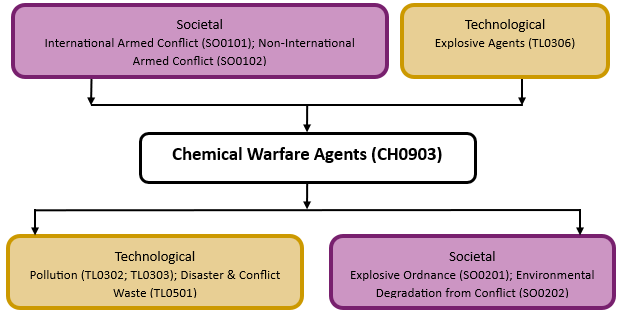
Risk Management
Risk Management strategies include prevention and non-proliferation, by strengthening treaties and verification methods. In addition, an international network of specialised analytical laboratories, able to detect potential chemical warfare agents in the environment and in exposed human bodies, is likely to be of benefit (EU, 2009). New technological approaches are being developed for the detection and monitoring of chemical warfare. Developing and exercising response plans, including medical treatment protocols, decontamination procedures, and public communication strategies, to mitigate the consequences of chemical weapons.
Monitoring
The section and the table below offer an overview of monitoring chemical warfare agents. This information can be used for forecasting within a national early warning system (EWS). Since EWS capacities and processes differ across countries, the most current and specific information regarding EWS should be obtained from the appropriate national or regional agency/authority responsible for disaster management.
| Which institution(s) produce(s) Disaster Risk Data/Information? | Organization for the Prohibition of Chemical Weapons (OPCW); national terrorism agencies |
| How is the Hazard Observed/Monitored/Forecast? | Sensors; monitoring networks; response protocols |
References
Australia Group, 2021a. Australia Group Common Control List Handbook: Volume 1: Chemical Weapons-Related Common Control Lists, Revision 6. Accessed 6 April 2024
Australia Group, 2021b. Australia Group Common Control List Handbook: Volume 2: Biological Weapons-Related Common Control Lists, Revision 6. Accessed 6 April 2024
Council of the European Union (EU), 2009. Council regulation (EC) No 428/2009: Setting up a community regime for the control of exports, transfer, brokering and transit of dual-use items (Recast). Official Journal of the European Union (EU), OJ L 134, 29.5.2009, p. 1. Accessed 1 December 2019
International Labour Organization (ILO), 2024. International Chemical Safety Cards (ICSC). Accessed 29 Aug 2024.
Organisation for the Prohibition of Chemical Weapons (OPCW), 2024a. What is a chemical weapon? Organization for the Prohibition of Chemical Weapons (OPCW). Accessed 6 April 2024.
Organisation for the Prohibition of Chemical Weapons (OPCW), 2024b. Chemical Weapons Convention: Article II: Definitions and criteria. Organization for the Prohibition of Chemical Weapons (OPCW). Accessed 6 April 2024
Organisation for the Prohibition of Chemical Weapons (OPCW), 2024c. Chemical Weapons Convention: Verification Annex, Part IV(A), paras. 15-19. Organisation for the Prohibition of Chemical Weapons (OPCW). Accessed 6 April 2024
Organisation for the Prohibition of Chemical Weapons (OPCW), 2024d. Preventing the Re-Emergence of Chemical Weapons. Organization for the Prohibition of Chemical Weapons (OPCW). Accessed 30 June 2024.
United Nations Economic Commission for Europe (UNECE), 2023. Globally Harmonised System (GHS) of Classification and Labelling of Chemicals (2023). United Nations Economic Commission for Europe (UNECE). Accessed 11 May 2024.
United Nations Office for Disarmament Affairs (UNODA), 2004. UN Security Council Resolution 1540. United Nations Office for Disarmament Affairs (UNODA). Accessed 4 May 2024
United Nations Office for Disarmament Affairs (UNODA), 2021. Biological Weapons Convention. United Nations Office for Disarmament Affairs (UNODA). Accessed 4 May 2024
United States Naval Institute (USNI), 1957. Lieutenant Edward F. Oliver. The Bombay Explosion (1957). US Naval Institute. Accessed 2 June 2024.