
Substandard and Falsified Medical Products
Substandard and falsified medical products are defined as those that may cause harm to patients and fail to treat the diseases for which they were intended (WHO, 2018).
Primary reference(s)
WHO, 2018. Substandard and falsified medical products. World Health Organization (WHO). Accessed 22 September 2024.
Annotations
Additional scientific description
Substandard and falsified medical products lead to loss of confidence in medicines, healthcare providers and health systems. They affect every region of the world. Substandard and falsified medical products from all the main therapeutic categories have been reported to the World Health Organization (WHO) and include medicines, vaccines and in vitro diagnostics. Anti-malarials and antibiotics are among the most commonly reported substandard and falsified medical products. Both generic and innovator medicines can be falsified, ranging from very expensive products for cancer to very inexpensive products for treatment of pain (WHO, 2018).
Substandard and falsified medical products can be found in illegal street markets, via unregulated websites through to pharmacies, clinics and hospitals. An estimated one in ten medical products in low- and middle-income countries is substandard or falsified. Substandard and falsified medical products contribute to antimicrobial resistance and drug-resistant infections (WHO, 2018).
Falsified medical products may contain no active ingredient, the wrong active ingredient or the wrong amount of the correct active ingredient. They are also commonly found to contain corn starch, potato starch or chalk. Some substandard and falsified medical products have been found to be toxic with either fatal levels of the wrong active ingredient or other toxic chemicals (WHO, 2018).
Substandard and falsified medical products are often produced in very poor and unhygienic conditions by unqualified personnel and contain unknown impurities and are sometimes contaminated with bacteria (WHO, 2018).
Substandard and falsified medical products are difficult to detect. They are often designed to appear identical to the genuine product and may not cause an obvious adverse reaction, however they often will fail to properly treat the disease or condition for which they were intended and can lead to serious health consequences including death (WHO, 2018).
The WHO has adopted definitions of substandard, unregistered / unlicensed and falsified medical products (WHO, 2018):
- Substandard (also called ‘out of specification’) medical products, are authorised medical products that fail to meet either their quality standards or specifications, or both.
- Unregistered/unlicensed medical products are those that have not undergone evaluation and/or approval by the national or regional regulatory authority for the market in which they are marketed/distributed or used, subject to permitted conditions under national or regional regulation and legislation.
- Falsified medical products are those that deliberately/fraudulently misrepresent their identity, composition or source.
Metrics and numeric limits
Not available.
Key relevant UN convention / multilateral treaty
Sendai Framework for Disaster Risk reduction 2015-2030.
Drivers
Many countries and the media frequently report successful action against manufacturers of substandard and falsified medical products. Some reports refer to large-scale manufacturing and others to small back-street operations. With the availability of tableting machines, ovens, specialist equipment, ingredients and packaging materials, clandestine manufacturing facilities are quick and easy to assemble (WHO, 2018).
Impacts
No countries remain untouched by this issue – from North America and Europe through to sub-Saharan Africa, South East Asia, and Latin America. What was once considered a problem limited to developing and low-income countries has now become an issue for all. With the exponential increase in internet connectivity, those engaged in the manufacture, distribution and supply of substandard and falsified medical products have gained access to a global market place. However, it is in low- and middle-income countries and those in areas of conflict, or civil unrest, where healthcare systems are weak or non-existent that bear the greatest burden of substandard and falsified medical products. Substandard and falsified medical products are most likely to reach patients in situations where there is constrained access to quality and safe medical products, poor governance and weak technical capacity (WHO, 2018).
The falsification of medical products is a crime affecting all regions of the world and addressing it requires greater cooperation along the entire supply chain (WHO, 2017).
Multi-hazard context
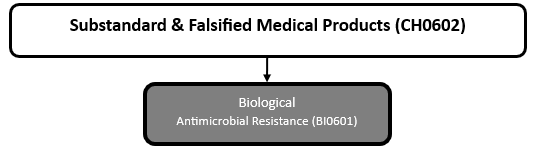
The figure below summarises common interactions between substandard and falsified medical products and other hazards. This information should be used with caution and not be solely relied upon in Disaster Risk Management, particularly as some interactions may not have been included. Note that hazardous events occurring together or locally in space or time may not necessarily cause, amplify or be otherwise related to each other. Specific examples of multi-hazard context can be found in the ‘Hazard drivers’ and ‘Impacts’ sections above.
Multi-hazard diagram
Risk Management
The Member State Mechanism is the global platform where countries can convene, coordinate, decide and organise actions to address substandard and falsified medical products. It was established in order to protect public health and promote access to affordable, safe, efficacious and quality medical products, through effective collaboration between Member States and the WHO to prevent and control substandard and falsified medical products and associated activities (WHO, 2018).
The structured reporting system allows for a fast response to emergencies and the issue of alerts in the most serious cases. It also facilitates in-depth analyses of the medical products most at risk, the vulnerabilities and weaknesses in health systems, the harm caused to public health and the need for investment, training and stronger regulations and standards (WHO, 2018).
The WHO provides guidance (WHO, 2018) for identifying substandard and falsified medical products, both as the products but also for those purchased from the Internet.
- Identifying a substandard or falsified medical product: Some falsified medical products are visually almost identical to the genuine product and very difficult to detect. However, many can be identified by examining the packaging for condition, spelling mistakes or grammatical errors; checking the manufacture and expiry dates and ensuring any details on the outer packaging match the dates shown on the inner packaging; ensuring the medicine looks correct, is not discoloured, degraded or has an unusual smell; discussing with your pharmacist, doctor or other healthcare professional as soon as possible if you suspect the product is not working properly or you have suffered an adverse reaction; and reporting suspicious medical products to your National Medicines Regulatory Authority.
- Substandard and falsified medical products and the Internet: Unregulated websites, social media platforms, and smartphone applications can also be direct conduits of substandard and falsified medical products. Risks to consumers are significantly increased when obtaining medical products from unlicensed and unregulated sources.
To support countries in enacting or strengthening domestic legislation in this area and in protecting public health, the United Nations Office on Drugs and Crime (UNODC) released a guide to good legislative practices on combating falsified medical product-related crime (UNODC, 2019).
Monitoring
The section and the table below offer an overview of monitoring substandard and falsified medical products. This information can be used for forecasting within a national early warning system (EWS). Since EWS capacities and processes differ across countries, the most current and specific information regarding EWS should be obtained from the appropriate national or regional agency/authority responsible for disaster management.
Which institution(s) produce(s) Disaster Risk Data/Information? | World Health Organization (WHO) |
| How is the Hazard Observed/Monitored/Forecast? | WHO Global Surveillance and Monitoring System |
References
UNECE, 2023. Globally Harmonised System (GHS) of Classification and Labelling of Chemicals (2023). United Nations Economic Commission for Europe (UNECE). Accessed 11 May 2024.
UNODC, 2019. Combating Falsified Medical Product-Related Crime: A Guide to Good Legislative Practices. United Nations Office on Drugs and Crime (UNODC). Accessed 22 September 2024.
WHO, 2017. Global Surveillance and Monitoring System for substandard and falsified medical products ISBN 978-92-4-151342-5, 9789241513425-eng.pdf Accessed 7 May 2025.
WHO, 2018. Substandard and falsified medical products. World Health Organization (WHO). Accessed 22 September 2024.