
Levels of Contaminants in Food and Feed
A contaminant in food and feed is defined as any substance not intentionally added but present in such food or feed as a result of the production, manufacture, processing, preparation, treatment, packing, packaging, transport or storage, or as a result of environmental contamination, which can lead to major public hazards (FAO and WHO, 2019).
Primary reference(s)
FAO and WHO, 2019. Codex Alimentarius Commission – Procedural Manual twenty-seventh edition. Food and Agriculture Organization of the United Nations (FAO) and World Health Organization (WHO). Accessed 1 July 2024
Annotations
Additional scientific description
Food contaminants include toxins and bacteria, but do not include insect fragments, rodent hairs and other extraneous matter. With an estimated 600 million cases of foodborne illnesses annually, unsafe food is a threat to human health, food security, nutrition and economies globally. Ensuring food safety is a public health priority and an essential step to achieving food and nutrition security. Effective national food safety and quality control systems are key not only to safeguarding the health and well-being of people, but also to fostering economic development and improving livelihoods by promoting access to domestic, regional and international markets (FAO/WHO, 2020).
Food poisoning is a form of contamination which can cause severe symptoms and illness, in some instances even becoming life-threatening. Common causes are harmful bacteria (bacillus cereus; campylobacter; cronobacter; E. coli; listeria; salmonella; vibrio bacteria; yersinia) and viruses (norovirus), with fungi, parasites, toxins (clostridium botulinum) and natural contaminants being less common causes. Symptoms of foodborne illnesses include nausea or vomiting; diarrhoea; allergic reactions; headache; stomach cramps or pains; fever or chills; muscle or joint aches.
Metrics and numeric limits
Maximum Level: The maximum level for a contaminant in a food or feed commodity is the maximum concentration of that substance recommended by the Codex Alimentarius Commission to be legally permitted in that commodity. There are also national regulations for maximum levels.
Guideline Level: A guideline level is the maximum level of a substance in a food or feed commodity which is recommended by the Codex Alimentarius Commission to be acceptable for commodities moving in international trade. When the guideline level is exceeded, governments should decide whether and under what circumstances the food should be distributed within their territory or jurisdiction.
Note: A contaminant in food or feed is considered a risk for human health when above the maximum/guideline level established by the Codex Alimentarius Commission.
Common contaminants, including relevant Hazard Information Profiles and their limits (EU, 2006):
Aflatoxins CH0201: EU: 2 µg/kg for aflatoxin B1 in nuts and dried fruits intended for direct human consumption; 4 µg/kg for total aflatoxins (B1, B2, G1, G2) in nuts and dried fruits.
Codex Alimentarius: 10 µg/kg for total aflatoxins in peanuts intended for further processing; 15 µg/kg for total aflatoxins in other nuts intended for further processing.
Lead CH0103 (ICSC 0052, 2019): EU: 0.10 mg/kg in milk; 0.20 mg/kg in fruits and vegetables.
Codex Alimentarius: 0.01 mg/kg in milk; 0.1 mg/kg in fruits and vegetables.
Mercury CH0104 (ICSC 0056, 2019): EU: 0.5 mg/kg in most fish; 1.0 mg/kg in predatory fish like swordfish and tuna.
Codex Alimentarius: 0.5 mg/kg in most fish; 1.0 mg/kg in predatory fish.
Cadmium CH0102 (ICSC 0020, 2005): EU: 0.05 mg/kg in cereals; 0.2 mg/kg in leafy vegetables.
Codex Alimentarius: 0.1 mg/kg in cereals; 0.2 mg/kg in leafy vegetables.
Pesticide Residues CH0501: EU: Varies by specific pesticide and food product (e.g., 0.01 mg/kg for chlorpyrifos in fruits).
Codex Alimentarius: Varies by specific pesticide and food product (e.g., 0.01 mg/kg for chlorpyrifos in fruits).
Dioxins and PCBs (Polychlorinated Biphenyls) CH0502: EU: 1.75 pg/g for dioxins in meat and meat products; 3.5 pg/g for dioxins and dioxin-like PCBs in fish and fish products.
Codex Alimentarius: Similar limits as the EU for comparable products.
Key relevant UN convention / multilateral treaty
Codex Alimentarius International Food Standards, Codex General Standard for Contaminants and Toxins in Food and Feed (CXS 193- 1995) (FAO/WHO, 2023).
Food and Agriculture Organization of the United Nations (FAO), Joint FAO/WHO Expert Committee on Food Additives (JEFCA) (FAO/WHO, 2024).
United Nations Environment Programme (UNEP), Basel Convention on the Control of Transboundary Movements of Hazardous Wastes and Their Disposal (UNEP, 2011).
United Nations Environment Programme (UNEP), Rotterdam Convention on the Prior Informed Consent (PIC) Procedure for Certain Hazardous Chemicals and Pesticides in International Trade (UNEP, 2010).
United Nations Environment Programme (UNEP), Stockholm Convention on Persistent Organic Pollutants (POPs) (UNEP, 2019).
Drivers
Hazard Drivers include environmental sources such as contaminants from environmental pollution like heavy metals; or from industrial activities and agricultural run-off containing pesticides and herbicides., Contaminants may also arise during food processing, packaging, or storage, due to inadequate hygiene practices, chemical additives, or unintentional contamination during manufacturing. Some contaminants are naturally occurring, such as mycotoxins, due to fungal growth under specific environmental conditions (HIP CH0201). (EEA, 2024; WHO, 2023)
Impacts
Impacts include health risks, economic impact and regulatory compliance. Consumption of contaminated food and feed can lead to acute or chronic health effects, including cancer (e.g. from aflatoxins), neurological disorders (e.g. from heavy metals), and reproductive issues. Contamination incidents can result in economic losses due to recalls, market disruptions, and loss of consumer confidence in affected products and brands. Non-compliance with regulatory limits for contaminants can lead to legal consequences, trade restrictions, and sanctions affecting global market access for food and feed products. (CDC, 2024; EC, 2024)
Multi-hazard context
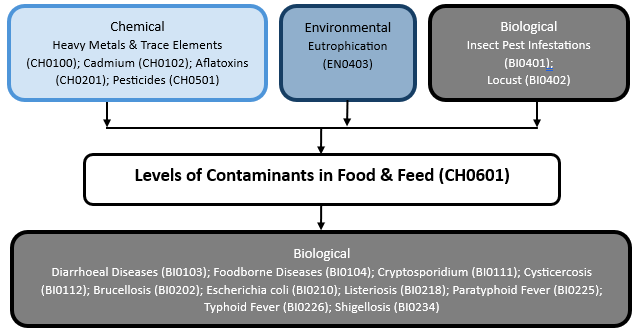
The figure below summarises common interactions between levels of contaminants in food and feed and other hazards. This information should be used with caution and not be solely relied upon in Disaster Risk Management, particularly as some interactions may not have been included. Note that hazardous events occurring together or locally in space or time may not necessarily cause, amplify or be otherwise related to each other. Specific examples of multi-hazard context can be found in the ‘Hazard drivers’ and ‘Impacts’ sections above.
Multi-hazard diagram
Risk Management
A national legislation and food control system, including food import control, export control, and national monitoring programmes should be implemented. Establishing and monitoring Maximum Residue Limits (MRLs), Acceptable Daily Intakes (ADIs), and other regulatory standards to assess contaminant levels and potential risks. Implementing preventive controls at various stages of the food and feed production chain to minimise contamination risks, including sanitation practices and pest management. Good Agricultural Practices (GAP) should also be applied. (DEFRA, 2009) Developing and implementing rapid response plans for contamination incidents, including product recalls and communication strategies, are examples of corrective actions to mitigate public health risks.
Other measures of risk management include:
- Science-based harmonised texts such as Codex standards, recommendations, guidelines, codes of practice, analytical monitoring, national and international monitoring networks, warning of consumers, and retraction from the market.
- Normative work to support ensuring safe levels of contaminants in food and feed.
- Setting up Food Safety and Quality Programmes (FAO, 2014, FAO, 2024)
- FAO Risk Based Imported Food Control Manual (FAO, 2016)
- Safety risk management
Monitoring
The section and the table below offer an overview of monitoring levels of contaminants in food and feed. This information can be used for forecasting within a national early warning system (EWS). Since EWS capacities and processes differ across countries, the most current and specific information regarding EWS should be obtained from the appropriate national or regional agency/authority responsible for disaster management.
| Which institution(s) produce(s) Disaster Risk Data/Information? | Food and Agriculture Organization of the United Nations (FAO); World Health Organization (WHO); food and hygiene agencies |
| How is the Hazard Observed/Monitored/ Forecast? | Monitoring and testing at various stages of production, processing, distribution and consumption; data collection and analysis; risk assessments and rapid response. |
References
CDC, 2024. Food Safety. Centers for Disease Control and Prevention (CDC). July 2024.
DEFRA, 2009. Protecting our Water, Soil and Air: A Code of Good Agricultural Practice for farmers, growers and land managers. Department for Environment, Food and Rural Affairs (DEFRA). Accessed 4 July 2024.
EC, 2024. General Food Law. European Commission (EC). Accessed 4 July 2024.
EEA, 2024. Chemicals (2024). European Environment Agency (EEA). Accessed 4 July 2024.
FAO, 2016. Risk Based Imported Food Control Manual. Food and Agriculture Organization of the United Nations (FAO). Accessed 16 October 2020.
FAO, 2024. FAO’s Work on Food Safety and Quality. Food and Agriculture Organization of the United Nations (FAO). Accessed 4 July 2024.
FAO/WHO, 2014. State of the art on the initiatives and activities relevant to risk assessment and risk management of nanotechnologies in the food and agriculture sectors. Food and Agriculture Organization of the United Nations (FAO). World Health Organization (WHO). Accessed 1 July 2024.
FAO/WHO, 2020. The Future of Food Safety – Transforming Knowledge into Action for People, Economies and the Environment. Technical summary by FAO and WHO. Food and Agriculture Organization of the United Nations (FAO). World Health Organization (WHO). https://doi.org/10.4060/ca8386en. Accessed 1 July 2024.
FAO/WHO, 2023. Codex Alimentarius International Food Standards. Codex General Standard for Contaminants and Toxins in Food and Feed (CXS 193- 1995). Food and Agriculture Organization of the United Nations (FAO). World Health Organization (WHO). Accessed 1 July 2024.
FAO/WHO, 2024. Joint FAO/WHO Expert Committee on Food Additives (JEFCA). Food and Agriculture Organization of the United Nations (FAO). World Health Organization (WHO). Accessed 1 July 2024.
ICSC 2024. International Chemical Safety Cards (ICSC). International Labour Organization (ILO). Accessed 29 Aug 2024.
MPI, 2024. Food Poisoning: Symptoms and Causes. Ministry for Primary Industries (MPI). Accessed 14 July 2024.
WHO, 2023. Mycotoxins (2023). World Health Organisation (WHO). Accessed 4 July 2024.
WHO, 2024. Food Safety. World Health Organisation (WHO). Accessed 1 July 2024.
UNECE, 2023. Globally Harmonised System (GHS) of Classification and Labelling of Chemicals (2023). United Nations Economic Commission for Europe (UNECE). Accessed 11 May 2024.
UNEP, 2010. Rotterdam Convention on the Prior Informed Consent (PIC) Procedure for Certain Hazardous Chemicals and Pesticides in International Trade (2010). United Nations Environment Programme (UNEP). Accessed 4 May 2024.
UNEP, 2011. Basel Convention on the Control of Transboundary Movements of Hazardous Wastes and Their Disposal (2011). United Nations Environment Programme (UNEP). Accessed 4 May 2024.
UNEP, 2019. Stockholm Convention on Persistent Organic Pollutants (POPs) (2019). United Nations Environment Programme (UNEP). https://chm.pops.int/ Accessed 4 May 2024.