
Dioxins and Dioxin-like Substances
Dioxins and dioxin-like substances, including polychlorinated biphenyls (PCBs), polychlorinated dibenzo-p-dioxins (PCDDs) and polychlorinated dibenzofurans (PCDFs) are persistent organic pollutants (POPs, see CH0500) and are unwanted by-products of combustion and various industrial processes, such as chlorine bleaching of paper pulp and smelting. They can travel long distances from the source of emission, and bioaccumulate in food chains. These substances represent a major public health concern. They have been associated with a range of acute and long-term adverse health effects and diseases (WHO, 2019).
Primary reference(s)
WHO, 2019. Preventing disease through healthy environments: Exposure to dioxins and dioxin-like substances: A major public health concern. World Health Organization (WHO). Accessed 12 May 2024.
Annotations
Additional scientific description
Dioxins and dioxin-like substances' are three- or two-ring structures chlorinated to varying degrees. Dioxin is also used as the colloquial (short) name of the toxic by-product (and sometimes contaminant) of herbicides: 2,3,7,8-tetrachlorodibenzo[b,e][1,4]-dioxin (IUPAC 2014). Polychlorinated biphenyls (PCBs) can have up to 10 chlorine atoms substituting for hydrogen atoms, and polychlorinated dibenzo-p-dioxins (PCDDs) and polychlorinated dibenzofurans (PCDFs) can have up to eight. The compounds tend to have similar toxicity profiles and common mechanisms of action and are generally considered together as a group to set guidelines (WHO, 2019). The International Labour Organisation provides a safety card for 2,3,7,8-tetrachlorodibenzo[b,e][1,4]-dioxin (ILO, no date).
PCDDs and PCDFs are widely present in the environment, occurring naturally, but mainly as unwanted by-products of combustion and of various industrial processes.2,3,7,8-tetrachlorodibenzo[b,e][1,4]-dioxin (TCDD) was a contaminant of a herbicide (2,4,5-T) and chlorodibenzofurans (CDFs) were major contaminants of PCBs, but neither PCDDs nor PCDFs have ever been manufactured or used for commercial purposes other than for scientific research. PCBs were globally manufactured and used in the past (WHO, 2019).
Although PCB manufacture is now prohibited under the Stockholm Convention, release into the environment still occurs from the disposal of large-scale electrical equipment and waste, from metallurgical uses, and from some chemical manufacture and processing (WHO, 2019).
Human exposure to dioxins and dioxin-like substances has been associated with a range of toxic effects, including chloracne; reproductive, developmental and neurodevelopmental effects; immunotoxicity; and effects on thyroid hormones, liver and tooth development. Dioxins are also carcinogenic. Developmental effects are the most sensitive human health endpoint, making children - particularly breastfed infants - a population at elevated risk (WHO, 2019).
Metrics and numeric limits
Toxic equivalency factors (TEFs) have been derived to relate the toxicities of individual PCDDs, PCDFs and PCBs to the most toxic of these compounds: TCDD, which is used as a reference and given a TEF of 1. The common mechanism of action for these substances means that their effects are additive, and TEFs for individual compounds can be used to establish the summed toxicity of a mixture. This approach has proved robust as a method for establishing the relative toxicities of these compounds (WHO, 2019), and has resulted in the development of guideline values as follows:
Provisional tolerable monthly intake: In 2002, the Joint Food and Agriculture Organization of the United Nations (FAO)/WHO Expert Committee on Food Additives (JECFA) established a provisional tolerable intake of 70 pg/kg body weight per month for PCDDs, PCDFs and coplanar PCBs expressed as TEFs. The TEFs were updated in 2022 (WHO, 2023; DeVito, 2024).
Drinking water: maximum contaminant level is given by the US Environmental Protection Agency as 0.00003 ppb (EPA, no date)
Air: An air quality guideline for PCBs was not established because direct inhalation exposures constitute only a small proportion of the total exposure - in the order of 1-2% of the daily intake from food (WHO, 2019).
Key relevant UN convention / multilateral treaty
The Stockholm Convention on Persistent Organic Pollutants was adopted by the Conference of Plenipotentiaries on 22 May 2001 in Stockholm, Sweden (UNEP, 2001). The Convention entered into force on 17 May 2004. By September 2019, 183 UN member states and the European Union had adopted the Stockholm Convention.
Drivers
Dioxins and dioxin-like substances exposure occurs in the following ways (WHO, 2019):
- Associated with natural hazards: Dioxins can be generated by natural events, such as volcanic eruptions and forest fires.
- Industrial processes: PCDDs and PCDFs are by-products of industrial processes, particularly waste incineration, cement kilns firing hazardous waste, chlorine bleaching of pulp, and thermal processes in the metallurgical industry, as well as the manufacture of chlorophenols and phenoxy herbicides.
- Environmental media and food: Dioxin releases into air from inadequate incineration and releases into air, water or soil from industrial and waste sites contaminate soil and aquatic sediments, leading to bioaccumulation and bioconcentration through food chains. Most general population exposure is through ingestion of contaminated foods of animal origin.
- Waste disposal: Any source of organic materials in the presence of chlorine or other halogens will generate dioxins and furans during combustion. PCDDs and PCDFs are generated through the incineration of waste (domestic, industrial and health-care facilities) at low to moderate temperatures; guidance has been developed to identify and quantify releases from various incineration processes.
- The wide use of PCBs in electrical equipment such as transformers means that any events (weather, geological, technological) that damage electrical facilities may release such molecules. Industrial sites where PCDDs and PCDFs are produced (for example as by-products) may be contaminated and need remediation. Climate change and its effects may lead to wider dispersal of persistent organic pollutants (Teran 2012).
Impacts
Dioxins are carcinogenic and produce negative reproductive and developmental effects.
Multi-hazard context
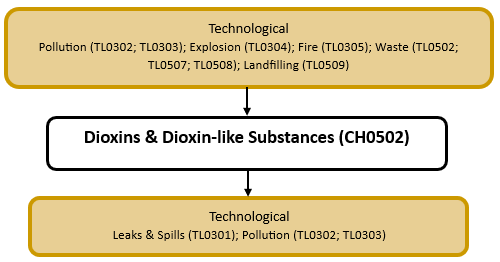
The figure below summarises common interactions between dioxins & dioxin-like substances and other hazards. This information should be used with caution and not be solely relied upon in Disaster Risk Management, particularly as some interactions may not have been included. Note that hazardous events occurring together or locally in space or time may not necessarily cause, amplify or be otherwise related to each other. Specific examples of multi-hazard context can be found in the ‘Hazard drivers’ and ‘Impacts’ sections above.
Multi-hazard diagram
Risk Management
Actions to reduce emissions of these substances are required by the Stockholm Convention (UNEP, 2001). Interventions to reduce human exposure include: identifying and safely disposing of material containing or likely to generate dioxins and dioxin- like substances, such as electrical equipment; ensuring appropriate combustion practices to reduce emissions; implementing FAO/WHO strategies to reduce contamination in food and feed; and monitoring of food items, human breastmilk and air, as well as exposures in workers likely to be exposed to higher levels.
Monitoring
The section and the table below offer an overview of monitoring dioxins & dioxin-like substances. This information can be used for forecasting within a national early warning system (EWS). Since EWS capacities and processes differ across countries, the most current and specific information regarding EWS should be obtained from the appropriate national or regional agency/authority responsible for disaster management.
| Which institution(s) produce(s) Disaster Risk Data/Information? | UNEP, 2001. Stockholm Convention on Persistent Organic Pollutants. WHO, 2023, WHO Fact Sheets Dioxins. |
| How is the Hazard Observed/Monitored/Forecast? | The Dioxin Monitoring Program - The EPA monitors dioxin levels in various media, including air, soil, and water, and conducts periodic National Dioxin Air Monitoring Network (NDAMN) assessments. (EPA, 2018) Japan’s Dioxin Monitoring Network - Japan has established a comprehensive monitoring network that includes regular sampling and analysis of dioxins in the environment and food supply, supported by rigorous regulatory standards. The Rapid Alert System for Food and Feed (RASFF) - as part of the food safety tools in Europe, the RASFF was established to ensure the exchange of information between member countries to support swift reaction by food safety authorities in case of risks to public health resulting from the food chain. (EC, 2024) |
References
DeVito, M., Bokkers, B., van Duursen, M. B. M., van Ede, K., Feeley, M., Fernandes Gaspar, E. A. Haws, L., Kennedy, S., Peterson, R. E., Hoogenboom, R., Nohara, K., Petersen, K., Rider, C., Rose, M., Safe, S., Schrenk, D., Wheeler, M. W., Wikoff, D. S., Zhao, B., van den Berg, M., 2024. The 2022 world health organization reevaluation of human and mammalian toxic equivalency factors for polychlorinated dioxins, dibenzofurans and biphenyls, Regulatory Toxicology and Pharmacology, 146 (2024) 105525, https://doi.org/10.1016/j.yrtph.2023.105525 Accessed 12 May 2024.
EC, 2024. Rapid Alert System for Food and Feed (RASFF). European Commission (EC). Accessed 14 July 2024.
EPA, 2018. National Dioxin Air Monitoring Network (Ndamn) Report of the Results of Atmospheric Measurements of Pcdds, Pcdfs, and Dioxin-Like PCBs in Rural and Remote Areas of the U.S. from June 1998 Through November 2004. United States Environmental Protection Agency (EPA). Accessed 14 July 2024.
EPA, no date National Primary Drinking Water Regulations, National Primary Drinking Water Regulations | US EPA Accessed 7 May 2025.
ILO No Date ICSC 1467 - 2,3,7,8-TETRACHLORODIBENZO-p-DIOXIN (ilo.org) Accessed 8 September 2024
IUPAC, 2014. 'dioxin' in IUPAC Compendium of Chemical Terminology, 3rd ed. International Union of Pure and Applied Chemistry; 2006. Online version 3.0.1, 2019. Accessed 27 May 2024.
Teran, 2012, Tair Teran, Lara Lamon, Antonio Marcomini, Climate change effects on POPs' environmental behaviour: a scientific perspective for future regulatory actions, Atmospheric Pollution Research, Volume 3, Issue 4, October 2012, Pages 466-476.
UNECE, 2023. Globally Harmonised System (GHS) of Classification and Labelling of Chemicals (2023). United Nations Economic Commission for Europe (UNECE). Accessed 11 May 2024.
UNEP, 2001. Stockholm Convention on Persistent Organic Pollutants. UN Environment Programme (UNEP). Accessed 17 May 2024.
WHO, 2019. Preventing disease through healthy environments: Exposure to dioxins and dioxin-like substances: A major public health concern. World Health Organization (WHO). Accessed 12 May 2024.
WHO, 2023. WHO Fact Sheets Dioxins. Dioxins (who.int), Accessed 12 May 2024.