
Benzene and Hydrocarbons
Hydrocarbons are organic compounds composed entirely of hydrogen (H) and carbon (C) atoms. They are the simplest form of organic molecules and are the main components of fossil fuels such as coal, natural gas, and petroleum. Benzene is a clear, colourless, highly flammable and volatile, liquid aromatic hydrocarbon (molecular formula C6H6) with a gasoline-like odour, which can lead to major public hazards. Benzene is the simplest aromatic hydrocarbon, characterised by alternating single and double bonds between the carbon atoms, forming a delocalized π-electron system. (WHO, 2019) The release of hydrocarbon ground gases, such as methane, can lead to major public hazards.
Primary reference(s)
WHO, 2019. Preventing disease through healthy environments: Exposure to benzene: a major public health concern. World Health Organization (WHO). Accessed 6 October 2024.
Annotations
Additional scientific description
Benzene (ICSC 0015, 2016) melts at 5.5°C and boils at 80.1°C; and has a high vapour pressure, which causes it to evaporate rapidly at room temperature, and is highly flammable. Methane and other light hydrocarbons exhibit similar properties. Benzene is slightly soluble in water but miscible with most other organic solvents (IPCS, 1993).
Benzene is used as a solvent in the chemical and pharmaceutical industries. It also occurs naturally in petroleum products (e.g., crude oil and gasoline) at levels up to 4 g/L. The primary route of benzene exposure and subsequent toxicity is via inhalation. The highest exposures have typically been in the workplace – for example, in industries that make or use benzene. The general population may be exposed through the inhalation of contaminated air, particularly in areas of heavy automobile traffic, gas stations and areas near industrial sources. Other sources include cigarette smoking, second-hand smoke, off-gassing from building material and structural fires. People also may be exposed to benzene in contaminated drinking water and some foods (WHO, 2019).
The compulsory introduction of catalytic converters on car exhausts and legislation to reduce benzene levels in car fuels has contributed to a reduction of benzene emissions. Other interventions to prevent or reduce exposures to airborne benzene include promoting the use of alternative solvents in industrial processes, developing and implementing policies and legislation to remove benzene from consumer products, discouraging domestic use of benzene-containing products, promoting building codes requiring detached garages, and implementing the World Health Organization (WHO) Framework Convention on Tobacco Control (WHO, 2003), including providing for protection from exposure to tobacco smoke in workplaces and public areas.
Metrics and numeric limits
Drinking water: The WHO guideline value for benzene is 0.01 mg/L. This is based on extrapolation of modelled excess lifetime risk for leukaemia from epidemiological studies involving inhalation exposure; guideline values corresponding to modelled excess lifetime cancer risks of 10-4, 10-5 and 10-6 are 0.1, 0.01 and 0.001 mg/L, respectively (WHO, 2019).
An excess lifetime cancer risk of 10-4, 10-5 or 10-6 means the risk of one new cancer case above background levels per 10,000, 100,000 or 1 million people, respectively.
Air: No specific WHO guideline value has been developed for benzene in air. Benzene is carcinogenic to humans and no safe level of exposure can be recommended. For general guidance, the concentrations of airborne benzene associated with an excess lifetime risk of leukaemia of 10-4, 10-5 and 10-6 are 17, 1.7 and 0.17 μg/m3, respectively (WHO, 2019).
Benzene has a flash point: -11.1°C (12°F), making it highly flammable; a vapour pressure of 12.7 kPa at 25°C making it a volatile liquid. The Occupational Exposure Limit (OEL) for benzene is strictly regulated due to its toxicity and carcinogenicity (NIOSH, 2020; OSHA, 2024; EPA, 2024):
- OSHA Permissible Exposure Limit (PEL): 1 part per million (ppm) as an 8-hour time-weighted average (TWA).
- NIOSH Recommended Exposure Limit (REL): 0.1 ppm over a 10-hour workday.
- ACGIH Threshold Limit Value (TLV): 0.5 ppm TWA, with a short-term exposure limit (STEL) of 2.5 ppm.
Alkanes (Saturated Hydrocarbons)
- Methane (CH₄): Flash point: -188°C (-306°F); Explosive limits (LEL/UEL): 5% to 15% by volume in air.
- Hexane (C₆H₁₄): Flash point: -22°C (-7.6°F); Vapour pressure: 17.6 kPa at 20°C; Occupational exposure limit: OSHA PEL is 500 ppm (TWA).
Alkenes (Unsaturated Hydrocarbons)
- Ethylene (C₂H₄): Vapour pressure: 5.29 MPa (at 21°C); Occupational exposure limit: OSHA PEL for ethylene is 200 ppm (TWA).
Alkynes (Unsaturated Hydrocarbons)
- Acetylene (C₂H₂): Flash point: Extremely flammable, can ignite spontaneously under pressure in air; Explosive limits: 2.5% to 100% by volume in air.
Aromatic Hydrocarbons
- Toluene (C₆H₅CH₃): Flash point: 4.4°C (40°F); Vapour pressure: 3.79 kPa at 20°C; OSHA PEL: 200 ppm (TWA), NIOSH REL: 100 ppm (TWA), ACGIH TLV: 20 ppm (TWA).
Key relevant UN convention / multilateral treaty
International Labour Organization (ILO), The Benzene Convention, 1971 (ILO, 1971).
World Health Organization (WHO), The International Health Regulations 2005 (WHO, 2008).
European Union REACH Regulation: The Registration, Evaluation, Authorization, and Restriction of Chemicals (REACH) regulation in the European Union addresses the safe use of chemicals, including strong acids, and imposes requirements on their registration, evaluation, and authorization. (EUR-Lex, 2023)
United Nations Climate Change (UNCC), The Kyoto Protocol and Paris Agreement on Climate Change (UNCC, 2024).
United Nations Environment Programme (UNEP), Basel Convention on the Control of Transboundary Movements of Hazardous Wastes and Their Disposal (UNEP, 2011).
United Nations Environment Programme (UNEP), Rotterdam Convention on the Prior Informed Consent (PIC) Procedure for Certain Hazardous Chemicals and Pesticides in International Trade (UNEP, 2010).
United Nations Environment Programme (UNEP), Stockholm Convention on Persistent Organic Pollutants (POPs) (UNEP, 2019).
Drivers
Benzene is a key building block in the production of various chemicals, including styrene, phenol, aniline, nylon, and rubber. Similarly, hydrocarbons such as methane, ethane, propane, and butane are crucial for energy production, heating, and chemical synthesis. Hydrocarbons like gasoline, diesel, and natural gas are primary energy sources for transportation, power generation, and industrial operations. Benzene and other hydrocarbons are used in paints, adhesives, detergents, and as solvents in industries such as pharmaceuticals and printing. Exposure is driven by leaks and spills from tanks and storage facilities.
As economies grow, particularly in emerging markets, the demand for energy, transportation fuels, and petrochemical products increases. Hydrocarbons play a critical role in meeting this demand. Expansion of urban centres and industries drives the demand for construction materials (plastics, polymers), energy for transportation, and heating fuels, leading to increased use of hydrocarbons and benzene derivatives.
Benzene and other hydrocarbons are economically attractive because they are cost-effective and have high energy content. Finding affordable, scalable, and safe alternatives to replace these substances in various industrial processes is challenging, prolonging their use
Impacts
Acute occupational exposure to benzene may cause narcosis: headache, dizziness, drowsiness, confusion, tremors and loss of consciousness (consumption of alcohol enhances the toxic effect). It is also irritating to the eyes, skin and respiratory tract (WHO, 2019).
Benzene is a well-established cause of cancer in humans. The International Agency for Research on Cancer (IARC) has classified benzene as carcinogenic to humans (Group 1). The evidence in humans is considered sufficient for acute non-lymphocytic leukaemia, including acute myeloid leukaemia, while the evidence in humans is limited for non-Hodgkin lymphoma, chronic lymphoid leukaemia, multiple myeloma, chronic myeloid leukaemia, acute myeloid leukaemia in children, and lung cancer (WHO, 2019).
Oil spills are a huge concern and have major environmental and economic effects:
- Short-Term Effects: Immediate toxicity to marine organisms, smothering of wildlife, and destruction of habitats.
- Long-Term Effects: Persistent contamination of sediments and bioaccumulation of hydrocarbons in the food chain.
- Economic Impacts: Losses in fisheries, tourism, and clean-up costs, often amounting to billions of dollars.
- Climate Interactions: Oil spills exacerbate greenhouse gas emissions through methane release and contribute to global warming.
The largest oil spill occurred on 20th April 2010 on the Gulf of Mexico when the Deepwater Horizon drilling rig operated by BP exploded, killing 11 people and releasing approximately 134 million gallons of crude oil. This spill caused widespread damage to coral reefs and loss of marine biodiversity. Populations of fish, shrimp, and oysters declined sharply. Over 100,000 birds, dolphins, and other marine mammals died due to oil exposure and ingestion. Long-term effects include persistent contamination in marshes and seabed sediments, as well as mutations and reproductive issues in marine species like fish and crabs. (NOAA, 2020). There have been many other large oil spills throughout history, including the Exxon Valdez Oil Spill of 1989; the Amoco Cadiz Oil Spill of 1978; the Prestige Oil Spill of 2002; the Torrey Canyon Oil Spill of 1967; and many more. Preventing oil spills requires a combination of improved technology, strict regulation, effective monitoring, and stakeholder collaboration. Ongoing advancements in ship design, real-time monitoring systems, and offshore safety measures are essential to reducing the risk of spills and mitigating their impact when they occur.
Multi-hazard context
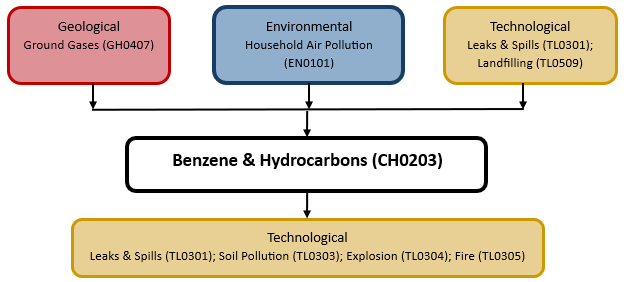
The figure below summarises common interactions between benzene & hydrocarbons and other hazards. This information should be used with caution and not be solely relied upon in Disaster Risk Management, particularly as some interactions may not have been included. Note that hazardous events occurring together or locally in space or time may not necessarily cause, amplify or be otherwise related to each other. Specific examples of multi-hazard context can be found in the ‘Hazard drivers’ and ‘Impacts’ sections above.
Multi-hazard diagram
Risk Management
The WHO factsheet on Preventing disease through healthy environments - exposure to Benzene: a major public health concern (WHO, 2019) includes the following risk mitigation recommendations:
- Promote the use of alternative solvents in industrial processes, glues and paints.
- Develop and implement policies and legislation to remove benzene from consumer products.
- Reduce exposure at petrol filling stations as far as possible by following best practice in location, design and extraction.
- Regulatory compliance, advanced technologies, operational safety, and emergency preparedness are critical to ensuring safe and sustainable fuel transport.
- Minimise emissions from vehicle exhausts by improved design and regular monitoring of engine settings.
- Separate dwelling spaces from areas where vehicles and benzene-containing products are kept. In particular, isolate children from indoor exposure to vehicle emissions.
- Avoid domestic use of benzene-containing products.
- Discourage indoor use of unflued oil and gasoline heating.
- Implement the WHO Framework Convention on Tobacco Control (WHO, 2003), including providing for protection from exposure to tobacco smoke in indoor workplaces, public transport, indoor public places, and, as appropriate, other public places.
- Raise public awareness regarding sources of exposure to benzene – especially exposure through smoking – and awareness of risk mitigation measures.
- Conduct educational activities to discourage the use of benzene or petrol for cleaning and degreasing in industry, including in the informal sector.
Monitoring
The section and the table below offer an overview of monitoring benzene & hydrocarbons. This information can be used for forecasting within a national early warning system (EWS). Since EWS capacities and processes differ across countries, the most current and specific information regarding EWS should be obtained from the appropriate national or regional agency/authority responsible for disaster management.
| Which institution(s) produce(s) Disaster Risk Data/Information? | Environmental agencies; industry regulatory bodies |
| How is the Hazard Observed/Monitored/ Forecast? | Air quality monitoring systems; leak detection systems; water, soil and marine monitoring systems |
References
Environmental Protection Agency (EPA), 2024. National Primary Drinking Water Regulations. United States Environmental Protection Agency (EPA). Accessed 6 October 2024.
European Union (EU), 2023. The Registration, Evaluation, Authorisation and Restriction of Chemicals (REACH) Regulation. European Union (EUR). Accessed 11 May 2024.
International Labour Organization (ILO), 2016. Benzene (2016). International Labour Organization (ILO). Accessed 6 October 2024.
International Labour Organization (ILO), 1971. ILO C136 - Benzene Convention, 1971 (No. 136). International Labour Organization (ILO). Accessed 6 October 2024.
International Programme on Chemical Safety (IPCS), 1993. Benzene environmental health criteria 150. International Programme on Chemical Safety (IPCS). Accessed 6 October 2024.
National Institute for Occupational Safety and Health (NIOSH), 2020. NIOSH Pocket Guide to Chemical Hazards (2020). The National Institute for Occupational Safety and Health (NIOSH). Centre for Disease Control and Prevention (CDC). Accessed 4 May 2024.
National Oceanic and Atmospheric Administration (NOAA), 2020. Oil Spills (2020). National Oceanic and Atmospheric Administration (NOAA). Accessed 17 November 2024.
Occupational Safety and Health Administration (OSHA), 2024. Occupational Chemical Database. Occupational Safety and Health Administration. Accessed 6 October 2024.
United Nations Climate Change (UNCC), 2024. What is the Kyoto Protocol? United Nations Climate Change (UNCC). Accessed 6 October 2024.
United Nations Economic Commission for Europe (UNECE), 2023. Globally Harmonised System (GHS) of Classification and Labelling of Chemicals (2023). United Nations Economic Commission for Europe (UNECE). Accessed 11 May 2024.
United Nations Environment Programme (UNEP), 2011. United Nations Environment Programme (UNEP), Basel Convention on the Control of Transboundary Movements of Hazardous Wastes and Their Disposal. Accessed 11 May 2024.
United Nations Environment Programme (UNEP), 2010. Rotterdam Convention on the Prior Informed Consent (PIC) Procedure for Certain Hazardous Chemicals and Pesticides in International Trade (2010). United Nations Environment Programme (UNEP). Accessed 4 May 2024.
United Nations Environment Programme (UNEP), 2019. Stockholm Convention on Persistent Organic Pollutants (POPs) (2019). United Nations Environment Programme (UNEP). Accessed 4 May 2024.
World Health Organization (WHO), 2003. Who Framework Convention on Tobacco control. World Health Organisation (WHO). Accessed 7 May 2021.
World Health Organization (WHO), 2008. International Health Regulations (2005). World Health Organization (WHO).
World Health Organization (WHO), 2019. Preventing disease through healthy environments: Exposure to benzene: a major public health concern. World Health Organization (WHO). Accessed 19 November 2019.