
Arsenic
Arsenic is a toxic metalloid widely distributed throughout the Earth’s crust, generally as arsenic sulfide or as metal arsenates and arsenides. Human exposure to arsenic compounds represents a major public health concern as it has been associated with a range of acute and long-term adverse health effects and diseases (WHO, 2019).
Primary reference(s)
WHO, 2019. Preventing Disease through Healthy Environments – Exposure to arsenic: A major public health concern. World Health Organization (WHO). Accessed 19 July 2024.
Annotations
Additional scientific description
Arsenic (chemical symbol As, atomic number 33) can be released into the atmosphere and water in the following ways: natural activities, such as volcanic activity, dissolution or desorption of minerals (particularly into groundwater), exudates from vegetation and wind-blown dusts; human activities, such as metal smelting, combustion of fossil fuels (especially coal), mining, timber treatment with preservatives and, historically, agricultural pesticide production and use; remobilisation of historic sources, such as mine drainage water; and mobilisation into drinking-water from geological deposits by drilling of tube wells (WHO, 2019). Arsenic compounds have been used as chemical weapons (OPCW, 2024)
In water, arsenic occurs in one of two main forms: arsenite As(III) under reducing conditions and arsenate As(V) if the water is oxygenated. It can be released to the atmosphere, primarily as the trioxide, mainly by high-temperature processes or through volatilisation from aerated soils. In the atmosphere, it is mainly adsorbed onto particles, which are dispersed by winds and deposited on land and water (WHO, 2019).
Soluble inorganic arsenic is highly acutely toxic. Intake of inorganic arsenic over a long period can lead to chronic arsenic poisoning (arsenicosis). Effects, which can take years to develop depending on the level of exposure, include skin lesions, peripheral neuropathy, gastrointestinal symptoms, diabetes, cardiovascular disease, developmental toxicity, and cancer of the skin and internal organs (IARC, 2018). Organic arsenic compounds, which are abundant in seafood, are less harmful to health and are rapidly eliminated by the body.
Human exposure to arsenic and arsenic compounds can occur through environmental or occupational routes. Human exposure to elevated levels of inorganic arsenic occurs mainly through the intake of groundwater containing naturally high levels of inorganic arsenic, food prepared with this water, and food crops irrigated with high-arsenic water sources. Public health actions need to be continued to reduce human exposure to arsenic, particularly in areas with naturally high levels in groundwater (WHO, 2019).
Metrics and numeric limits
In 2002, the World Health Organization (WHO) reported that at least 140 million people in 50 countries were estimated to have been drinking water containing arsenic at levels above the WHO provisional guideline value of 10 μg/L (WHO, 2019). Inorganic arsenic is naturally present at high levels in the groundwater of several countries, such as Argentina, Chile, China, India (West Bengal), Mexico, the USA, and particularly Bangladesh, where it was estimated that in 2012 approximately 19 million people were exposed to drinking-water concentrations above the national standard of 50 μg/L and 39 million people were drinking water with levels of arsenic above 10 μg/L. In 2010, 21.4% of all deaths in a highly affected area of Bangladesh were attributed to arsenic levels of above 10 μg/L in drinking-water, while another analysis published in 2012 for all districts indicated an annual total of nearly 43,000 deaths (about 5.6% of all deaths) attributable to chronic arsenic exposure (WHO, 2019).
The WHO has published arsenic guidelines for tolerable intake levels, drinking-water and air (WHO, 2019):
- Tolerable daily intake level: In a review of the latest scientific evidence conducted in 2010, the Joint Food and Agriculture Organization of the United Nations (FAO)/WHO Expert Committee on Food Additives (JECFA) determined the lower limit on the benchmark dose for a 0.5% increased incidence of lung cancer (BMDL0.5) from epidemiological data to be 3.0 μg/kg body weight per day (2-7 μg/kg body weight per day based on the range of estimated total dietary exposure). No new tolerable intake level could be established. In areas where levels in water are below the WHO drinking-water guideline value, human health effects are unlikely.
- Drinking-water: The provisional guideline value is 10 μg/L, in light of practical difficulties in removing arsenic in drinking-water, every effort should be made to keep concentrations as low as reasonably possible and below the guideline value when resources are available.
- Air: A safe level of arsenic in air cannot be established.
Key relevant UN convention / multilateral treaty
International Labour Organization C042 - Workmen’s Compensation (Occupational Diseases) Convention (Revised), 1934 (ILO, 1934).
Drivers
Drinking-water poses the greatest threat to public health from arsenic (WHO, 2019). Exposure of smokers to arsenic arises from the natural inorganic arsenic content of tobacco. Exposures were higher in the past when tobacco plants were treated with lead arsenate insecticide (WHO, 2019).
Impacts
Most arsenic in industrial processes is used to produce antifungal wood preservatives, which can lead to soil contamination. Other current or historical uses occur within the pharmaceutical and glass industries, in the manufacture of alloys, sheep dips, leather preservatives, arsenic-containing pigments, antifouling paints and poison baits and, to a diminishing extent, in the production of agrochemicals (especially for use in orchards and vineyards). Arsenic compounds are also employed in limited amounts in the microelectronics and optical industries. High arsenic levels in air can be found in the working environment as well as the general environment around non-ferrous metal smelters, where arsenic trioxide may be formed, and some coal-fired power plants (especially those using low-grade brown coal) (WHO, 2019).
In areas where arsenic is not naturally present at high levels, food usually contributes most to the daily intake of arsenic. Fish, shellfish, meat, poultry, dairy products and cereals are the main sources of dietary intake. However, the arsenic in fish and shellfish is usually in the form of organic compounds (e.g., arsenobetaine) that are of low toxicity. In areas where arsenic is naturally present at high levels, food (e.g., rice) prepared with high arsenic-containing water and food crops irrigated with contaminated water also contribute to total daily intake (WHO, 2019).
Accidents involving arsenic have occurred in various contexts, with significant impacts on human health and the environment.
High concentrations of naturally occurring arsenic poisoning in drinking water have resulted in multiple poisoning episodes worldwide. An example from the 1950’s and 1960’s was the Taiwan Arsenic Poisoning (Blackfoot Disease), which led to the development of a condition known as Blackfoot Disease, characterized by peripheral vascular disease and gangrene. The contamination was traced to artesian well water with high levels of arsenic (Lai, 1994). A second example is the Bangladesh Arsenic Crisis in the 1990s, where a widespread contamination of arsenic from shallow tube wells led millions of exposed to high levels of arsenic in drinking water to various health issues, including skin lesions, cancers (such as skin, lung, and bladder cancer), cardiovascular diseases, and neurological disorders (Smith, 2000).
Chemical spills have had a negative impact on the environment. An example is the Sandoz Chemical Spill which occurred in 1986. A fire at a Sandoz chemical warehouse in Basel, Switzerland, led to the release of various toxic chemicals, including arsenic compounds, into the Rhine River. The contamination caused widespread fish kills and had significant ecological impacts on the river ecosystem (Capel, 1988).
Historical use of lead arsenate as a pesticide in agriculture led to soil contamination in many regions. Accidental ingestion or inhalation of soil particles containing lead and arsenic residues, particularly by farm workers and children living in treated areas, has resulted in cases of acute poisoning and long-term health effects (Lasky, 1985). The health of inhabitants of communities near to mining activities can be affected by arsenic presence. In a region of Colombia where gold mining activities are developed, genotoxicity and mutagenicity in blood and drinking water of exposed population were induced by arsenic. The results showed DNA damage related to arsenic in blood (p < 0.05) in the exposed population, with arsenic levels above the Agency for Toxic Substances and Disease Registry (ATSDR) limit of 1 μg/L. Mutagenic activity was detected in the drinking water, with only one sample exceeding the WHO's maximum permissible arsenic concentration of 10 μg/L (Calao-Ramos, 2023).
Multi-hazard context
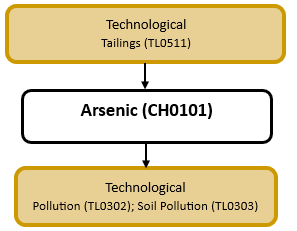
The figure below summarises common interactions between arsenic and other hazards. This information should be used with caution and not be solely relied upon in Disaster Risk Management, particularly as some interactions may not have been included. Note that hazardous events occurring together or locally in space or time may not necessarily cause, amplify or be otherwise related to each other. Specific examples of multi-hazard context can be found in the ‘Hazard drivers’ and ‘Impacts’ sections above.
Multi-hazard diagram
Risk Management
Long-term actions are required to reduce exposure to arsenic from mining, metal smelting and refining, combustion of low-grade coal, pesticide use and timber treatment. In particular, action is needed to reduce the intake of arsenic from drinking-water and food in areas with naturally high levels in the groundwater (WHO, 2019).
The WHO factsheet on preventing disease through healthy environments (WHO, 2019) includes the following risk mitigation recommendations:
- Make available drinking-water with arsenic concentrations below the WHO provisional drinking-water guideline value of 10 μg/L in areas where the level is higher. Possible measures include:
- Testing water for arsenic levels and informing users of the results.
- Installing arsenic removal systems, either centralised or domestic, and ensuring appropriate disposal of the removed arsenic.
- Substituting high-arsenic sources, such as groundwater, with low-arsenic, microbiologically safe sources such as rainwater and treated surface water. Low-arsenic water can be used for drinking, cooking and irrigation purposes, whereas high-arsenic water can be used for other purposes such as bathing and washing clothes.
- Discriminating between high-arsenic and low-arsenic sources by testing water for arsenic levels and painting tube wells or hand pumps in different colours (e.g., red and green).
- Blending low-arsenic water with higher-arsenic water to achieve an acceptable arsenic concentration level.
- Reduce occupational exposure to arsenic and its compounds.
- Make both the general public and the health sector aware of the harmful effects of high-arsenic intake and the sources of exposure (including use of high-arsenic water for crop irrigation or food preparation) and how to avoid these sources.
- Monitor high-risk populations for early signs of arsenic poisoning, usually skin problems. It should be noted that total urinary arsenic does not differentiate between inorganic arsenic, which is toxic, and organic arsenic, some of which is not. Where possible, arsenic speciation should be attempted in order to differentiate these two forms (and their metabolites).
- The WHO/UNICEF Joint Monitoring Programme for Water Supply, Sanitation and Hygiene monitors progress towards global targets on drinking water. In addition, under the new 2030 Agenda for Sustainable Development, the indicator of ‘safely managed drinking water services’ calls for tracking the population accessing drinking water that is free of faecal contamination and priority chemical contaminants, including arsenic (UN Water, no date; Council of Europe, 2021).
The documented accidents in the impacts section underscore the importance of monitoring and regulating arsenic exposure, implementing safe drinking water practices, and promoting alternative agricultural methods to minimize the risks associated with arsenic contamination.
- World Health Organization (WHO)
- Arsenic in Drinking Water: Guidelines and information on the health impacts of arsenic exposure and strategies for prevention.
- United States Geological Survey (USGS)
- Arsenic in Groundwater: Information and resources on monitoring arsenic levels in groundwater and surface water across the United States.
- USGS Arsenic in Groundwater
- Directive (EU) 2020/2184 of the European Parliament and of the Council of 16 December 2020 on the quality of water intended for human consumption
- European Commission, Food, Farming, Fisheries, Arsenic in food
Actions to be taken by affected communities to prevent further arsenic exposure for providing safe water for drinking, food preparation, and crop irrigation, include:
- Replace high-arsenic sources, like groundwater, with low-arsenic sources, such as rainwater and treated surface water. Use low-arsenic water for drinking, cooking, and irrigation, and high-arsenic water for bathing and washing clothes.
- Identify high-arsenic and low-arsenic sources. Test water and mark wells or pumps with different colors to indicate arsenic levels. Educate the community for effective use.
- Mix low-arsenic water with higher-arsenic water to reach safe levels.
- Install arsenic removal systems (centralized or domestic) and ensure proper disposal of removed arsenic. Methods include oxidation, coagulation-precipitation, absorption, ion exchange, and membrane techniques. There are more low-cost and effective options available, though long-term effectiveness needs further evidence.
Monitoring
The section and the table below offer an overview of monitoring arsenic. This information can be used for forecasting within a national early warning system (EWS). Since EWS capacities and processes differ across countries, the most current and specific information regarding EWS should be obtained from the appropriate national or regional agency/authority responsible for disaster management.
| Which institution(s) produce(s) Disaster Risk Data/Information? | World Health Organization (WHO) |
| How is the Hazard Observed/Monitored/Forecast? | Sensors and sampling stations measure arsenic levels in air, water, and soil, coupled with data analysis and modeling to identify contamination trends and predict future risks. |
References
Calao-Ramos, 2023 Calao-Ramos C. R., et al, (2023). Genotoxicity and mutagenicity in blood and drinking water induced by arsenic in an impacted gold mining region in Colombia, Environmental Research, Volume 233, 116229, ISSN 0013-9351.
Capel, P. D., et al (1988). Accidental input of pesticides into the Rhine River. Environmental Science and Technology, 22 (9), 992-997.
Council of Europe, 2021. UN Agenda 2030. Accessed 19 July 2024.
European Commission, Food, Farming, Fisheries, Arsenic in food. Accessed 19 July 2024.
ILO, 1934. C042 - Workmen’s Compensation (Occupational Diseases) Convention (Revised), 1934 (No. 42). International Labour
Organization (ILO). Accessed 19 July 2024.
Lai, M. S., et al. (1994). Ingested inorganic arsenic and prevalence of diabetes mellitus. American Journal of Epidemiology, 139(5), 484–492.
Lasky, T., et al. (1985). Acute arsenic intoxication in a Vermont dairy farmer. American Journal of Public Health, 75(5), 497–498.
OPCW, 2024. What is a chemical weapon? Organisation for the Prohibition of Chemical Weapons (OPCW). Accessed 6 April 2024.
Smith, A. H., et al. (2000). Contamination of drinking-water by arsenic in Bangladesh: a public health emergency. Bulletin of the World Health Organization, 78(9), 1093–1103.
WHO, 2019. Preventing Disease through Healthy Environments – Exposure to arsenic: A major public health concern. World Health Organization (WHO). Accessed 19 July 2024.
UNECE, 2023. Globally Harmonised System (GHS) of Classification and Labelling of Chemicals (2023). United Nations Economic Commission for Europe (UNECE). Accessed 11 May 2024.
UN Water, no date. WHO/UNICEF Joint Monitoring Programme for Water Supply – Sanitation and Hygiene (JMP). Accessed 19 July 2024.
United States Geological Survey (USGS). Arsenic in Groundwater. Accessed 19 July 2024.
WHO Arsenic in Drinking Water. Accessed 19 July 2024.