
Chlorine
Chlorine is a reactive pale green gas with many uses including disinfection of water. Chlorine is approximately 2.4 times heavier than air and has a characteristic odour similar to bleach. Most significant exposures to chlorine result from loss of containment of chlorine during storage and transport. Human exposure can result in symptoms ranging from mild irritation to rapid death related to pulmonary oedema. It is considered a significant public health hazard (adapted from IPCS, 1982 and PHE, 2019).
Primary reference(s)
IPCS, 1982. Environmental Health Criteria 21: Chlorine and hydrogen chloride. International Programme on Chemical Safety (IPCS). Accessed 2 December 2019.
PHE, 2019. Chlorine: health effects, incident management and toxicology. Public Health England (PHE). Accessed 2 December 2019.
Annotations
Additional scientific description
Chlorine (chemical symbol Cl, atomic number 17) reacts violently with bases and is a corrosive, strong oxidant. It also reacts violently with combustible substances and reducing agents and most organic and inorganic compounds, causing a fire and explosion hazard. It may also combine with water or steam to produce toxic and corrosive fumes of hydrochloric acid (PHE, 2019). During fires involving chlorine and carbon-containing materials, the formation of phosgene-a highly toxic pulmonary agent-may occur, representing an additional risk to emergency responders (Vaish, 2013).
Chlorine is used in the disinfection of water and in the production of bleach and chlorinated hydrocarbon solvents, polyvinyl chloride and other industrial processes. Large quantities are also used in the bleaching of pulp and paper.
Bleach contains sodium hypochlorite, which, if (inadvertently) mixed with acidic chemicals can result in the generation and release of chlorine gas. If chlorine is released from a tank into the air, the chlorine will evaporate very quickly, forming a highly toxic greenish-yellow cloud (ATSDR, 2010). Due to its relatively low boiling point and high density compared to air, chlorine gas tends to settle in low-lying and enclosed areas, increasing the risk of accumulation and exposure in confined spaces.
Metrics and numeric limits
Drinking water: 5 mg/L (WHO, 2011).
Emergency response and acute exposure: there are Emergency Response Planning Guidelines (ERPG) (NOAA, 2016) and Acute Exposure Guideline Values for Airborne Chemicals (AEGLs) (US EPA, 2004) as a result of health risks associated with releases and spills of chlorine.
Key relevant UN convention / multilateral treaty
World Health Organization (WHO) International Health Regulations (WHO, 2016).
Organisation for the Prohibition of Chemical Weapons (OPCW), Chemical Weapons Convention. (OPCW, 2024a; b)
Drivers
Chlorine contamination is caused by anthropogenic activities that include accidents or misuse in industrial and similar settings, leading to significant health and environmental impacts.
Documented accidents involving chlorine, a highly reactive and toxic gas, have occurred in various industries and settings, leading to significant health and environmental impacts. Chlorine can be related to: (1) Industrial Accidents, (2) Natural hazards, (3) Urban Environments, (4) Terrorism and Sabotage, (5) Transport and Storage.
Chlorine Release Accidents in Chemical Plants:
Accidental releases of chlorine gas can occur in chemical manufacturing facilities, particularly those involved in the production of chlorinated chemicals such as PVC (polyvinyl chloride) and chlorine bleach. Chlorine gas is highly toxic and can cause respiratory irritation, lung damage, and even death at high concentrations (CDC, 2023 - https://emergency.cdc.gov/agent/chlorine/basics/facts.asp).
Chlorine is transported in railcars and tanker trucks for various industrial applications. Accidents involving derailments, collisions, or leaks during transportation can result in the release of chlorine gas into the environment. These incidents pose risks to nearby communities and emergency responders, who may be exposed to the toxic gas (USDT PHMSA, 2024, UK HSA, 2024).
Chlorine is commonly used in water treatment facilities to disinfect drinking water supplies. Accidental over-chlorination or equipment failures can lead to the release of excess chlorine into the water distribution system, resulting in elevated chlorine levels in drinking water and potential health risks for consumers. These documented accidents underscore the importance of proper handling, storage, and transportation of chlorine, as well as emergency preparedness and response measures, to prevent and mitigate the impacts of chlorine-related incidents on public health and safety.
Impacts
Minor exposures to chlorine may result in a burning sensation of the eyes and throat. More substantial exposure may cause coughing or breathing difficulties. Exposure to high concentrations of chlorine gas can damage the lungs and airways, hours after the exposure, potentially without preceding warning symptoms; this may cause a build-up of fluid in the lungs (oedema) which can be fatal. Following severe injuries from inhaling chlorine, there may be a shock, coma and death, or when surviving, a chronic disorder of the lungs. Those exposed during physical exertion appear especially vulnerable (IPCS, 1982; PHE, 2019).
Owing to its hazardous nature, the majority of chlorine is transported by rail (ILO, 2004).
The modern use of chemical weapons began with World War I, when both sides in the conflict used poisonous gas to inflict agonising suffering and cause significant battlefield casualties. Such weapons basically consisted of well-known commercial chemicals put into standard munitions such as grenades and artillery shells. Chlorine was a common chemical used in this way historically and still presents a risk (United Nations Office for Disarmament Affairs, no date; OPCW, 2024a; b; c).
Multi-hazard context
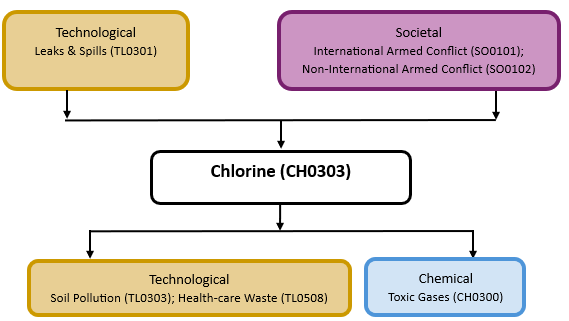
The figure below summarises common interactions between chlorine and other hazards. This information should be used with caution and not be solely relied upon in Disaster Risk Management, particularly as some interactions may not have been included. Note that hazardous events occurring together or locally in space or time may not necessarily cause, amplify or be otherwise related to each other. Specific examples of multi-hazard context can be found in the ‘Hazard drivers’ and ‘Impacts’ sections above.
Multi-hazard diagram
Risk Management
Spillages and run-off should be prevented from entering watercourses as chlorine is harmful to the natural environment; evacuation should be considered in a written emergency plan for significant spills and leaks of chlorine such as from tanks; and harmonised labelling and transport approaches should be adhered to.
Monitoring
The section and the table below offer an overview of monitoring chlorine. This information can be used for forecasting within a national early warning system (EWS). Since EWS capacities and processes differ across countries, the most current and specific information regarding EWS should be obtained from the appropriate national or regional agency/authority responsible for disaster management.
Which institution(s) produce(s) Disaster Risk Data/Information? | World Health Organization (WHO) Organization for the Prohibition of Chemical Weapons (OPCW); National terrorism agencies |
| How is the Hazard Observed/Monitored/Forecast? | Sensors; monitoring networks; response protocols, portable gas detectors |
References
ATSDR, 2010. Toxicological Profile For Chlorine. Agency for Toxic Substances & Disease Registry (ATSDR). Accessed 2 December 2019.
CDC, 2023. Chlorine: Exposure, Decontamination, Treatment (2023). U.S. Centers for Disease Control and Prevention (CDC). Accessed 21 July 2024.
ILO, 2004. Transport and Storage. International Labour Organization (ILO). Accessed 2 December 2019.
IPCS, 1982. Environmental Health Criteria 21: Chlorine and hydrogen chloride. International Programme on Chemical Safety (IPCS). Accessed 2 December 2019.
NOAA, 2016. Emergency Response Planning Guidelines. National Oceanic and Atmospheric Administration (NOAA). Accessed 2 December 2019.
OPCW, 2024a. What is a chemical weapon? Organisation for the Prohibition of Chemical Weapons (OPCW). Accessed 6 April 2024.
OPCW, 2024b. Chemical Weapons Convention: Article II: Definitions and criteria. Organisation for the Prohibition of Chemical Weapons (OPCW). www.opcw.org/chemical-weapons-convention/articles/article-ii-definition… Accessed 6 April 2024
OPCW, 2024c. Chemical Weapons Convention: Verification Annex, Part IV(A), paras. 15-19. Organisation for the Prohibition of Chemical Weapons (OPCW). Accessed 6 April 2024
PHE, 2019. Chlorine: health effects, incident management and toxicology. Public Health England (PHE). Accessed 2 December 2019.
UNECE, 2023. Globally Harmonised System (GHS) of Classification and Labelling of Chemicals (2023). United Nations Economic Commission for Europe (UNECE). Accessed 11 May 2024.
United Nations Office for Disarmament Affairs, no date. Chemical weapons. Accessed 2 December 2019.
US EPA, 2004. Acute Exposure Guideline Levels for Airborne Chemicals. United States Environmental Protection Agency (US EPA). Accessed 2 December 2019.
USDT PHMSA, 2024. Emergency Response Guidebook (ERG) (2024). U.S. Department of Transportation Pipeline and Hazardous Materials Safety Administration (USDT PHMSA). Accessed 21 July 2024.
Vaish 2013, Vaish, A. K., et al, Accidental phosgene gas exposure: A review with background study of 10 cases, J Emerg Trauma Shock. 2013 Oct-Dec;6(4):271–275. doi: 10.4103/0974-2700.120372. Accidental phosgene gas exposure: A review with background study of 10 cases - PMC Accessed 9 May 2025.
WHO, 2011. Guideline for drinking water quality, Fourth edition. World Health Organization (WHO). Accessed 2 December 2019.
WHO, 2016. International Health Regulations (2005), Third Edition. World Health Organization (2016). Accessed 26 September 2020.
UK HSA, 2024 Chlorine Incident Management, Incident management: aliminium Accessed 8 January 2025.