
Microplastics
Microplastics are small plastic pieces less than five millimetres in length which can be harmful to the environment, especially marine life. They originate from a variety of sources, including larger plastic debris that degrade into progressively smaller pieces (adapted from UNEP, 2016 and NOAA, 2023).
Primary reference(s)
UNEP, 2016. Marine plastic debris and microplastics: Global lessons and research to inspire action and guide policy change. United Nations Environment Programme (UNEP). Accessed 30 April 2024.
NOAA, no date. Last updated: 12/14/23. What are microplastics? National Oceanic and Atmospheric Administration (NOAA). Accessed 30 April 2024.
Annotations
Additional scientific description
Microplastics are routinely defined as small particles or fragments of plastic measuring less than 5 mm in length, which are insoluble in the aqueous environment. The broad classification of these small plastic residues is based on their size; (i) large microplastics of size ranging between 5 mm to 1 mm, (ii) small microplastics of 1 mm to 1 μm size range, and (iii) nanoplastics of <1 μm size. A more scientifically rigorous definition of plastic pieces might refer to nano-, micro-, meso-, macro and mega-size ranges, although this has not yet been formally proposed for adoption by the international research community. At present, the lack of an agreed nomenclature, together with practical difficulties of sampling and measuring different size ranges in the field, has encouraged the widespread adoption of microplastics as a generic term for 'small' pieces of plastic.
There are primary and secondary sources of microplastics. The distinction is based on whether the particles were originally manufactured to be that size (primary) or whether they have resulted from the breakdown of larger items (secondary). Some microplastics are intentionally manufactured for industrial and domestic purposes ('primary' microplastics). These include 'microbeads' used in cosmetic and personal healthcare products, such as toothpaste. 'Secondary' microplastics are created by the weathering and fragmentation of larger plastic objects. Weathering and fragmentation are enhanced by exposure to ultraviolet (UV) irradiation. These processes become extremely slow in the absence of UV radiation, as is the case in much of the ocean. Plastics marked as 'biodegradable' degrade more slowly in the ocean (UNEP, 2016). There is evidence that microplastics are littered into the environment at all steps in the life cycle of a plastic product from producers to waste management. Microplastics can enter the marine environment via riverine systems, coastlines, directly at sea from vessels and platforms or by wind-induced transport in the atmosphere. Methods of defining microplastics, sampling and measurement vary considerably among studies, source sectors and geographical regions making it difficult to synthesize data across studies.
A special subclass of microplastics are nanoplastics. Nanoplastics are a form of marine debris, the significance of which is only now emerging. They are minuscule particles with dimensions of 1 to 100 nanometres (a nanometre is one millionth of a millimetre). It is important to note that nanoplastics do not have any legal definition, but the general definitions of nanomaterials can be adapted to nanoplastic particles. The most important definitions can be found in the standards ISO/TS 80004-1:2015, the regulation (EC) no 1223/2009 on cosmetic products, the regulation (EU) 2015/2283 on novel foods, and the regulation (EU) 1169/2011 on the provision of food information to consumers. Applying these definitions for polymer-based particles, it can be used as a definition for nanoplastics. It is very common for the two terms, nanoplastics and nanoparticles to be used interchangeably in the literature.
A large proportion of the nanoplastic particles found in the ocean are of natural origin. It is the anthropogenic nanoplastics that are of concern. These originate from two sources: (i) nanoparticles created intentionally for use in industrial processes and cosmetics and (ii) from the breakdown of plastics in marine debris, from fragments of artificial fabrics discharged into urban wastewater, and through leaching from land-based waste sites (NOAA, 2021).
Recent scientific research has highlighted the potential environmental impacts of nanoplastics. For example, they appear to reduce primary production and the uptake of food by zooplankton and filter-feeders. Nanoparticles of titanium dioxide, which is widely used in paints and metal coatings and in cosmetics, are of particular concern. When nanoparticles of titanium dioxide are exposed to UV radiation from the sun, they transform into a disinfectant and have been shown to kill phytoplankton, which are the basis of primary production in the ocean. The scale of the threat from nanoparticles is unknown, and further research is required (UN, 2017).
About half the global population lives within 100 km of a coastline, and population growth is greatest in that zone. This means the amount of plastic debris entering the ocean from land-based sources is likely to increase unless significant changes are made to waste management practices on land (UNEP, no date).
Biodegradable plastics - Biodegradable polymers are able to undergo degradation into small molecules such as carbon dioxide (CO2), methane (CH4), and H2O due to the action of biota, usually microorganisms at a rate that is much faster than that for common plastics. The bio-prefix in bio-PE, bio-PET or bio-PA does not suggest that these polymers will therefore also be biodegradable. Some biopolymers, bio-derived plastics and bio-based plastics are indeed biodegradable. However, others in the same categories, such as the bio-based plastic bio-PE or the bio-derived plastic, fully acetylated cellulose, are not biodegradable.
Metrics and numeric limits
Environmental Metrics and Limit
Water Bodies: European Union (EU): The EU has proposed a threshold of 20 microplastic particles per litre of water for freshwater environments. This guideline is part of the broader Water Framework Directive aimed at maintaining good ecological status of water bodies (European Commission, 2018)
United States Environmental Protection Agency (EPA): The EPA has yet to establish regulatory limits for microplastics in water, but they are actively researching the prevalence and impacts of microplastics (EPA, 2020).
Soil and Sediments: Research Studies: Studies have found varying concentrations of microplastics in soils and sediments. For instance, a study in agricultural soils found concentrations ranging from 78 to 593 microplastic particles per kilogram of dry soil (Piehl et al., 2018).
Human Health Metrics and Limits:
Drinking Water - The WHO has reviewed the presence of microplastics in drinking water and concluded that current evidence does not suggest significant health risks at present levels. However, they emphasize the need for further research (WHO, 2019).
Food Products - European Food Safety Authority has conducted risk assessments on microplastics in seafood, estimating that a European consumer might ingest up to 11,000 microplastic particles annually through seafood consumption (EFSA, 2016).
- Air Quality: Research Findings: Studies have found microplastics in indoor and outdoor air with varying concentrations. Indoor environments have been reported to have higher concentrations, ranging from 1 to 60 microplastic fibres per cubic meter (Dris et al., 2016).
Regulatory and Research Initiatives: United Nations Environment Programme (UNEP): UNEP is working on global guidelines and frameworks to address plastic pollution, including microplastics, with an emphasis on prevention and reduction strategies (UNEP, 2018).
Microplastic Research Projects: Various international projects are underway to understand the sources, distribution, and effects of microplastics. Notable examples include the "Microplastic Pollution" project by the National Oceanic and Atmospheric Administration (NOAA) and the European Marine Strategy Framework Directive.
Key relevant UN convention / multilateral treaty
The Convention on the Prevention of Marine Pollution by Dumping of Wastes and Other Matter 1972, the ‘London Convention’ for short, is one of the first global conventions to protect the marine environment from human activities and has been in force since 1975 (IMO, 1972). Its objective is to promote the effective control of all sources of marine pollution and to take all practicable steps to prevent pollution of the sea by dumping of wastes and other matter. Currently, 87 States are Parties to this Convention.
The International Convention for the Prevention of Pollution from Ships (MARPOL) is the main international convention covering prevention of pollution of the marine environment by ships from operational or accidental causes (IMO, 1996). The MARPOL Convention was adopted on 2 November 1973. The Protocol of 1978 was adopted in response to a spate of tanker accidents in 1976–1977. As the 1973 MARPOL Convention had not yet entered into force, the 1978 MARPOL Protocol absorbed the parent Convention. The combined instrument entered into force on 2 October 1983. In 1997, a Protocol was adopted to
UN Member States endorsed a historic resolution to End Plastic Pollution and forge an international legally binding agreement by 2024. The resolution addresses the full lifecycle of plastic, including its production, design and disposal. The resolution, based on three initial draft resolutions from various nations, establishes an Intergovernmental Negotiating Committee (INC), which will begin its work in 2022, with the ambition of completing a draft global legally binding agreement by the end of 2024. It is expected to present a legally binding instrument, which would reflect diverse
The BRS (Basel, Rotterdam, and Stockholm) Conventions are not specifically dedicated to plastic pollution, but they play a significant role in addressing various aspects of plastic waste management and chemical pollution. The Basel Convention is the most relevant of the three conventions for addressing plastic pollution: a) Plastic Waste Amendments: In 2019, the Conference of the Parties adopted amendments to include plastic waste in the scope of the Convention; b) Partnership on Plastic Waste (PWP): Established to improve and promote environmentally sound management of plastic waste and
Drivers
Primary Sources - i) Personal Care Products: Microbeads in exfoliating scrubs, toothpaste, and cosmetics; ii) Industrial Applications: Microplastics used in sandblasting and as raw materials in manufacturing processes; iii) Agricultural Practices: Plastic mulching films and controlled-release fertilizers.
Secondary Sources - i) Plastic Waste Degradation: Larger plastic items breaking down into smaller particles through weathering, UV radiation, and mechanical action; ii) Synthetic Textiles: Microfibers released during the washing of synthetic fabrics like polyester and nylon; iii) Tire Wear: Tiny particles generated from the abrasion of tires on roads.
Environmental Dispersal Mechanisms - i) Atmospheric Transport: Microplastics can be carried by wind and atmospheric currents, depositing in remote areas; ii) Waterways: Rivers and streams transport microplastics from urban and rural areas to oceans; iii) Wastewater Treatment Plants: Effluent and sludge from treatment plants can contain and spread microplastics.
Given that humans can be exposed to microplastics through a variety of environmental media, including food and air, a better understanding of overall exposure to microplastics from the broader environment is needed (WHO, 2020).
Impacts
Environmental Impacts - i) Marine Ecosystems: Ingestion by marine organisms, leading to physical harm, digestive blockages, and chemical exposure; ii) Soil Health: Accumulation in agricultural soils, affecting soil structure and potentially entering the food chain through crops; iii) Freshwater Systems: Contamination of lakes and rivers, impacting freshwater species and ecosystems.
Human Health Impacts - i) Ingestion: Consumption of microplastics through contaminated food and water, potentially leading to exposure to toxic chemicals; ii) Inhalation: Breathing in microplastic particles present in the air, particularly in urban environments; iii) Chemical Exposure: Microplastics can adsorb harmful pollutants, which can then enter the human body, posing risks such as endocrine disruption and carcinogenic effects.
Economic Impacts - i) Fishing Industry: Decreased fish populations and contamination of seafood, affecting livelihoods and economies dependent on fishing; ii) Tourism: Pollution of beaches and water bodies can deter tourists, impacting local economies; iii) Waste Management Costs: Increased costs for cleaning up plastic pollution and managing waste effectively.
Multi-hazard context
The figure below summarises common interactions between microplastics and other hazards. This information should be used with caution and not be solely relied upon in Disaster Risk Management, particularly as some interactions may not have been included. Note that hazardous events occurring together or locally in space or time may not necessarily cause, amplify, or be otherwise related to each other. Specific examples of multi-hazard context can be found in the ‘Hazard drivers’ and ‘Impacts’ sections above.
Multi-hazard diagram
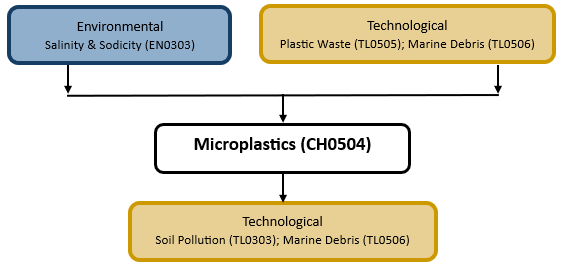
Addressing the issue of microplastics in a multi-hazard context requires an integrated approach that considers the interactions between various environmental, anthropogenic, and socioeconomic factors. Effective management strategies must encompass regulatory measures, technological innovations, public engagement, and international cooperation to mitigate the impacts of microplastics on both the environment and human health as demonstrated on the two cases below:
North Pacific Gyre (Great Pacific Garbage Patch)
- Drivers: Ocean currents and human activity.
- Impacts: Significant accumulation of microplastics affecting marine life and potentially entering the human food chain.
- Risk Management: Initiatives like The Ocean Cleanup project aim to remove plastics from the ocean.
Urban Stormwater Management in Los Angeles
- Drivers: Urban runoff and ineffective waste management.
- Impacts: Microplastics transported to the ocean, impacting marine ecosystems.
- Risk Management: Implementation of green infrastructure and improved stormwater management practices to reduce runoff pollution.
Risk Management
The human health risk from microplastics in drinking water is a function of both hazard and exposure. Potential hazards associated with microplastics come in three forms: the particles themselves which present a physical hazard, chemicals (unbound monomers, additives, and sorbed chemicals from the environment), and microorganisms that may attach to and colonise microplastics, known as biofilms. Based on the limited evidence available, chemicals and microbial pathogens associated with microplastics in drinking water pose a low concern for human health. Although there is insufficient information to draw firm conclusions on the toxicity of nanoparticles, no reliable information suggests it is a concern (WHO, 2020).
Monitoring
The section and the table below offer an overview of monitoring microplastics. This information can be used for forecasting within a national early warning system (EWS). Since EWS capacities and processes differ across countries, the most current and specific information regarding EWS should be obtained from the appropriate national or regional agency/authority responsible for disaster management.
| Which institution(s) produce(s) Disaster Risk Data/Information? | UNEP Global Monitoring Plan (GMP) – through its Global Monitoring Plan (GMP), collaborates with countries and organizations to monitor persistent pollutants, including microplastics, in air, water, and soil European Commission – Marine Strategy Framework Directive - OJ L 164, 25.6.2008, p. 19–40 The Ocean Cleanup – Plastic Pollution Index - PPI is a tool developed to map and predict plastic pollution, including microplastics, in marine environments The International Maritime Organization’s (IMO) MARPOL Annex V |
| How is the Hazard Observed/Monitored/Forecast? | As made clear under Drivers, above, asbestos release is often a result of other events that cause damage or fires in the vicinity of asbestos fibres (see Multi-Hazard Context). Early warning will therefore be related to those precipitating events coupled with good risk management related to mapping areas with high asbestos burdens. |
References
GESAMP, 2015. Sources, fate and effects of microplastics in the marine environment (part 1). Accessed 30 April 2024.
GESAMP, 2016. Sources, fate and effects of microplastics in the marine environment (part 2). Accessed 30 April 2024.
IMO, 1972. Convention on the Prevention of Marine Pollution by Dumping of Wastes and Other Matter 1972, International Maritime Organization (IMO). Accessed 30 April 2024.
IMO, 1996. International Convention for the Prevention of Pollution from Ships (MARPOL) 1996. Accessed 30 April 2024
IUPAC Recommendations 2012, "Terminology for biorelated polymers and applications”. Pure and Applied Chemistry. 84 (2): 377–410. doi:10.1351/PAC-REC-10-12-04.
NOAA, 2021. What are microplastics? National Oceanic and Atmospheric Administration (NOAA). Accessed 30 April 2024.
Paul, M. B., Stock, V., Cara-Carmona, J., Lisicki, E., Shopova, S., Fessard, V., Braeuning, A., Sieg, H., Böhmert, L., 2020. Micro- and nanoplastics - current state of knowledge with the focus on oral uptake and toxicity. Nanoscale Adv.: 4350-4367. doi: 10.1039/d0na00539h Micro- and nanoplastics – current state of knowledge with the focus on oral uptake and toxicity - Nanoscale Advances (RSC Publishing). Accessed 30 April 2024.
UN, 2017. The First Global Integrated Marine Assessment: World Ocean Assessment I. United Nations (UN). Cambridge University Press. Accessed 30 April 2024.
UNECE, 2023. Globally Harmonised System (GHS) of Classification and Labelling of Chemicals (2023). United Nations Economic Commission for Europe (UNECE). Accessed 11 May 2024.
UNEP, no date. Microplastics. United Nations Environment Programme (UNEP). Accessed 30 April 2024.
UNEP, 2016. Marine plastic debris and microplastics: Global lessons and research to inspire action and guide policy change. United Nations Environment Programme (UNEP). Accessed 30 April 2024.
WHO, 2020. Microplastics in Drinking Water. World Health Organization (WHO). Accessed 30 April 2024.