
Cadmium
Cadmium is a toxic heavy metal which is widely distributed in the Earth’s crust (soil and rocks), air and water; however, human activity has greatly increased levels in environmental media relevant to population exposure. Human exposure to cadmium represents a major public health concern as it has been associated with a range of acute and long-term adverse health effects and diseases (WHO, 2019).
Primary reference(s)
WHO, 2019. Preventing disease through healthy environments – Exposure to cadmium: A major public health concern. World Health Organization (WHO). Accessed 19 July 2024.
Annotations
Additional scientific description
Cadmium (chemical symbol Cd, atomic number 48) is an element that exists as a number of compounds due to its combining with other elements, including oxygen to form cadmium oxide, chlorine to form cadmium chloride, or sulphur to form cadmium sulphide and cadmium sulphate. Cadmium oxide and cadmium sulphide are most commonly found in the air, whereas cadmium chloride and cadmium sulphate dissolve in water (UK HSA, 2024).
Cadmium is generally present in the environment at low levels; however, human activity has greatly increased levels in environmental media relevant to population exposure. Cadmium can travel long distances from the source of emission by atmospheric transport. It is readily accumulated in many organisms, notably molluscs and crustaceans. Lower concentrations are found in vegetables, cereals and starchy roots (WHO, 2019). Cadmium compounds can be released to the environment in a number of ways, including:
- Natural activities, such as volcanic activity (both on land and in the deep sea), weathering and erosion, and river transport (WHO, 2019).
- Human activities, such as tobacco smoking, mining, smelting and refining of non-ferrous metals, fossil fuel combustion, incineration of municipal waste (especially cadmium-containing batteries and plastics), use of cadmium containing phosphate fertilisers, and recycling of cadmium-plated steel scrap and electric and electronic waste (WHO, 2019).
- Remobilisation of historic sources, such as the contamination of watercourses by drainage water from metal mines or from waste sites (WHO, 2019).
Cadmium exerts toxic effects on the kidney, the skeletal system and the respiratory system and is classified as a human carcinogen (IARC, 1993). Osteomalacia (softening of the bones) and osteoporosis may occur in those exposed through living or working in cadmium-contaminated areas; for example, in an area of Japan where water and soil were contaminated with cadmium from zinc/lead mines, itai-itai (‘ouch-ouch’) disease (characterised by osteomalacia, osteoporosis, painful bone fractures and kidney dysfunction) used to be widespread (WHO, 2019).
Human exposure occurs mainly from consumption of contaminated food, active and passive inhalation of tobacco smoke, and inhalation by workers in a range of industries. National, regional and global actions are needed to decrease global environmental cadmium releases and reduce occupational and environmental exposure (WHO, 2019).
Metrics and numeric limits
The World Health Organization (WHO) has published cadmium guidelines for provisional tolerable monthly intake levels, drinking water and air (WHO, 2019).
- Provisional tolerable monthly intake: The Joint Food and Agriculture Organization of the United Nations (FAO)/WHO Expert Committee on Food Additives (JECFA) established a provisional tolerable monthly intake for cadmium in 2010 of 25 μg/kg body weight, based on meta-analysis of epidemiological studies on the relationship between urinary cadmium and beta-2-microglobulin (a marker of renal tubular effects). In light of the long half-life of cadmium in humans, JECFA decided to express the tolerable intake as a monthly value.
- Drinking-water: The guideline for cadmium in drinking-water is 3 μg/L.
- Air: The guideline for cadmium in air is 5 ng/m3 (annual average)
Key relevant UN convention / multilateral treaty
The UNECE Convention on Long-range Transboundary Air Pollution.
Drivers
Cadmium contained in soil and water can be taken up by certain crops and aquatic organisms and accumulate in the food chain. Food constitutes the main environmental source of cadmium for non-smokers (see CH0601 Levels of Contaminants in Food and Feed). Highest cadmium levels are found in the kidney and liver of mammals when fed with cadmium-contaminated feed, and in certain species of oyster, scallop, mussel and crustacean (WHO, 2019).
The tobacco plant naturally accumulates relatively high concentrations of cadmium in its leaves. Thus, smoking tobacco is an important source of exposure and – in the case of heavy smokers – daily intake may exceed that from food. Cigarette smoking can cause significant increases in the concentration of cadmium in the kidney, the main target organ for cadmium toxicity (WHO, 2019).
Inexpensive jewellery, toys and plastics can be significant sources of exposure to cadmium, especially for children; however, many countries have moved to restrict or ban cadmium in such products (WHO, 2019).
In terms of occupational exposure through industrial processes, principal uses are currently in nickel-cadmium batteries, pigments, coatings and plating, as a stabiliser in plastics and other materials (including non-ferrous alloys, semiconductors and photovoltaic devices). The highest potential occupational exposures occur in cadmium production and refining, nickel-cadmium battery manufacture, cadmium pigment manufacture and formulation, cadmium alloy production, mechanical plating, zinc smelting, brazing with silver-cadmium-silver alloy solder and polyvinylchloride compounding (WHO, 2019).
Impacts
Impacts of cadmium exposure include environmental impacts (soil contamination, particularly near industrial sites; water pollution from leaching; and biodiversity loss); human health impacts (kidney damage from ingestion through food and water; bone damage; respiratory issues; and carcinogenic effects); and economic impacts (agricultural losses from reduced crop yields and quality; and healthcare costs for the human health impacts). Documented accidents involving cadmium have occurred in various industries and settings, leading to significant health and environmental impacts.
One of the most well-known incidents involving cadmium occurred in the Jinzu River basin in Toyama Prefecture, Japan, during the mid-20th century. Widespread mining and industrial activities released cadmium into the river, contaminating rice paddies and water supplies. As a result, residents, particularly women, who consumed cadmium-contaminated rice and water developed severe renal and skeletal abnormalities, known as Itai-Itai Disease.
In the 1910s and 1920s, industrial activities in Toyama Prefecture, Japan, led to the release of cadmium and other heavy metals into the environment, contaminating soil, water, and crops. This pollution resulted in widespread health problems among residents, including kidney damage and skeletal deformities.
In 2003, in Bangalore, India, the Janaagraha organization discovered lead and cadmium contamination in groundwater sources used by local residents. The contamination was traced to a battery recycling plant in the vicinity. Residents, particularly children, were found to have elevated levels of lead and cadmium in their blood, leading to health concerns and protests against the plant's operations.
Accidental releases of cadmium from industrial facilities, such as metal plating plants, battery manufacturing facilities, and electronic waste recycling operations, have led to localized contamination of air, soil, and water. These incidents can result in acute exposure to cadmium, causing respiratory problems, gastrointestinal issues, and other health effects among workers and nearby residents. (ATSDR, 2012)
These documented accidents underscore the importance of monitoring and regulating cadmium exposure, implementing pollution control measures, and promoting safe handling and disposal practices to prevent adverse health and environmental impacts.
Multi-hazard context
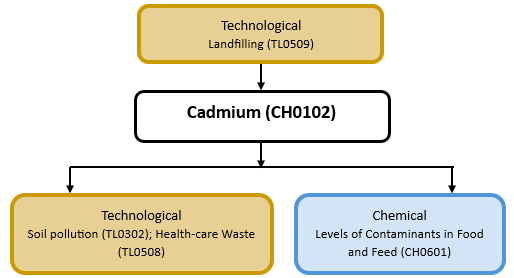
The figure below summarises common interactions between cadmium and other hazards. This information should be used with caution and not be solely relied upon in Disaster Risk Management, particularly as some interactions may not have been included. Note that hazardous events occurring together or locally in space or time may not necessarily cause, amplify or be otherwise related to each other. Specific examples of multi-hazard context can be found in the ‘Hazard drivers’ and ‘Impacts’ sections above.
Multi-hazard diagram
Risk Management
The WHO factsheet on preventing disease through healthy environments (WHO, 2019) includes the following risk mitigation recommendations:
- Implement the WHO Framework Convention on Tobacco Control, including providing for protection from exposure to tobacco smoke in indoor workplaces, public transport, indoor public places and, as appropriate, other public places (WHO, 2003).
- Reduce, as far as is practicable, emissions of cadmium – particularly into surface waters – from mining and smelting, waste incineration, application of sewage sludge to the land, and use of phosphate fertilisers and cadmium-containing manure. Develop techniques for the safe disposal of cadmium-containing wastes and effluents.
- Washing fruit and vegetables and peeling roots and tubers can help reduce cadmium contamination.
- Promote safe and effective measures to increase recycling of cadmium and to restrict non-recyclable uses.
- Promote the elimination of use of cadmium in products such as toys, jewellery and plastics.
- Reduce cadmium exposure by, for instance, improving working conditions in the non-ferrous metal smelting industry and disseminating information on the proper selection of fertilisers (which sometimes contain high levels of cadmium).
- Raise global awareness on the importance of minimising waste discharges of cadmium.
Monitoring
The section and the table below offer an overview of monitoring cadmium. This information can be used for forecasting within a national early warning system (EWS). Since EWS capacities and processes differ across countries, the most current and specific information regarding EWS should be obtained from the appropriate national or regional agency/authority responsible for disaster management.
| Which institution(s) produce(s) Disaster Risk Data/Information? | World Health Organization (WHO) Food and Agriculture Organization of the United Nations (FAO). |
| How is the Hazard Observed/Monitored/Forecast? | Sensors and sampling stations to measure cadmium levels in air, water, and soil, coupled with data analysis and modeling to identify contamination trends and predict future risks. |
References
ATSDR, 2012. Cadmium-ToxFAQs (2012). Agency for Toxic Substances and Disease Registry (ATSDR). Accessed 21 July 2024.
Food and Agriculture Organization (FAO), 2024. Joint FAO/WHO Food Standards Programme, Discussion paper on the development of a code of practice for the prevention and reduction of cadmium contamination in foods. Accessed 19 July 2024.
International Agency for Research on Cancer (IARC), 1993. Summaries & Evaluations: Cadmium and cadmium compounds (Group 1). International Agency for Research on Cancer (IARC), Monographs on the Evaluation of Carcinogenic Risks to Humans, Vol. 58. Accessed 19 July 2024.
UK Health Security Agency (UK HSA), 2024. Cadmium: General Information. Public Health England (PHE). Cadmium: general information - GOV.UK Accessed 2 May 2025.
United Nations Economic Commission for Europe, (UNECE). Convention on Long-range Transboundary Air Pollution. Accessed 2 May 2025
United Nations Economic Commission for Europe (UNECE), 2023. Globally Harmonised System (GHS) of Classification and Labelling of Chemicals (2023). United Nations Economic Commission for Europe (UNECE). Accessed 11 May 2024.
World Health Organization (WHO), 2019. Preventing disease through healthy environments – Exposure to cadmium: A major public health concern. World Health Organization (WHO). Accessed 19 July 2024.
World Health Organization (WHO), 2022. WHO Chemical fact sheets: Cadmium. Accessed 19 July 2024