
Waterborne Diseases
Contaminated water and poor sanitation are linked to transmission of diseases such as cholera, diarrhoea, dysentery, hepatitis A, hepatitis E, typhoid and polio (adapted from WHO, 2023a and WHO, 2023b).
Primary reference(s)
WHO, 2023 a. Drinking-water. World Health Organization (WHO).Accessed 26 February 2025.
WHO, 2023 b. Hepatitis E. World Health Organization (WHO). Accessed 26 February 2025.
Annotations
Additional scientific description
Safe and readily available water is important for public health, whether it is used for drinking, domestic use, food production or recreational purposes. Improved water supply and sanitation, and better management of water resources, can boost countries' economic growth and can contribute greatly to poverty reduction (WHO, 2023a).
In 2010, the UN General Assembly explicitly recognized the human right to water and sanitation. Everyone has the right to sufficient, continuous, safe, acceptable, physically accessible and affordable water for personal and domestic use.
Diarrhoeal disease is the third leading cause of death in children 1-59 months of age. It is both preventable and treatable. Each year diarrhoea kills around 443,832 children under 5 and an additional 50,851 children aged 5 to 9 years. A significant proportion of diarrhoeal disease can be prevented through safe drinking water and adequate sanitation and hygiene. Globally, there are nearly 1.7 billion cases of childhood diarrhoeal disease every year. Diarrhoea is a leading cause of malnutrition in children under 5 years old (WHO, 2024).
Diarrhoea is defined as the passage of 3 or more loose or liquid stools per day (or more frequent passage than is normal for the individual). Frequent passing of formed stools is not diarrhoea, nor is the passing of loose, pasty stools by breastfed babies. Diarrhoea is usually a symptom of an infection in the intestinal tract, which can be caused by a variety of bacterial, viral and parasitic organisms. Infection spreads through contaminated food or drinking-water, or from person to person as a result of poor hygiene (WHO, 2024). Chemical irritation of the gut or non-infectious bowel disease can also result in diarrhoea.
Contaminated water and poor sanitation are linked to transmission of diseases such as cholera, diarrhoea, dysentery, hepatitis A, typhoid and polio (WHO, 2023a). Diarrhoea is the most widely known disease linked to contaminated food and water but there are other hazards. In 2021, over 251.4 million people required preventative treatment for schistosomiasis - an acute and chronic disease caused by parasitic worms contracted through exposure to infested water (WHO, 2023a). Inadequate management of urban, industrial and agricultural wastewater means the drinking water of hundreds of millions of people is dangerously contaminated or chemically polluted. The natural presence of chemicals, particularly in groundwater, can also be of health significance, including arsenic and fluoride, while other chemicals, such as lead, may be elevated in drinking water as a result of leaching from water supply components in contact with drinking water (WHO, 2023a).
Metrics and numeric limits
In 2022, globally, at least 1.7 billion people use a drinking water source contaminated with faeces. Microbial contamination of drinking-water as a result of contamination with faeces poses the greatest risk to drinking-water safety (WHO, 2023a).
Microbiologically contaminated drinking water can transmit diseases such as diarrhoea, cholera, dysentery, typhoid and polio and is estimated to cause approximately 505,000 diarrhoeal deaths each year (WHO, 2023a).
Key relevant UN convention / multilateral treaty
International Health Regulations (2005), 3rd ed. (WHO, 2016b).
Drivers
Absent, inadequate, or inappropriately managed water and sanitation services expose individuals to preventable health risks. This is particularly the case in health care facilities where both patients and staff are placed at additional risk of infection and disease when water, sanitation and hygiene services are lacking (WHO, 2023a). Out of every 100 patients in acute-care hospitals, 7 patients in high-income countries (HICs) and 15 patients in low- and middle-income countries (LMICs) will acquire at least one health care-associated infection during their hospital stay (WHO, 2023a).
Impacts
Some 1 million people are estimated to die each year from diarrhoea as a result of unsafe drinking water, sanitation and hand hygiene. Yet diarrhoea is largely preventable, and the deaths of 395,000 children aged under 5 years could be avoided each year if these risk factors were addressed. Where water is not readily available, people may decide handwashing is not a priority, thereby adding to the likelihood of diarrhoea and other diseases (WHO, 2023, a).
Sharp geographic, sociocultural and economic inequalities persist, not only between rural and urban areas but also in towns and cities where people living in low-income, informal or illegal settlements usually have less access to improved sources of drinking water than other residents.
Multi-hazard context
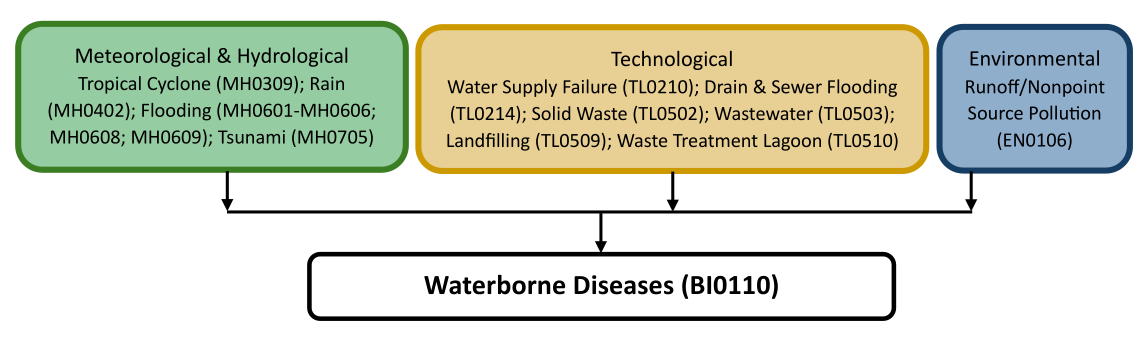
The figure below summarises common interactions between waterborne diseases and other hazards. This information should be used with caution and not be solely relied upon in Disaster Risk Management, particularly as some interactions may not have been included. Note that hazardous events occurring together or locally in space or time may not necessarily cause, amplify or be otherwise related to each other. Specific examples of multi-hazard context can be found in the ‘Hazard drivers’ and ‘Impacts’ sections above.
Multi-hazard diagram
Risk Management
In many parts of the world, insects that live or breed in water carry and transmit diseases such as dengue fever. Some of these insects, known as vectors, breed in clean, rather than dirty water, and household drinking water containers can serve as breeding grounds. The simple intervention of covering water storage containers can reduce vector breeding and may also reduce faecal contamination of water at the household level (WHO, 2023a).
As the international authority on public health and water quality, WHO leads global efforts to prevent the transmission of waterborne diseases. This is achieved by promoting health-based regulations to governments and working with partners to promote effective risk management practices to water suppliers, communities and households (WHO no date). Water safety and quality are fundamental to human development and well-being. Providing access to safe water is one of the most effective instruments in promoting health and reducing poverty (WHO, no date a).
WHO produces a series of water quality guidelines, including on drinking water, safe use of wastewater, and recreational water quality. The water quality guidelines are based on managing risks, and since 2004 the Guidelines for drinking-water quality promote the Framework for safe drinking water. The Framework recommends the establishment of health-based targets, the development and implementation of water safety plans by water suppliers to most effectively identify and manage risks from catchment to consumer, and independent surveillance to ensure that water safety plans are effective and health-based targets are being met (WHO, 2023a).
The drinking-water guidelines are supported by background publications that provide the technical basis for the Guidelines recommendations. WHO also supports countries in implementing the drinking-water quality guidelines through the development of practical guidance materials and the provision of direct country support. This includes the development of locally relevant drinking-water quality regulations aligned to the principles in the Guidelines, the development, implementation and auditing of water safety plans and strengthening of surveillance practices (WHO, 2023 a).
- Guidelines for drinking-water quality (WHO, 2022)
- Water Safety Plan resources (WHO, no date b)
- Developing drinking-water quality regulations and standards (WHO, no date c)
- Supporting publications to the Guidelines for drinking-water quality (WHO, no date e)
Since 2014, WHO has been testing household water treatment products against WHO health-based performance criteria through the WHO International Scheme to Evaluate Household Water Treatment Technologies (WHO no date e). The aim of the scheme is to ensure that products protect users from the pathogens that cause diarrhoeal disease and to strengthen policy, regulatory and monitoring mechanisms at the national level to support appropriate targeting and consistent and correct use of such products (WHO, 2023a).
WHO works closely with UNICEF in a number of areas concerning water and health, including water, sanitation, and hygiene in health-care facilities. In 2015 the two agencies jointly developed WASH FIT (Water and Sanitation for Health Facility Improvement Tool), an adaptation of the water safety plan approach. WASH FIT aims to guide small, primary health-care facilities in low- and middle-income settings through a continuous cycle of improvement through assessments, prioritization of risk, and definition of specific, targeted actions. A 2023 report describes practical steps that countries can take to improve water, sanitation and hygiene in health-care facilities (WHO, 2023b).
Monitoring
Drinking-water surveillance is a core public health function and an integral component of the framework for safe drinking water recommended by the WHO Guidelines for drinking water quality. It is fundamental for the delivery of safe drinking water and the protection of public health by promoting the improvement of quality, quantity, accessibility, reliability, affordability and continuity of drinking water supplies. Risk-based drinking-water surveillance is considered best practice as it supports the development of appropriate and efficient monitoring programmes for individual supplies. It also aids prediction and identification of long-term changes and associated risks for drinking water supply (WHO, no date h).
WHO supports countries to conduct all-hazards strategic risk assessment in the contexts of health emergencies and disasters, which results in the development of a country risk profile. Empowered with the country's risk profile, inclusive of a seasonal risk calendar, countries can anticipate potential emergencies before they occur to trigger early alerts and inform early actions (WHO, 2021).
WHO's Early Warning, Alert and Response System (EWARS) has been designed to improve disease outbreak detection in emergency settings, such as in countries in conflict or following a natural disaster. It is a simple and cost-effective way to rapidly set up a disease surveillance system. EWARS is deployed during an emergency as an adjunct to the national disease surveillance system. WHO works with Ministries of Health and health sector partners to train local health workers to use the system. After the emergency, EWARS should re-integrate back into the national system (WHO, no date g).
References
WHO, no date a. Water safety and quality. World Health Organization (WHO). Accessed 26 February 2025.
WHO, no date b. Water safety planning. World Health Organization (WHO). Accessed 26 February 2025.
WHO, no date c. Drinking-water quality regulation. World Health Organization (WHO). Accessed 26 February 2025.
WHO, no date d. Water safety and quality publications (World Health Organization (WHO). Accessed 26 February 2025.
WHO, no date e. International Scheme to Evaluate Household Water Treatment Technologies. World Health Organization (WHO). Accessed 26 February 2025.
WHO, no date f. WASH in health care facilities. World Health Organization (WHO). Accessed 26 February 2025.
WHO, no date g. Early Warning, Alert and Response System (EWARS). World Health Organization (WHO). Accessed 26 February 2025.
WHO, no date h. Strengthening drinking-water, wastewater and water-related disease surveillance, WHO. Accessed 26 February 2025.
WHO, 2016. International Health Regulations (2005), 3rd ed. World Health Organization (WHO). Accessed 13 February 2025.
WHO 2018. Water and sanitation for health facility improvement tool (WASH FIT). World Health Organization (WHO). Accessed 26 February 2025.
WHO, 2021. Strategic toolkit for assessing risks (STAR): a comprehensive toolkit for all-hazards health emergency risk assessment. World Health Organization (WHO). Accessed 13 February 2025.
WHO, 2022. Guidelines for drinking-water quality: fourth edition incorporating the first and second addenda World Health Organization (WHO). Accessed 26 February 2025.
WHO, 2023 a. Drinking-water. World Health Organization (WHO). Accessed 26 February 2025.
WHO, 2023 b. Hepatitis E. World Health Organization (WHO). Accessed 26 February 2025.
WHO, 2024. Diarrhoeal disease. World Health Organization (WHO). Accessed 26 February 2025.