
Vector-borne diseases (VBD)
Vector-borne diseases encompass a variety of illnesses that are caused by the spread of pathogens by living organisms known as vectors. These infectious diseases can be transmitted via vectors among humans (e.g. malaria, dengue), among animals (e.g. African swine fever, East Coast fever), or from animals to humans (e.g. Nipah virus disease). Many of these vectors are bloodsucking insects, and mosquitoes are the best-known disease vectors. Other vectors include ticks, flies, sandflies, fleas, triatomine bugs and some species of freshwater aquatic snails (adapted from WOAH, 2024a; WHO, 2024).
Primary reference(s)
WHO, 2024. Vector-borne Diseases. World Health Organisation (WHO). Accessed 1 January 2025.
WOAH. 2024a. Manual of Diagnostic Tests and Vaccines for Terrestrial Animals, 13th edition. World Organisation for Animal Health (WOAH). Accessed 1 January 2025.
Annotations
Additional scientific description
Vectors are living organisms that can transmit infectious pathogens between humans, or from animals to humans. Many of these vectors are bloodsucking insects, which ingest disease-producing microorganisms during a blood meal from an infected host (human or animal) and later transmit it into a new host, after the pathogen has replicated. Often, once a vector becomes infectious, they are capable of transmitting the pathogen for the rest of their life during each subsequent bite/blood meal (WHO, 2020).
VBDs included in the HIPs: Plague (BI0228), Chikungunya (BI0203), Zika Virus (BI0242), Yellow Fever (BI0241), Dengue (BI0207), Malaria (BI0219), Crimean-Congo Haemorrhagic Fever (BI0206), African Swine Fever (BI0301), Lumpy Skin Disease (BI0307), Q Fever (BI0231), Rift Valley Fever (BI0311), Trypanosomiasis (BI0238), West Nile Fever (BI0240), Yellow Fever (BI0241), Zika (BI0242).
Human
Vector-borne diseases are human illnesses caused by parasites, viruses and bacteria that are transmitted by vectors. Every year there are more than 700 000 deaths from diseases such as malaria, dengue, schistosomiasis, human African trypanosomiasis, leishmaniasis, Chagas disease, yellow fever, Japanese encephalitis and onchocerciasis. The burden of these diseases is highest in tropical and subtropical areas, and they disproportionately affect the poorest populations. Since 2014, major outbreaks of dengue, malaria, yellow fever and Zika have afflicted populations, claimed lives, and overwhelmed health systems in many countries. Other diseases such as chikungunya, leishmaniasis and lymphatic filariasis cause chronic suffering, life-long morbidity, disability and occasional stigmatization (WHO, 2024).
Many of the vectors are bloodsucking insects which ingest disease-producing microorganisms during a blood meal from an infected host (human or animal) and later transmit it into a new host, after the pathogen has replicated. Often, once a vector becomes infectious, they are capable of transmitting the pathogen for the rest of their life during each subsequent bite/blood meal (WHO, 2024).
Vector-borne diseases account for more than 17% of all infectious diseases, causing more than 700,000 deaths annually. They may be caused by parasites, bacteria or viruses (WHO, 2020). Examples of vector borne diseases include:
- Malaria is a parasitic infection transmitted by Anopheline mosquitoes. Malaria causes an estimated 219 million cases globally, and results in more than 400,000 deaths every year. Most of the deaths occur in children under the age of 5 years (WHO, 2020).
- Dengue is the most prevalent viral infection transmitted by Aedes mosquitoes. More than 3.9 billion people in over 129 countries are at risk of contracting dengue, with an estimated 96 million symptomatic cases and an estimated 40,000 deaths every year (WHO, 2020).
- Other viral diseases transmitted by vectors include chikungunya fever, Zika virus fever, yellow fever, West Nile fever, Japanese encephalitis (all transmitted by mosquitoes), and tick-borne encephalitis (transmitted by ticks) (WHO, 2020).
- Other vector-borne diseases such as Chagas disease (transmitted by triatomine bugs), leishmaniasis (sandflies) and schistosomiasis (snails) affect hundreds of millions of people worldwide (WHO, 2020).
The table is a non-exhaustive list of vector-borne diseases, ordered according to the vector by which it is transmitted. The list also illustrates the type of pathogen that causes the disease in humans (WHO, 2020):
| Vector | Disease caused | Type of pathogen | |
|---|---|---|---|
| Mosquito | Aedes | Chikungunya Dengue Lymphatic filariasis Rift Valley fever Yellow Fever Zika | Virus Virus Parasite Virus Virus Virus |
| Anopheles | Lymphatic filariasis Malaria | Parasite Parasite | |
| Culex | Japanese encephalitis Lymphatic filariasis West Nile fever | Virus Parasite Virus | |
| Aquatic snails | Schistosomiasis (bilharziasis) | Parasite | |
| Blackflies | Onchocerciasis (river blindness) | Parasite | |
| Fleas | Plague (transmitted from rats to humans) Tungiasis | Bacteria Ectoparasite | |
| Lice | Typhus Louse-borne relapsing fever | Bacteria Bacteria | |
| Sandflies | Leishmaniasis Sandfly fever (phlebotomus fever) | Bacteria Virus | |
| Ticks | Crimean-Congo haemorrhagic fever Lyme disease Relapsing fever (borreliosis) Rickettsial diseases (e.g. spotted fever and Q fever) Tick-borne encephalitis Tularaemia | Virus Bacteria Bacteria Bacteria Virus Bacteria | |
| Triatome bugs | Chagas disease (American trypanosomiasis) | Parasite | |
| Tsetse flies | Sleeping sickness (African trypanosomiasis) | Parasite | |
Animal
Vector-borne animal diseases include:
- Crimean-Congo Haemorrhagic Fever (BI0206)
- African Swine Fever (BI0302)
- Lumpy Skin Disease (BI0307)
- New World Screwworm (NWS) (BI0309)
- Rift Valley Fever (BI0311)
- West Nile Fever (BI0240)
- Trypanosomiasis / African Trypanosomosis (BI0238)
Many VBDs in animals are preventable through control measures, including vaccination. Most countries maintain a list of approved veterinary vaccines for use. For specific regulations, consult the country's veterinary authorities (FAO, 2021).
Metrics and numeric limits
Vector-borne diseases account for more than 17% of all infectious diseases, causing more than 700,000 deaths annually. They can be caused by either parasites, bacteria or viruses (WHO, 2024).
Key relevant UN convention / multilateral treaty
International Health Regulations (2005), 3rd ed. (WHO, 2016).
WTO Agreement on the Application of Sanitary and Phytosanitary Measures (SPS Agreement) (1994) (WTO, 1994).
WTO and the World Organization for Animal Health (OIE) (WTO, 1998).
UN Recommendations on the Transport of Dangerous Goods - UN Model Regulations Model Regulations Nature, Purpose and Significance of the Recommendations (UNECE, no date). Available from: https://unece.org/transport/dangerous-goods/un-model-regulations-rev-23 Accessed 1 January 2025.
The Global Vector Control Response 2017–2030 (GVCR) provides a new strategy to strengthen vector control worldwide through increased capacity, improved surveillance, better coordination and integrated action across sectors and diseases.
Terrestrial Animal Health Code. 32nd edition. World Organisation for Animal Health (WOAH) (WOAH, 2024b).
In May 2017, the World Health Assembly adopted resolution WHA 70.16, which calls on Member States to develop or adapt national vector control strategies and operational plans to align with this strategy (WHO, 2017).
Drivers
Human
Previously relatively stable geographical distributions are now changing owing to a range of factors, including climate change, intensive farming, dams, irrigation, deforestation, population movements, rapid unplanned urbanisation, and phenomenal increases in international travel and trade (WHO, 2014).
The distribution of vector-borne diseases in humans is determined by a complex set of demographics, and environmental and social factors. Global travel and trade, unplanned urbanization, climate change and silent spread and adaptation of the vectors have all contributed to the spread of vector-borne diseases.
Climate change substantially affects pathogens (parasites, viruses and bacteria), vectors, and reservoir hosts, with implications for the transmission of many vector-borne diseases. Several vectors have expanded their latitude and altitude ranges, and the length of the season during which they are active is increasing. These trends are expected to continue as the climate continues to get warmer (WHO, 2024). Climate-driven fluctuations in environmental conditions, such as drought, flood, rainfall, wind and unpredictable weather have a direct influence on the disease burden from bacteria, parasites and their vectors. Work is being carried out to improve prevention, preparedness, early detection and early response to animal health threats and emergencies that could be triggered by climate change (FAO, 2020).
Animal
Vector-borne diseases infected mosquitoes (OIE, 2015a)
Impacts
Human
Vector-borne disease generates disease in humans after consuming unheated dairy products (e.g., raw milk); and trade implications. These may involve substantial economic losses, including loss of income and manpower, medical care costs, and loss of food due to inadequacy of processing or spoilage.
Animal
High fever, abortion, and depending on the pathogen, death of infected animals and humans, spread of infection, trade/travel ban (OIE, 2015b).
Multi-hazard context
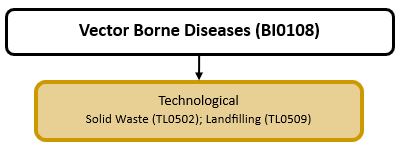
The figure below summarises common interactions between vector-borne diseases and other hazards. This information should be used with caution and not be solely relied upon in Disaster Risk Management, particularly as some interactions may not have been included. Note that hazardous events occurring together or locally in space or time may not necessarily cause, amplify, or be otherwise related to each other. Specific examples of multi-hazard context can be found in the ‘Hazard drivers’ and ‘Impacts’ sections above.
Multi-hazard diagram
Risk Management
Human
Many vector-borne diseases are preventable, through protective measures, and community mobilisation (WHO, 2020).
The World Health Organization (WHO) has taken forward the Global Vector Control Response (GVCR) 2017–2030 (WHO, 2017) which was approved by the World Health Assembly in 2017. It provides strategic guidance to countries and development partners for the urgent strengthening of vector control as a fundamental approach to preventing disease and responding to outbreaks. To achieve this a re-alignment of vector control programmes is required, supported by increased technical capacity, improved infrastructure, strengthened monitoring and surveillance systems, and greater community mobilisation. Ultimately, this will support the implementation of a comprehensive approach to vector control that will enable the achievement of disease-specific national and global goals and contribute to the achievement of the Sustainable Development Goals (UN, 2015) and Universal Health Coverage (WHO, 2020). Specifically, the WHO responds to vector-borne diseases by: providing evidence-based guidance for controlling vectors and protecting people against infection; providing technical support to countries so that they can effectively manage cases and outbreaks; supporting countries to improve their reporting systems and capture the true burden of the disease; providing training (capacity building) on clinical management, diagnosis and vector control with support from some of its collaborating centres; and supporting the development and evaluation of new tools, technologies and approaches for vector-borne diseases, including vector control and disease management technologies (WHO, 2020).
A crucial element in reducing the burden of vector-borne diseases is behavioural change. The WHO works with partners to provide education and improve public awareness, so that people know how to protect themselves and their communities from mosquitoes, ticks, bugs, flies and other vectors (WHO, 2020).
Access to water and sanitation is a very important factor in disease control and elimination. The WHO works together with many different government sectors to improve water storage and sanitation, thereby helping to control these diseases at the community level (WHO, 2020).
Rapid progress has been made in recent years in developing policy mandates, operational frameworks and pilot initiatives on health adaptation to climate change, including vector-borne disease as a particular priority. These present an excellent opportunity for a stronger and more coherent connection between applied research and public health policy (Campbell-Lendrum et al., 2015).
Applied research is nevertheless essential to ensure continued progress in reducing the burden of vector-borne diseases in the face of the additional challenges caused by anthropogenic climate change, along with rapid changes in other environmental and social determinants. To increase relevance to current health programming, there is a need to complement current work on the detection and attribution of health effects to climate change, and the modelling of future scenarios, with a more directly applied approach to assessing and managing climate-related risks in the present (Campbell-Lendrum et al., 2015).
Progress has been made in recent years in developing policies, operational frameworks and pilot initiatives on animal health-based adaptation to climate change, with vector-borne diseases as a priority. These represent excellent opportunities for stronger and more coherent linkages between applied research and public health policy (Campbell-Lendrum et al., 2015).
Animal
Vaccination programme, movement control, improve biosecurity (OIE, 2015b). Climate-driven fluctuations in environmental conditions, such as drought, flood, rainfall, wind and unpredictable weather have a direct influence on the disease burden from bacteria, parasites and their vectors. Work is being carried out to improve prevention, preparedness, early detection and early response to animal health threats and emergencies that could be triggered by climate change (FAO, 2020). Progress has been made in recent years in developing policies, operational frameworks and pilot initiatives on animal health-based adaptation to climate change, with vector-borne diseases as a priority. These represent excellent opportunities for stronger and more coherent linkages between applied research and public health policy (Campbell-Lendrum et al., 2015).
Monitoring
The section and the table below offer an overview of monitoring for vector-borne diseases. This information can be used for forecasting within a national early warning system (EWS). Since EWS capacities and processes differ across countries, the most current and specific information regarding EWS should be obtained from the appropriate national or regional agency/authority responsible for disaster management.
WHO supports countries to conduct all-hazards strategic risk assessment in the contexts of health emergencies and disasters, which results in the development of a country risk profile. Empowered with the country risk profile, inclusive of a seasonal risk calendar, countries can anticipate potential emergencies before they occur to trigger early alerts and inform early actions (WHO, 2021).
WHO's Early Warning, Alert and Response System (EWARS) has been designed to improve disease outbreak detection in emergency settings, such as in countries in conflict or following a natural disaster. It is a simple and cost-effective way to rapidly set up a disease surveillance system. EWARS is deployed during an emergency as an adjunct to the national disease surveillance system. WHO works with Ministries of Health and health sector partners to train local health workers to use the system. After the emergency, EWARS should re-integrate back into the national system (WHO, 2023).
| Which institution(s) produce(s) Disaster Risk Data/Information? | WHO, Ministry of Health, FAO Reference Centres, WOAH Reference Centres |
| How is the Hazard Observed/Monitored/Forecast? | WHO, Ministry of Health, FAO empres-i+ https://empres-i.apps.fao.org/diseases WOAH WAHIS https://wahis.woah.org/#/event-management |
References
Campbell-Lendrum, D., L. Manga, M. Bagayoko and J. Sommerfeld, 2015. Climate change and vector-borne diseases: what are the implications for public health research and policy? Philosophical Transactions of the Royal Society B, 370:20130552. doi:10.1098/rstb.2013.0552. Accessed 1 January 2025
FAO, 2020. Animal Health and Climate Change. Food and Agriculture Organization of the United Nations (FAO). Accessed 1 January 2025.
FAO, 2021. Veterinary vaccines: principles and applications. Eds: Metwally, S. Viljoen, G. & El Idrissi, A. Chichester, John Wiley & Sons Limited and FAO. Accessed 1 January 2025.
OIE, 2015a. New Developments in Major Vector-borne Diseases. Part I: An overview. Scientific and Technical Review, 34(1). World Organisation for Animal Health (OIE). DOI: 10.20506/rst.issue.34.1.58. Accessed 1 January 2025.
OIE, 2015b. New Developments in Major Vector-borne Diseases. Part II: Important diseases for veterinarians. Scientific and Technical Review, Vol. 34(2). World Organisation for Animal Health (OIE). DOI: 10.20506/rst.issue.34.2.59. Accessed 1 January 2025.
UNECE, no date. UN Recommendations on the Transport of Dangerous Goods - UN Model Regulations Model Regulations Nature, Purpose and Significance of the Recommendations. United Nations Economic Commission for Europe (UNECE). Accessed 14 November 2024.
WHO, 2014. A Global Brief on Vector-borne Diseases. World Health Organization (WHO). Accessed 1 January 2025.
WHO, 2016. International Health Regulations (2005), 3rd ed. World Health Organization (WHO). Accessed 1 January 2025.
WHO, 2017. Global vector control response 2017-2030. World Health Organisation (WHO). Accessed 1 January 2025.
WHO, 2020. Vector-borne diseases. Accessed 1 January 2025.
WHO, 2021. Strategic toolkit for assessing risks (STAR): a comprehensive toolkit for all-hazards health emergency risk assessment. World Health Organization (WHO). Accessed 24 May 2025.
WHO, 2023. Early Warning, Alert and Response System (EWARS). World Health Organization (WHO). Accessed 1 November 2024.
WHO, 2024. Vector-borne diseases. Accessed 24 May 2025.
WOAH. 2024a. Manual of Diagnostic Tests and Vaccines for Terrestrial Animals, 13th edition. World Organisation for Animal Health (WOAH). Accessed 1 January 2025.
WOAH. 2024b. Terrestrial Animal Health Code. 32nd edition. World Organisation for Animal Health (WOAH). Accessed 1 January 2025.
WTO, 1994. The WTO Agreement on the Application of Sanitary and Phytosanitary Measures (SPS Agreement). World Trade Organization (WTO). Accessed 1 January 2025.
WTO, 1998. The WTO and the World Organization for Animal Health (OIE). G/SPS/GEN/775. Accessed 1 January 2025.