
Locust upsurge
Widespread and heavy infestations of crops and natural vegetation by locusts causing significant threats to food security, livelihoods and natural habitats in multiple regions (adapted from FAO, 2009a).
Primary reference(s)
FAO, 2009a. Glossary on Desert Locust. Food and Agriculture Organization of the United Nations (FAO). Accessed 27 May 2025.
Annotations
Additional scientific description
Locusts are a member of a large group of insects commonly called grasshoppers which have big hind legs for jumping. Locusts belong to the family called Acrididae (FAO, 2025a). All grasshoppers belong to the superfamily Acridoidea, and the most significant species are all in the family Acrididae. Locusts differ from other grasshoppers in that they have the ability to change their behaviour, physiology, colour and shape (morphology) in response to changes in their population density. The life cycle of all species of locusts and grasshoppers comprises three stages: egg, hopper, and adult (FAO, 2009a).
A plague of locusts is defined as a period of one or more years of widespread and heavy locust infestations, the majority of which occur as bands or swarms. A plague can occur when favourable breeding conditions are present, and control operations fail to stop a series of local outbreaks from developing into an upsurge that cannot be contained. A major plague exists when two or more regions are affected simultaneously (FAO, 2009a).
The Desert Locust (Schistocerca gregaria) is able to fly long distances and migrate very fast. It is a transboundary pest, whose control requires international collaboration. This is also the case for about a dozen other locust species, which can produce outbreaks on every continent except Antarctica (FAO, 2015). During outbreaks, upsurges and plagues, locusts attack and destroy pasturelands and a wide range of cultivated crops, including cereals, cucurbits, legumes, sunflowers, tobacco, vegetables, vines, fruit trees, cotton and other plants.
The Desert Locust is considered the most dangerous migratory pest in the world to threaten crop production and food security. It might be the oldest registered pest for its danger and ability to live and breed under wide-ranging ecological and climatic regimes, in vast areas covering 29 million km2 and extending from the Atlantic Ocean in the west to India and Pakistan in the east (FAO, 2009a). During plagues, swarms can invade more than 60 of the world's poorest countries and potentially damage the livelihoods of one tenth of the world's population, mostly in Africa, the Middle East and Asia (FAO, 2015).
The worst Desert Locust outbreak of the last 25 years took place in the Near East, the Greater Horn of Africa and Southwest Asia in 2020-2021 (FAO, 2022a). Tens of thousands of hectares of cropland and pasture were damaged in Ethiopia, Kenya and Somalia where food security is already fragile. As a consequence, 36.6 million people in locust-affected countries faced crisis-level food insecurity (FAO, 2022b).
Species other than Desert Locusts can also cause significant damage under favourable conditions in different parts of the world. These include the Italian Locust and the Moroccan Locust in the Caucasus and Central Asia, the Red Locust in Eastern Africa, the Brown Locust in Southern Africa, the Migratory Locusts in Africa and Asia, the Tree Locust in Africa, and the Australian Plague Locust in Australia (FAO, 2020c; 2020d).
Locusts are also serious threats to agriculture in The Caucasus and Central Asia. The borders of countries in the region are often located across traditional locust habitats and breeding areas, and locusts frequently cross countries' political borders. As a result, international collaboration is critical for their control in the region. Three main locust pests, the Asian Migratory Locust (Locusta migratoria migratoria), the Italian Locust (Calliptamus italicus) and the Moroccan Locust (Dociostaurus maroccanus) jeopardise food security and livelihoods in both regions as well as in adjacent areas of northern Afghanistan and southern Russian Federation, putting over 25 million hectares of cultivated areas potentially at risk.
Metrics and numeric limits
Not available.
Key relevant UN convention / multilateral treaty
The Food and Agriculture Organization of the United Nations (FAO) Desert Locust Control Committee (FAO, 2020b).
The FAO regional Desert Locust Commissions (FAO, 2009b).
Drivers
Locusts are known as the most destructive invasive plant pests. Locusts have a high capacity to multiply, form groups, migrate over relatively large distances (they can fly up to 100 km per day) and settle and breed in various habitats. These capacities enhance their prevalence at the regional level. Highly mobile and capable of stripping an area’s vegetation, locust swarms can cause large-scale agricultural and environmental damage. Even a relatively small locust swarm can eat the same amount of food in one day as about 35,000 people. This can be especially devastating in countries facing food security crises, where every gram of food produced counts towards alleviating hunger (FAO, 2020c).
Impacts
Locusts have the ability to change their behaviour and appearance under particular environmental conditions (unusually heavy rains) and to transform themselves from harmless individuals to a collective mass of insects that forms swarms. During quiet periods (known as recessions), solitarious locusts are found in low numbers scattered throughout the deserts of North Africa, the Middle East and Southwest Asia (Desert Locust). This arid area is around 16 million km² in size and includes about 30 countries. It is called the recession area. In severe cases, the swarms can invade an area of land equivalent to about 20% of Earth’s surface (FAO, 2015).
Locust upsurges may cause food security challenges especially if the staple food crops are affected. They can also result in market or price instability. In certain cases, such infestations can cause severe food insecurity as in the case of desert locust upsurges in the Horn of Africa and Yemen in 2020-21 (FAO, 2022b).
In addition to the impact on food security, locusts can also devastate natural landscapes. Other implications on local populations can include local conflicts or migration due to shortage of food in severe locust upsurges. Furthermore, in certain cases, insecticide sprays can have implications on the health of local habitants.
Multi-hazard context
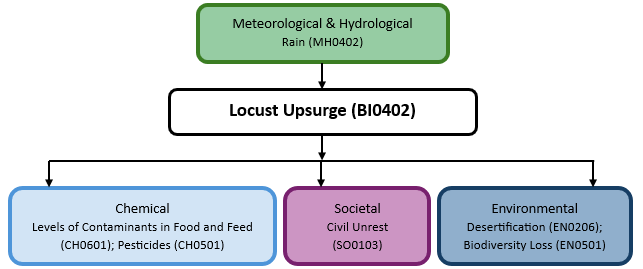
The figure below summarises common interactions between locust upsurge and other hazards. This information should be used with caution and not be solely relied upon in Disaster Risk Management, particularly as some interactions may not have been included. Note that hazardous events occurring together or locally in space or time may not necessarily cause, amplify, or be otherwise related to each other. Specific examples of multi-hazard context can be found in the ‘Hazard drivers’ and ‘Impacts’ sections above.
Multi-hazard diagram
Risk Management
Improvement of national capacities in preparedness, contingency planning, surveillance and rapid response is key for the prevention of such infestations and for mitigation of impacts. Likewise, international cooperation data and knowledge sharing is also key to address cases of transboundary infestations and upsurges. A good example of international collaboration has been experienced through the expansion of fall armyworms across Africa and Asia. FAO has developed and run a global initiative (FAO, 2020c).
Concerning the benefits of international collaboration and a solid response to emergencies, good lessons can be learnt from the locust upsurges in 2020-21 in the Horn of Africa and Yemen. The FAO-led response effort averted 4.5 million tonnes of crop losses, saved 900 million litres of milk production, and secured food for 41.5 million people (FAO, 2022a).
The main strategy for locust management, which has been promoted by the FAO for decades, relies on the so-called locust preventive control strategy. This is based on appropriate monitoring of locust habitats at key periods of their development in order to allow early detection of number increase and behaviour change, early warning, and early reaction (FAO, 2020d).
If well implemented, this approach facilitates a reduction in the occurrence and intensity of locust outbreaks and the prevention of their development into major upsurges or plagues.
Over decades, this strategy has been proven to be the most effective, making it possible to react before a significant increase in locust populations can occur. It results in: reduced damage to crops and rangelands and thus increased food security and improved livelihood of highly vulnerable rural communities; reduced negative impacts on human health and the environment (through reduced pesticide sprays); and lower financial costs.
For such transboundary plant pests, this strategy also needs to be coupled with global or regional cooperation. The FAO recommendations for dealing with locust upsurges in the Greater Horn of Africa Region include the following (FAO, 2020a):
- Ground surveillance and impact assessments: Facilitate ground surveillance, monitoring and continuous assessment in partnership with country governments and the Desert Locust Control Organization for Eastern Africa (DLCO-EA) with the objective of reinforcing region-wide early warning and response.
- Informing response: Continue to assess the situation through the FAO Desert Locust Information Service and provide early warning, forecasts and advice to affected countries and international partners.
- Control operations: Provide aerial and ground control operations support and enhance national preparedness capacity.
- Ground control operations (hopper-stage locusts): procurement of chemical and bio-pesticides and equipment, storage, training, human and environmental safety, and disposal of chemical drums and containers.
- Air control operations (adult-stage locusts): contracting planes, pesticide procurement, human and environmental safety, training, and disposal of chemical drums and containers.
On average, over the past 15 years, locust-affected areas as large as almost 4 million hectares have been treated annually in the Caucasus and Central Asia.
Monitoring
The section and the table below offer an overview of monitoring for locust upsurge. This information can be used for forecasting within a national early warning system (EWS). Since EWS capacities and processes differ across countries, the most current and specific information regarding EWS should be obtained from the appropriate national or regional agency/authority responsible for disaster management.
| Which institution(s) produce(s) Disaster Risk Data/Information? | The most efficiently functioning monitoring and early warning system is the desert locust monitoring system operated by FAO. Desert Locust Information Service (DLIS) and the three commissions (Western Region, Central Region and Southwest Asia) as well as the desert locust control committee (DLCC) (FAO, 2025a). |
| How is the Hazard Observed/Monitored/ Forecast? | The system utilizes a network of concerned countries that run surveys and share data over satellite tools with the Desert Locust Information Service (DLIS) operating since 1978 (FAO, 2025b) and housed at the headquarters of FAO, where the data is analysed together with geospatial and meteorological data. Analysis helps monitoring of the overall situation and production of forecasts and early warning for potential outbreaks to be shared with the concerned countries publicly. |
References
FAO, 2009a. Glossary on Desert Locust. Food and Agriculture Organization of the United Nations (FAO). Accessed 15 January 2025.
FAO, 2009b. FAO regional Desert Locust commissions. Food and Agriculture Organization of the United Nations (FAO). Accessed 27 May 2025.
FAO, 2015. FAO Desert Locust Information Service (DLIS). Food and Agriculture Organization of the United Nations (FAO). Accessed 27 May 2025.
FAO, 2020a. Desert Locust Crisis. Appeal for rapid response and anticipatory action in the Greater Horn of Africa, January–July 2020. Food and Agriculture Organization of the United Nations (FAO). Accessed 15 January 2025.
FAO, 2020b. Policy Support and Governance Gateway. Desert Locust Control Committee. Food and Agriculture Organization of the United Nations (FAO). Accessed 27 May 2025.
FAO, 2020c. Locusts: Food Chain Crisis. Food and Agriculture Organization of the United Nations (FAO). Accessed 15 January 2025.
FAO, 2020d. Locust Watch: Locusts in Caucasus and Central Asia. Food and Agriculture Organization of the United Nations (FAO). Accessed 27 May 2025.
FAO 2022a. Desert locust upsurge: Progress report on the response in the Greater Horn of Africa and Yemen, September–December 2021. Accessed 27 May 2025.
FAO, 2022b. Real-time evaluation of FAO’s response to the desert locust upsurge 2020–2021 - Summary brief. Food and Agriculture Organization (FAO). Accessed 27 May 2025.
FAO. 2025a. FAO Desert Locust Information Service. Food and Agriculture Organization (FAO). Accessed 15 January 2025.
FAO, 2025b. Locust watch. Food and Agriculture Organization (FAO). Accessed 15 January 2025.